Franklin officials outline McEwen Drive Phase 4: $46M contract, three-year schedule and months-long side-street closures
Loading...
Summary
City officials and project staff described McEwen Drive Phase 4 financials, schedule and community impacts at a town-hall meeting, saying federal grants cover roughly $30 million of a roughly $47 million project and warning of temporary closures including a months-long shutdown of Players Mill for a raised “box” structure.
Franklin city officials on Tuesday summarized plans for McEwen Drive Phase 4, saying the board awarded the construction contract in December and the city expects construction to begin tentatively in March and run about three years.
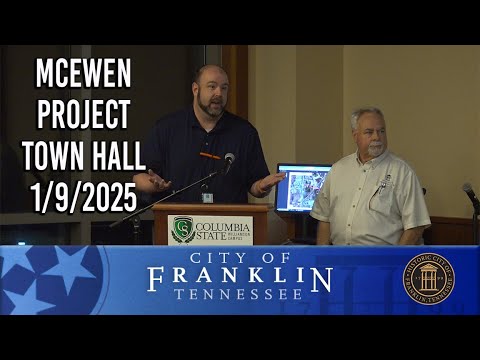
At a public town-hall, City Administrator Eric Stuckey told residents, "It's just over $46,000,000, 30,000,000 of which has come from federal grants," and said staff would continue seeking additional funding to stretch city dollars. Project Manager David Hodgett told the audience the work will require major utility relocations, retaining walls, and traffic shifts that will cause temporary inconvenience for nearby neighborhoods.
Why it matters: McEwen Drive Phase 4 is the largest roadway project Franklin officials said the city has undertaken. The reconstruction will add capacity and pedestrian facilities along a key east–west corridor linking McEwen Drive to Wilson Pike and is likely to affect traffic patterns, school-bus routing and neighborhood access during construction.
City presentation and funding Officials described a roughly $47 million project budget and said the low construction bid was $45,844,410.80 from Vulcan Construction Materials, which the city has selected to build the work. Stuckey said federal grants already account for about $30 million of the amount the city has secured; he said the city began with $10 million and increased grant funding over time. The city indicated some funding details remain subject to change as staff pursue additional grants.
Scope and schedule Hodgett and the engineering team summarized work the contractor will perform: grading and earthwork, new water and sewer mains, a new gas main, storm drainage (the team said roughly 2 miles of pipe will be installed), construction of up to 11 retaining walls, and new pavement and striping. Hodgett said the project will phase work to maintain traffic on portions of McEwen while crews build the new lanes alongside the existing roadway.
On timing, staff gave these points: construction is tentatively to start in March, the contract sets a three-year completion window, and the city expects to hold a pre-construction conference with the contractor in February to finalize the contractor schedule. Hodgett said the contractor will submit a detailed phasing and schedule after that meeting and the city will publish updates on the project web page.
Traffic, closures and neighborhood impacts City staff said the existing roadway will remain in service during most of construction through traffic shifts, but some side streets and neighborhood connections will be closed temporarily to allow reconstruction. Hodgett said Players Mill "will most likely be closed for a while because we're building a box and we're raising that up 20 about 20 feet," and later characterized the closure as “several months, at least,” with earlier discussions with the neighborhood estimating six to eight months for certain closures. He also said the old road will be repurposed in places as a walking trail and that a 12-foot multimodal path will run on the south side of the rebuilt corridor.
Residents asked about left turns, signal timing at Wilson Pike, school-bus routing and the prospect that a wider McEwen might attract more traffic. Staff said signal timing will be revisited once lanes are widened and that phase 5 of the broader corridor work is intended to address queuing at the McEwen–Wilson Pike intersection.
Utilities, overhead lines and blasting Officials said new gas, water and sewer mains will be installed as part of early work. The city told residents that existing overhead electric lines are normal service lines (not high‑voltage transmission) and will remain overhead for this project unless a separate pay‑for‑underground decision is made by the utility or private interests. The project team said blasting is possible depending on subsurface conditions; they emphasized that blasting would be regulated by the Tennessee Fire Marshal's Office and that pre‑blast surveys are required for properties within a specified radius. Staff urged property owners to participate in pre‑blast surveys if notified.
Contracting and incentives The project contract was awarded to Vulcan Construction Materials; staff said the low bid was $45,844,410.80. City staff said federal funding rules attached to the grants used on the project prohibit offering contractor incentives tied to federal funds; the city said the contract includes standard liquidated damages for late completion (staff cited a typical figure of $200 per day). Stuckey and others said staff would continue to pursue additional grant dollars to stretch local funds.
Information and next steps Officials said the city will maintain a dedicated project page on the City of Franklin website (franklintn.gov) with the capital projects dashboard, construction plans and regular updates. Hodgett and other staff encouraged residents to check the site first for notices of closures and to use provided phone and email contacts for construction concerns. Staff also said they would post meeting materials and answers to questions submitted in advance.
Details noted during the meeting included: the contractor selection in December, tentative March start, roughly three-year construction window, the low bid amount of $45,844,410.80, approximately $30,000,000 in federal grant funds secured so far, a possible six- to eight-month closure for some localized work at Players Mill, and an intended 12-foot multimodal path on the south side of the rebuilt roadway.
The city closed its prepared remarks with an offer to meet one‑on‑one with residents and to hold a follow‑up public meeting once the contractor's detailed phasing schedule is available.