Get Full Government Meeting Transcripts, Videos, & Alerts Forever!
Get email alerts on the Audit Financials topic
No spam. Unsubscribe anytime.
County audit yields ‘clean’ opinion; auditors field questions about pensions, OPEB and pooled treasury
Summary
Independent auditors presented a clean (unmodified) opinion on San Bernardino County Superintendent of Schools’ 2023–24 financial statements. The board and auditors discussed long-term pension and OPEB liabilities, scope and sampling of the audit, and where to find more detail on pooled treasury and pass-through special education funds.
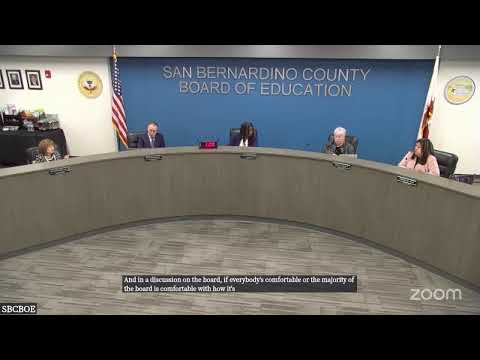
Nigro & Nigro presented the San Bernardino County Superintendent of Schools’ 2023–24 audit to the county Board of Education and issued an unmodified (clean) opinion on the financial statements.
The auditors summarized their multistage process: site visits, interim testing (controls and compliance), and a final year‑end review that ties the unaudited actuals to supporting documentation. "This is an unmodified or a clean opinion," auditor Jessica Barry told the board, explaining that the firm found the financial statements to be "presented fairly in all material aspects."
The nut graf: the report showed no audit findings for the fiscal year, but board members pressed auditors and staff on large reported liabilities and reporting practices that can be hard for the public to read. The conversation focused on the difference between fund‑based reports (the day‑to‑day budget) and the government‑wide statements that include long‑term obligations such as pensions and other post‑employment benefits (OPEB).
Board members asked for clarity about pension and OPEB numbers that appear large on government‑wide statements. Barry and staff explained those liabilities are calculated at a statewide level and a district or county receives a proportionate share. Some items, such as plan valuation timing and investment gains or losses, are reflected as “deferred inflows/outflows” and amortized over future years rather than hitting a single year’s expense. The auditors said those figures do not represent cash debt payable within the fiscal year and that the pension/OPEB accounting is inherently backward looking and actuarial in nature.
Direct questions touched on audit scope and sampling: Barry explained the audit does not examine every transaction but uses rotating, representative samples across funds and programs (including a focus on IDEA special education federal funds). She said expenditure testing typically samples dozens of transactions across object and fund categories and that payroll and federal program testing use statistically representative approaches.
Board members also asked whether the audit reviewed local board approvals of pass‑through IDEA funds to districts; auditors said the county’s monitoring procedures and time‑accounting for employees paid with federal funds were tested, but verifying each local board’s approvals is outside the typical scope of the county financial audit.
Other points raised included questions about the county’s optional post‑employment benefit reserve (which is reportable differently depending on whether contributions are placed in an irrevocable trust) and the county treasury pooled investment balances. Staff said some of those funds remain internally designated and therefore are reported differently under government accounting standards.
The auditor presentation concluded with thanks to county internal business staff and the firm’s statement that the audit contained no findings and that the federal programs schedule was clean. Board members requested follow‑up briefings or workshops covering pooled treasury mechanics, pension/OPEB amortization, and greater transparency of how certain restricted and unrestricted fund pools are used.
The board did not vote to accept the audit in that hearing (the audit presentation is typically informational), and district staff said bound copies and the auditor’s letter would be distributed to board members and posted per the county’s usual procedures.
The county’s chief auditor and district finance staff said they would provide more detailed briefings for trustees on pensions, the post‑employment benefit fund and the treasury pooling process in a future board work session.