Get Full Government Meeting Transcripts, Videos, & Alerts Forever!
Get email alerts on the Utility Scale Solar Ordinance topic
No spam. Unsubscribe anytime.
Chino Valley planning commission forwards utility-scale solar ordinance to council after hours of public comment
Summary
The Planning and Zoning Commission voted 5-1 to forward text amendment TA 2024-04, a proposed ordinance regulating utility-scale solar, to the Town Council with recommended edits after a lengthy public hearing focused on setbacks, water, fire risk and decommissioning.
The Planning and Zoning Commission for the Town of Chino Valley voted 5-1 on Jan. 7 to forward text amendment TA 2024-04 — a proposed revision to Chapter 4 of the Chino Valley Unified Development Ordinance that would set siting, design, environmental and decommissioning standards for utility-scale solar projects — to the Town Council with a recommendation of approval as amended at the meeting.
The ordinance would not approve any specific project. Will Dingey, assistant director for development services, told the commission the text amendment “is not a request for a zone change. This is not a project approval.” Dingey said the draft ordinance establishes the “ground rules and the project requirements if a utility scale solar project were to come into the Town of Chino Valley limits.”
The item drew more than two dozen public speakers. Many residents raised concerns about groundwater, dust, views, wildlife and fire risk, while representatives of the solar industry and their counsel urged that the town adopt clear rules that would allow responsible projects to be proposed.
The commission’s action forwards the ordinance as presented by staff and “as amended at this meeting.” Commissioners polled during discussion indicated majority support for increasing a proposed separation distance for solar panels and equipment from developed residential property; staff and commissioners discussed rewording setbacks and deleting a related separation clause so the ordinance would instead treat certain distances as a minimum buffer measured from project equipment to neighboring property lines. The motion to forward the text amendment passed on a roll-call vote: Commissioners Welker, Pen (yes), Zamudio (yes), Meadors (yes), Vice Chair Paiszak (yes) and Chair Merritt (no). The motion carried.
Why it matters: the ordinance would create the town’s first comprehensive set of standards for siting utility-scale solar inside incorporated Chino Valley and would govern application review, required technical reports, environmental protections, and decommissioning or surety requirements. Commission and public debate focused on several provisions that would affect whether and where projects could be feasible inside town limits.
Key provisions and staff changes
- Scope and process: The draft ordinance creates a two-step Solar Facility Use Permit process (preliminary and final) and clarifies application and review steps. Staff said the ordinance is intended to let the town evaluate projects when and if applicants apply, not to approve any project tonight.
- Acreage cap: The ordinance as discussed limits cumulative solar development within town limits to a maximum in the proposed language; staff and commissioners referenced a working figure of about 3,800 acres as the practical cap under the draft language.
- Setbacks and separations: Staff’s draft included a range of distances: a proposed quarter-mile (about 1,320 feet) separation from developed residential property for solar fields and a separate one-mile (or centrally located) requirement for battery energy storage systems (BESS). During discussion commissioners debated raising that panel separation to as much as one mile; the commission ultimately directed amendments to the draft language at the meeting and instructed staff to reflect the changes in the version forwarded to council.
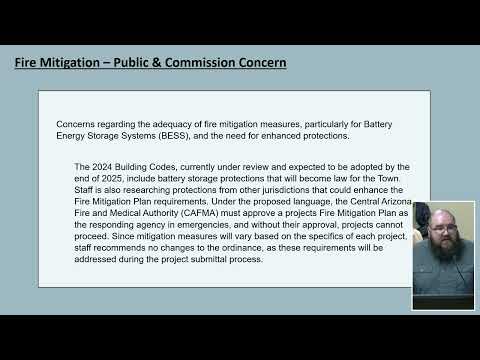
- Fire/lifesafety: Staff said Central Arizona Fire and Medical Authority (CAFMA) must approve a project’s fire mitigation plan and that the 2024 building-code provisions addressing battery storage protections were under review and expected to be adopted later. Dingey told the commission that “if [CAFMA] do[es] not approve [a fire mitigation plan] to their satisfaction, there will be no project.”
- Water, dust and drainage: Staff added a required water-usage plan (new Section F11) and a stormwater pollution prevention / drainage plan (Section F1C) to address construction and operational water demands, runoff and possible recharge strategies. Staff also added a required property maintenance plan (Section F10) covering weed control and herbicide usage.
- Decommissioning and financial surety: The draft requires projects to provide decommissioning assurances (escrow, bond or other surety). Staff told the commission the town would require development agreements that obligate developers to ensure community-benefit commitments are secured for the entire project lifespan or made whole before any transfer of ownership to another entity.
Public testimony and industry statements
Residents urged larger buffers from homes, stronger water protections, and preapproval consultation with CAFMA. Rhonda Ceremony (resident) told the commission the town’s general plan “designates ranch, agricultural, and open space areas as suitable for solar development” but asked that the ordinance treat utility-scale projects differently and require legally binding decommissioning and long-term maintenance responsibilities. Multiple residents — including Stacy Wagner and Richard Huck — asked the commission to increase setbacks and to require environmental and water-impact studies.
Representatives of the solar industry pushed the town for clear, consistent rules. John Gillespie, a land-use attorney with Rose Law Group, said in public comment that utility-scale projects “can yield great benefits to communities, including construction job creation, economic boost to local businesses, significant increases in tax revenue, and investment in local public services,” and he complimented the town for drafting a comprehensive ordinance. James Lestrange, a developer with LightSource BP speaking on behalf of the Draconis Energy Project, said a project his company might bring would create “450 to 500 jobs” during construction and would produce long-term property-tax revenue for local services; he also said LightSource BP requires panels that meet EPA testing standards and conducts wildlife and water studies.
Commission questions and staff clarifications
Commissioners and staff exchanged detailed questions about measurement of setbacks (from project equipment versus parcel boundary), how the ordinance treats developed versus undeveloped residential land, and whether waivers should be allowed. Staff said much of the proposed language reflected previous work with a staff advisory solar committee and that they had not adopted developer-requested changes submitted by Prospect 14, LightSource BP and the Arizona Solar Energy Industry Association.
Staff provided quantitative clarifications raised in the hearing: an illustrative town revenue estimate of roughly $2 million–$3 million per year for the town under a large acreage scenario (staff said this equates to approximately $500–$1,000 per acre per year), an industry construction employment estimate from LightSource BP of 450–500 jobs for a hypothetical project, and that an example cited by a resident showed a 1,000-acre project using roughly 20 million gallons of water over two months for dust control during construction (resident-supplied example).
Outstanding issues and next steps
- Legal risk and viability: Commissioners repeatedly noted the town faces legal and feasibility tradeoffs if it tightens siting rules; several commissioners said a more restrictive ordinance might invite litigation or simply preclude projects. Staff and the commission discussed which distances are legally defensible and what the council may ultimately decide.
- CAFMA coordination and building code changes: Staff said CAFMA must approve project fire mitigation plans and that the town will incorporate battery-storage-related portions of the 2024 building codes when they are adopted.
- Council consideration: The commission’s vote forwards the amended draft ordinance to the Town Council for final action. The motion to forward was made and seconded during the meeting; the commission recorded a roll-call vote. Chair Merritt cast the sole dissenting vote, saying he opposed locating utility-scale solar in Chino Valley. The ordinance as forwarded includes the staff changes discussed at the meeting and the specific amendments the commission directed staff to make.
Votes at a glance
- Motion: Forward TA 2024-04 (Utility Scale Solar) to the Town Council with a recommendation of approval as presented by staff and as amended at this meeting. - Vote (roll call): Commissioner Welker — yes; Commissioner Pen — yes; Commissioner Zamudio — yes; Commissioner Meadors — yes; Vice Chair Paiszak — yes; Chair Merritt — no. Outcome: approved (motion passes).
What to watch next
The Town Council will receive the commission’s recommendation and decide whether to adopt, amend or reject the ordinance. Staff told the commission that any future project would still require a Solar Facility Use Permit, project-specific reviews, CAFMA fire-plan approval, and financial surety for decommissioning. If the council approves the ordinance, applicants would still need to provide the technical studies required in the ordinance before any project permit could be granted.
Ending
The commission’s action does not authorize any specific solar project; it only forwards a proposed regulatory framework to the Town Council. The council’s upcoming consideration will determine whether the town formally adopts the ordinance language and, if so, with what final setbacks, standards and legal conditions.