Get Full Government Meeting Transcripts, Videos, & Alerts Forever!
Get email alerts on the School Consolidation topic
No spam. Unsubscribe anytime.
Fairbanks residents, principals and teachers urge board to keep neighborhood schools open
Summary
At a Jan. 13 public hearing, more than two dozen residents, principals and teachers urged the Fairbanks North Star Borough School District board to abandon or modify a plan that would close five elementary schools, warning of lost services, long bus rides and harm to vulnerable students.
Fairbanks — More than an hour of public testimony on Jan. 13 drew parents, principals, teachers and students who urged the Fairbanks North Star Borough School District board to reconsider a proposed consolidation that would close five elementary schools and reassign about 1,190 students.
Speakers focused on equity, transportation and the loss of programs targeted to high‑need students. "This proposal does not do the most good for the most students," said Jay Million, a testifier who criticized the district's rationale for repurposing Midnight Sun Elementary. Several speakers asked the board to preserve neighborhood schools or pursue alternatives such as converting Pearl Creek into a K–5 magnet school.
The concern centered on how closures would affect Title I and special‑needs services. Audra Hull, an advocate who identified herself as the mother of three children and supporter of Hunter Elementary, said Hunter serves high numbers of Alaska Native students, students with disabilities and families experiencing economic hardship and homelessness and that the school currently provides an extensive mix of supports, including an on‑site clinician and Alaska Native education tutoring. "Losing the support of family by sending these kids to a different school would be an unnecessary hardship for families that are already struggling," Hull said.
Several principals and community partners described local programs tied to individual schools. Jane Bedford, principal of Hunter Elementary, told the board Hunter's students had shown 16.4% growth in reading last year and said many students rely on the school as a stable daily anchor. Allison Wylde, principal of 2 Rivers, outlined partnerships — with 1 Tree Alaska, the Fairbanks Soil and Water Conservation District and others — that she said help fund place‑based curriculum and extracurricular programs intended to boost enrollment and local support.
Speakers also raised practical concerns about bus ride times, walkability and siblings. Catherine Baird, a Hunter teacher, said most Hunter students currently walk to school and that becoming bus riders would create a three‑to‑five‑minute window for students to catch buses; she warned that missing that window could cause students to miss a full day of school. Several speakers said single‑vehicle households, shift work and limited transit options would make families less able to participate in school activities and support their children.
Some testifiers proposed concrete alternatives. Shawna Henderson, Pearl Creek principal, urged the board to "consider turning Pearl Creek Elementary into a magnet school" focused on science, technology, engineering, arts and mathematics and said the change could attract outside students without adding district costs for transportation or losing boundary students. Shane Powers — who proposed a thought experiment to transfer some military‑connected schools to the Department of Defense Education Activity (DoDEA) — said alternate ideas should be explored to avoid closures.
Testimony included both data points and personal consequences. Jessica Wagner said the district repeatedly addressed only part of the deficit in earlier rounds of consolidation and urged officials to make larger, decisive cuts rather than repeated incremental changes that keep families uncertain. A student, Rosalie Hamilton, testified that she was worried about longer bus rides and losing friends and teachers.
Why it matters: Board members repeatedly heard that closures would not affect every family the same way. Speakers emphasized concentrations of poverty, high Title I enrollment, Alaska Native students and students with disabilities at particular schools and warned that redistributing those students could reduce access to services and drive families out of the district.
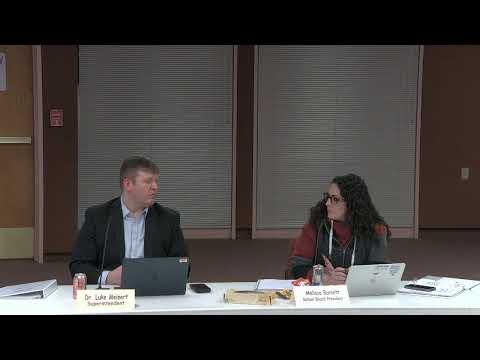
What the district said next: Superintendent Dr. Luke Minor acknowledged the public testimony at the start of the work session and told the board his proposed budget will be released Feb. 17 and that the board will need to finalize a recommended budget to send to the borough by April 1. Community members referred to a Feb. 4 deadline for decisions that would allow administration time to prepare its budget submission.
The board will continue the work‑session series on Jan. 27, when administration plans to present how the recommended consolidations would affect programs and student services.
Ending: Testimony closed after roughly an hour; the board recessed and then opened a work session where administrators presented data used to recommend consolidation and outlined timelines, transportation modeling and staffing impacts.