Get Full Government Meeting Transcripts, Videos, & Alerts Forever!
Get email alerts on the Foreign Policy State Department Address topic
No spam. Unsubscribe anytime.
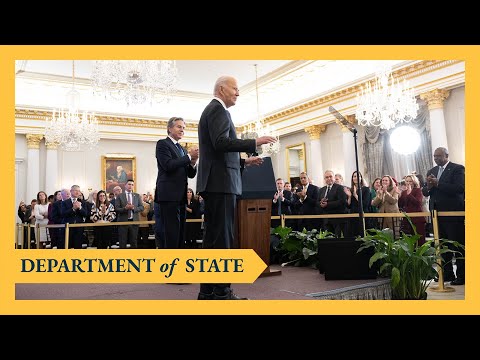
President Biden reviews four years of U.S. diplomacy, urges continuity on AI and climate
Summary
President Joe Biden told State Department staff that U.S. alliances and global influence are stronger now than four years ago and urged the next administration to sustain work on artificial intelligence and climate policy.
President Joe Biden told State Department staff that U.S. alliances and global influence are stronger now than four years ago and urged the next administration to sustain work on artificial intelligence and climate policy.
Biden opened with an assessment of broad strategic gains, saying the United States has increased diplomatic, military, technological and economic power and that partnerships have “made a difference.” He told the room that stronger alliances and expanded cooperation leave the country “in a fundamentally stronger position” in competition with major powers.
The speech put several policy areas at the center of the administration’s foreign‑policy account. On Russia and Ukraine, Biden credited U.S. leadership and allied support with keeping Ukraine independent and said the United States rallied roughly 50 nations to back Ukraine. On China and the Indo‑Pacific, he described a strategy of competition plus cooperation: targeted tariffs and export controls, allied coordination, and continuing lines of communication with Beijing to reduce risks of miscalculation. He cited new regional arrangements and partnerships including AUKUS and expanded cooperation with Japan, South Korea and other partners.
Biden also described the Middle East as a continuing challenge. He said the administration pressed to repel Iranian attacks on Israel after the Oct. 7 Hamas attacks, organized coalition responses to missile and drone strikes, and is pursuing a diplomatic structure aimed at freeing hostages, halting fighting and increasing humanitarian aid to Palestinians. He said talks with leaders in the region were ongoing and urged continued pressure to prevent Iran from acquiring a nuclear weapon.
On counterterrorism and Afghanistan, Biden defended his decision to end large U.S. troop deployments, cited the 2,461 Americans who died in the war and said the administration had focused resources on other threats and brought home more than 75 Americans who had been detained overseas.
The president highlighted major economic and industrial investments at home that he said underpin U.S. competitiveness abroad: nearly $500 billion in private‑sector investment tied to climate and clean‑energy packages, and roughly $1.3 trillion in defense procurement and research and development over four years. He also emphasized efforts to onshore semiconductor and other advanced-technology production.
On global infrastructure and climate, Biden described a U.S. alternative to certain foreign projects, citing a program he named PGI and saying his administration has leveraged hundreds of billions of dollars in public and private capital for overseas projects, including an example he gave in Angola.
He singled out artificial intelligence and the clean‑energy transition as two priorities the next administration must continue, calling AI a strategic domain where the United States must “stay in the lead” and saying climate change is the “single greatest existential threat to humanity.”
Biden concluded by thanking State Department personnel and partners across government for their work and urged continuity of the administration’s approach to alliances and technology.
"We're the United States of America, for God's sake," he said near the close of his remarks.