Get Full Government Meeting Transcripts, Videos, & Alerts Forever!
Get email alerts on the Traffic Enforcement topic
No spam. Unsubscribe anytime.
Edgewood leaders review updated school-zone camera ordinance, clarify process and fines
Summary
City staff presented a cleaned-up school-zone camera ordinance aligning written language with camera settings, explained civil infraction procedures and how camera revenues are tracked; item will appear at the next regular council meeting for formal action.
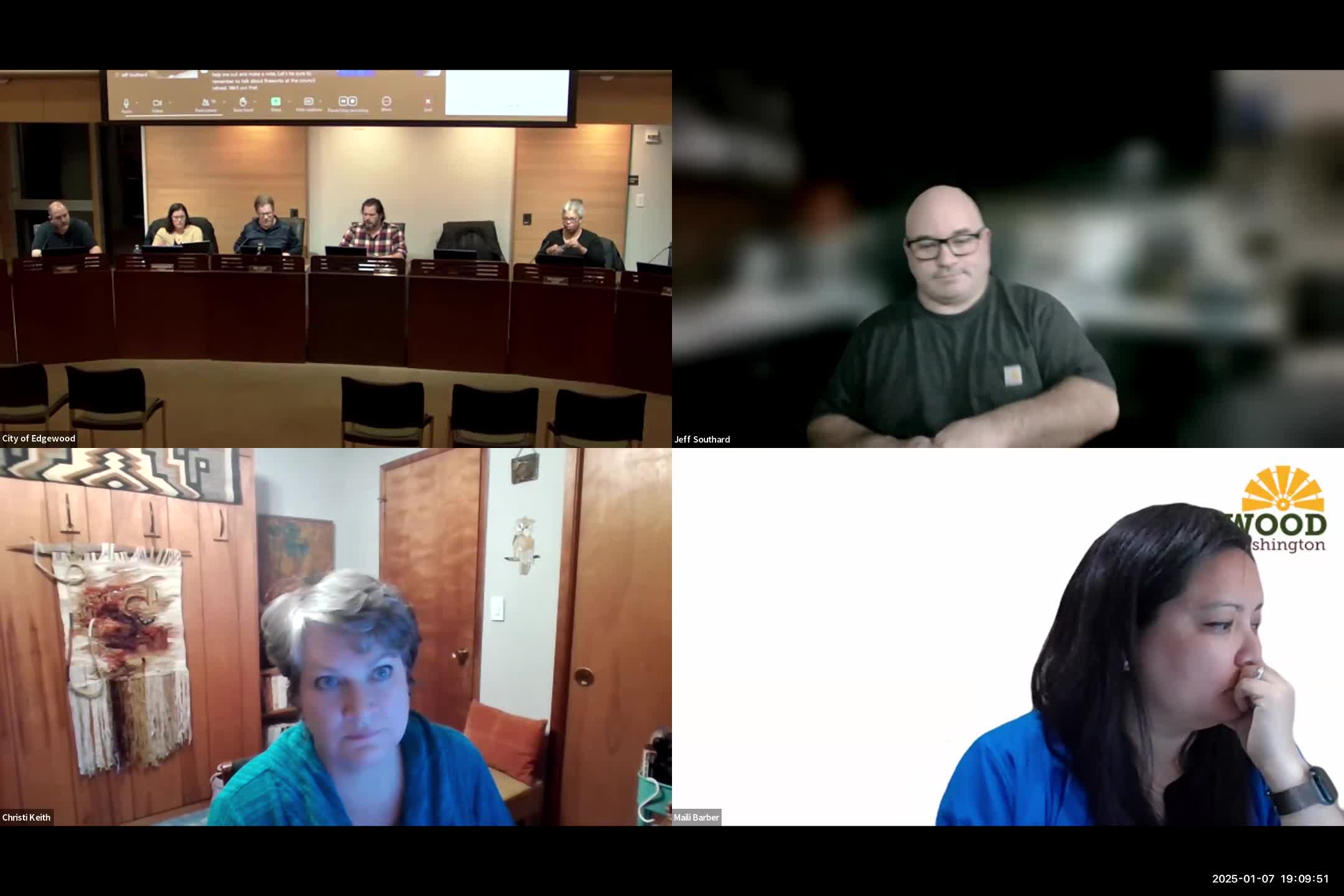
City staff and council members discussed an updated school-zone camera ordinance during the Edgewood City Council study session on Jan. 7, 2025, including how the cameras trigger, how fines and due-process work in Washington and how camera revenue is tracked in the budget.
The council heard the presentation from Rachel Pitzel, who said the update chiefly aligns ordinance language with the cameras’ real-world trigger (4 miles per hour over the posted limit) and cleans up other wording. Pitzel pointed council members to a new page in the 2025 budget book (page 43) that details school-zone camera revenues and expenditures.
Why it matters: the ordinance governs automated enforcement in school zones, the civil process for contesting those infractions and how the city accounts for proceeds that support public-safety spending.
Pitzel said the cameras are set to record at 4 mph over the posted limit (for example 24 mph in a 20-mph zone) and that the ordinance language was adjusted to match that setting. She also said the ordinance’s fine schedule remains the same as before; the update does not increase the listed fines, but makes the written rules consistent with camera operation.
City staff and legal counsel explained that traffic-camera violations are processed as civil infractions rather than criminal charges. "It is civil," said Maylee (city attorney/staff), who summarized applicable rules and evidence standards and directed listeners to the state resources for infractions. Maylee cited the Infraction Rules for Limited Jurisdiction (noted in the meeting as IRLJ 3.3(c)) when describing what evidence is required for a contested infraction hearing and explained the applicable burden of proof is a preponderance of the evidence rather than the criminal standard of beyond a reasonable doubt.
Mayor (presiding) and Council members asked operational questions about calibration and data posting. Chief Youngman said the city posts annual datasets and that staff had “caught up” police data posting for prior years; moving forward the city will continue to publish the data annually. Chief Youngman said persistent high violation counts in posted datasets indicate continued speeding through school zones and remain a reason to maintain camera enforcement alongside patrols and other measures.
Council members also raised equity and court-process questions. Randy Schaeffer and city staff confirmed that Pierce County District Court handles payments and dispositions for these infractions and that certain state provisions allow reduced penalties for recipients of public assistance. Staff cited the automated camera statute noted in meeting remarks as "RCW 4663220 subsection 15," which the discussion described as providing for a reduced penalty (50%) for specified recipients of public assistance when requested.
Council member Jeff Souther asked about who receives tickets; staff reported prior-year data showing approximately 77% of camera-issued citations went to non-Edgewood drivers. Pitzel said the program’s revenue is roughly $500,000 and expenses about $400,000 in recent accounting, leaving about $100,000 that has been earmarked for law enforcement-related uses; staff said the budget book now makes that flow clearer.
Next steps: staff said the ordinance update will be an agenda item at the council’s next regular meeting, when the council will have an opportunity to take public comment and consider formal action.