Get Full Government Meeting Transcripts, Videos, & Alerts Forever!
Get email alerts on the Dhhs Staffing And Billing topic
No spam. Unsubscribe anytime.
Committees back DHHS request to add infrastructure staff; hearing highlights revenue-generation plan and reporting timeline
Summary
Joint committees recommended that the County Council consider a supplemental to fund 11 DHHS infrastructure positions (6 revenue-generating, 5 not), directing the department to hire revenue positions first and report back in six months on revenue gains and claims processing improvements.
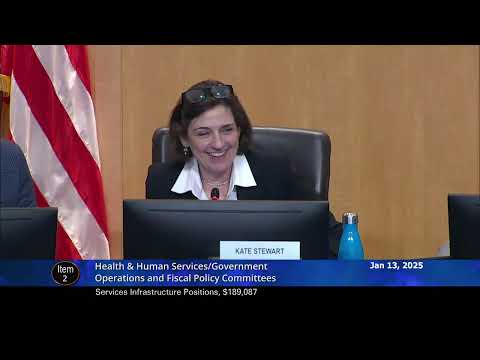
A joint session of the Montgomery County Council committees on Government Operations & Fiscal Policy and Health and Human Services on Oct. 12 recommended that the full council consider a supplemental appropriation to fund 11 infrastructure positions in the Department of Health and Human Services (DHHS). The committee discussion focused on which positions will be revenue-generating, how the department will secure Medicaid/MCO contracts and claims reimbursements, and a timeline for performance reporting.
At the hearing, Ms. Clemens Johnson, Department of Health and Human Services, described the supplemental as supporting 11 new positions: six positions tied directly to revenue-generation (primarily billing and practice-management functions) and five positions focused on program delivery and supervision. "So these positions will continue into FY26 knowing that and we will also, to offset that, increase our revenues for FY26 to continue to pay for this," Ms. Clemens Johnson said when asked about FY26 budgeting.
The transcript contains an inconsistent reference to the supplemental amount; the packet and several speakers referenced a total cost figure expressed as "189,000" and also as "189,87,000" in different blocks. The committee material says the supplemental is intended to start personnel and bring them on board for the total cost reported in packet materials; exact total supplemental dollar amount is not specified in the transcript segments provided to the committee and is therefore recorded here as not specified.
DHHS said the six revenue-generating positions include front-desk staff to capture billing data, professional coders, an accountant to manage claim rejections and resubmissions, and a social worker who can bill for clinical services. Department leaders described steps already taken to improve billing, including stronger monthly monitoring of utilization, forcing claims submission within the allowed billing window, use of a clearinghouse tied to the department’s electronic health record (NextGen), and plans to negotiate memoranda of understanding (MOUs) with managed care organizations (MCOs).
"We cannot—we see clients now. We bill the insurance companies and get $0 back, because we are considered not in network providers," said Mr. Hodge, (DHHS practice management lead), describing the need for MOUs and in‑network status to secure reimbursements. The department said it expects the revenue generated by the revenue-focused positions to offset the cost of those positions and that additional revenue will also support the non-revenue positions.
Committee members pressed for a measurable reporting plan. Councilmember Friedson asked for a clear standard: whether each new position must pay for itself or whether the group of positions would produce net revenue sufficient to cover the supplemental. Ms. Clemens Johnson replied the department expects the 6 revenue-focused roles, together with improved claims processes and MOUs, to produce sufficient revenue and said the department would prioritize hiring those posts first.
DHHS proposed a timeline: hire revenue-generating positions first with the goal of having staff in place by June, then use a six-month post-hire reporting window (i.e., first six months under new staffing) to present revenue and claims performance to the council to inform FY27 planning. "Because we're going to prioritize getting the revenue generating positions hired first, I think that that's very reasonable to think we will have everybody in place by June... I think 6 months is very reasonable to come back," Ms. Clemens Johnson said.
Members asked how the department would manage if collections fall short of expectations. Ms. Clemens Johnson said that becoming in‑network providers with MOUs and improving coding and billing practices should materially increase successful reimbursements; nonetheless, the department acknowledged uncertainty and agreed to return with data. Council members emphasized they want position-by-position or position-type revenue baselines so future requests can be evaluated against concrete returns.
After extended discussion and questions, the chair indicated there was no objection and moved the committee recommendation to the full council. The recommendation was advanced without recorded objection; exact roll-call counts were not provided in the transcript.