Get Full Government Meeting Transcripts, Videos, & Alerts Forever!
Get email alerts on the Student Safety Vaping topic
No spam. Unsubscribe anytime.
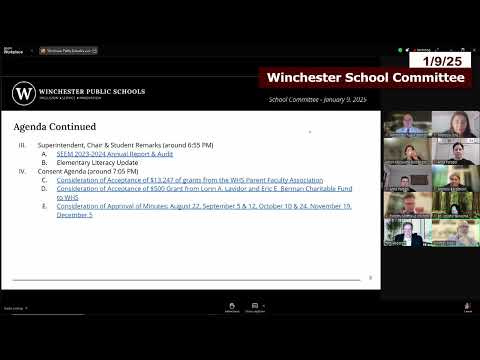
Winchester committee agrees to pursue vape detectors in high school bathrooms
Summary
After months of internal work and reports from school staff, the Winchester School Committee gave consensus to pursue installing wireless vape detectors in Winchester High School bathrooms and to work with the Select Board and town on funding and installation details.
The Winchester School Committee on Jan. 9 gave general consent for school staff to proceed with planning the installation of wireless vape detectors in multistall restrooms at Winchester High School and to coordinate with the Select Board and town offices on funding and next steps.
School administrators and community partners described repeated incidents of vaping in bathroom stalls, said the detectors would provide time-stamped alerts to administrators, and argued detectors would reduce the number of hidden locations where students can vape. “It removes 14 spaces in our building where students can vape undetected,” said Anna Paradise, dean of students at Winchester High School, who led the school’s presentation with Dot Butler of the Coalition For A Safer Community.
Paradise and Butler told the committee that the district researched products used in neighboring districts and proposed adaptive, wireless units that mount with a handful of screws and run on rechargeable batteries. Principal Dennis Mahoney said the units would report alerts to administrators’ computers or phones and would allow staff to time-stamp the event and check hallway cameras outside the restroom for identification. He also said the detectors include a loud alarm that can indicate other emergencies in a stall.
Committee members raised technical and practical questions about the devices’ effectiveness in multi-stall bathrooms, independent laboratory testing of vendor claims, installation locations and potential costs if additional units were required. “What I want to look for for any technology we’re putting in our buildings is where’s the independent lab testing to prove that it’s actually effective?” said committee member Chris Nixon, citing specifications he found on the vendor website noting recommended ceiling heights and room volumes.
Administrators and the presenters acknowledged those limits. Paradise said the company will evaluate the district’s bathrooms and recommend the number and placement of devices; the committee asked that vendor representatives meet with district staff before purchase. The proposal before the committee asked for initial funding routed through the town’s Winchester Hospital gift fund; Paradise said the invoice total in the current quote was roughly $16,000 and that a Select Board request had asked for $14,480 from the Winchester Hospital fund toward the purchase. Paradise also said the school included a three-year software/license component in the quote to allow a proof-of-concept period before any recurring cost decisions.
Rather than a formal roll-call vote, the committee registered consensus that Paradise, Butler and principal Mahoney should proceed to work with the Select Board and town staff on the vendor assessment, procurement steps and final funding details. Committee members asked that the district secure the vendor’s placement recommendations and any independent performance data and return with a final purchase request or revised quote for a formal vote.
The committee’s action directs administrators to continue the vendor review, share placement and testing information with the committee, and coordinate with the Select Board on the proposed use of funds from the Winchester Hospital gift fund.