
Committee hears bill to let municipalities offer 100% property tax waiver for totally disabled veterans
Get AI-powered insights, summaries, and transcripts
Subscribe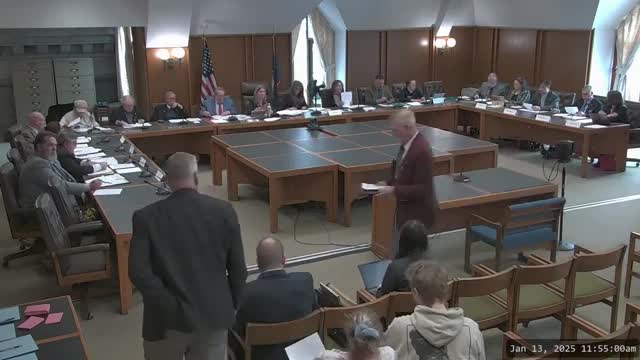
Summary
Sponsor and veterans’ advocates said enabling towns to adopt a full property‑tax exemption for service‑connected, total disability would help veterans stay in homes; DRA warned of technical issues in implementation and tax‑rate calculation.
House Bill 99 would amend RSA 72:27 so municipalities could adopt a property‑tax credit up to 100% for veterans with total, service‑connected disability. The Municipal and County Government Committee heard the bill Jan. 13 and received broad testimony from advocates, municipal staff and the Department of Revenue Administration.
Representative Mike Moffett, prime sponsor, said the bill is enabling: it would give municipalities the option to grant a full local exemption, rather than mandate it. He framed the proposal as a targeted relief for veterans with 100% service‑connected disability who face difficulty remaining in their long‑term homes. Moffett said local officials could require VA certification to document eligibility.
Veterans and advocates described gaps and inconsistencies in how state statute and administrative practice treat disabled‑veteran exemptions. Representative John Souter, who has worked on veteran benefits issues, urged careful drafting so that veterans who received VA‑funded home adaptations or used VA adaptive‑housing services would not be excluded. Maura Ryan, a retired Army veteran and advocate, told the committee some veterans cannot obtain SAH/SHA grants because of limited program funds and that a local option would help those veterans remain housed.
The Department of Revenue Administration (DRA) said it has no policy position on the proposal but raised a technical concern: a percentage credit of 1–100 percent complicates tax‑rate calculation. DRA’s witness said credits must be known at rate‑setting time because credits function like an appropriation; an open percentage tied to the final tax rate creates a circular computation. DRA suggested an exemption (which removes assessed value before the rate calculation) rather than an open percentage credit, or that bill language be amended to resolve the calculation issue.
Committee members asked whether the bill would be a blanket municipal adoption or allow town discretion to set a percentage less than 100%; witnesses said that drafting choices can permit either approach. Members also raised questions about interaction with existing statutes (including RSA 7236‑A for special adaptive housing) and whether municipalities routinely have the capacity to administer additional exemption programs. DRA offered to provide data to the committee on the number of existing veteran exemptions statewide.
The committee closed the hearing without voting and invited further clarification and potential drafting changes to address the tax‑calculation and statutory‑overlap concerns raised by DRA and other witnesses.