Get Full Government Meeting Transcripts, Videos, & Alerts Forever!
Get email alerts on the Gas Station Text Amendment topic
No spam. Unsubscribe anytime.
Committee forwards zoning changes to limit new gas stations near rail, other stations and residential districts
Summary
The Land Use, Transportation and Infrastructure Committee voted to forward two text amendments (241866 and 241867) that would limit where new retail gas stations can be built in Denver, including buffers from rail transit stations, existing gas stations and low‑intensity residential districts.
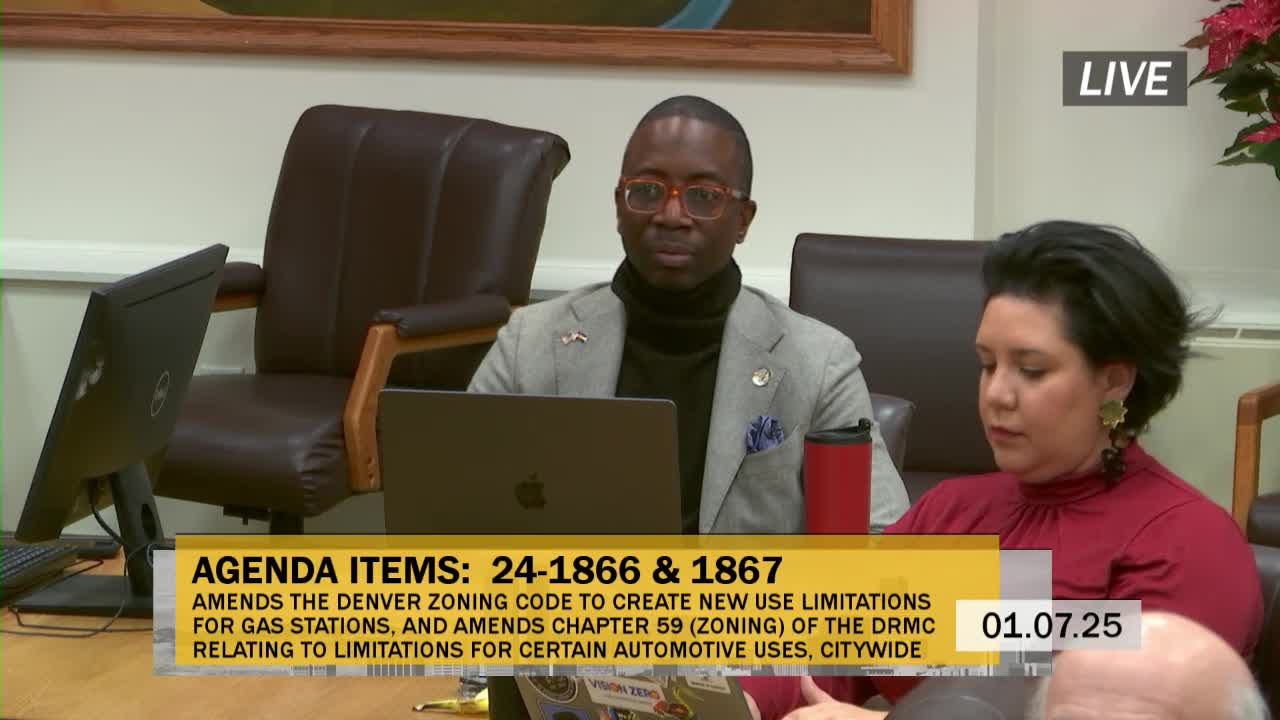
The Land Use, Transportation and Infrastructure Committee on Tuesday voted to forward two zoning text amendments (files 241866 and 241867) to the full City Council that would limit where new retail gas stations (automobile fueling stations) can be established in Denver.
Community Planning and Development staff Alisa Childress and Andrew Webb presented the proposal on behalf of sponsors Council President Pro Tem Diana Romero Campbell (District 4), Councilmember Amanda Sawyer (District 5) and Councilmember Paul Cashman (District 6). Childress said the amendment would prohibit new retail gas stations in three circumstances: within a quarter mile of a rail transit station, within a quarter mile of an existing retail gas station, and within 300 feet of protected (low‑intensity residential) districts. The proposal would not apply to non‑public fueling facilities such as fleet or government fueling sites.
The proposed ordinance includes an exception that would allow a new fueling station where it is established simultaneously with a related large‑format retail use (for example, a full‑service grocery or big‑box store) in a single structure of 20,000 square feet or more. Childress and Webb said that threshold was chosen to allow traditional grocery anchors while limiting smaller convenience‑store fueling combinations.
The amendment also revises “compliant use” language in the Denver Zoning Code so existing gas stations that become compliant after the change could continue operating and would be allowed to add electric vehicle (EV) charging equipment. The ordinance contains a grandfathering clause permitting projects submitted for review by May 13, 2024, to proceed under the current rules.
Webb framed the change as consistent with Denver’s adopted plans—Blueprint Denver and the Comprehensive Plan 2040—by preserving land along corridors for transit‑oriented, pedestrian‑oriented and housing uses rather than additional auto‑oriented fueling uses. He said the Planning Board unanimously recommended approval on Dec. 18, 2024.
Sponsors and council members described the policy goals and stakeholder outreach. Council President Pro Tem Diana Romero Campbell thanked staff and sponsors and noted extensive parcel‑level review: “All of those dots that you see was painstakingly, they drove down every street, I swear, in Denver, to figure all of that out, to really put together a comprehensive list,” she said. Sponsor Amanda Sawyer summarized the policy aim: “The problem we're trying to solve here is an extreme proliferation of gas stations in the city and county of Denver on land that could and should be used for housing,” she said.
City staff reported outreach and public comment: the sponsor team mailed notices to about 18,000 commercial property owners in September 2024; public review opened Nov. 7; the Planning Board informational item was Aug. 21 and the Planning Board recommended approval Dec. 18. CPD reported about 123 public comments from 118 unique commenters: roughly 42% indicated support (including a letter from the Colorado Wyoming Petroleum Marketers Association); about 35% indicated opposition, citing property‑rights and competition concerns. Staff said all comments will be added to the council record through the council hearing.
Committee members asked several substantive questions. Councilmember Amanda Alvidrez asked whether the proposal would prevent redevelopment of abandoned stations that have underground storage tanks; staff answered existing stations can be reoccupied and compliant uses may be rebuilt without expansion, and that existing fueling footprints could be reconfigured to provide alternative fuels or chargers. Councilmember Hines and others discussed safety and traffic concerns tied to vehicle ingress/egress at fueling sites and asked staff to prepare maps and data showing overlap between fueling sites and the city’s high‑injury network for future presentations.
Parks and Recreation requested buffers around parkland; sponsors said that request arrived after public comment began and was not incorporated into the current draft but remains open for future consideration. The sponsors and CPD said they had engaged heavily with industry stakeholders during drafting; staff reported mixed industry input (some trade groups supported the proposal while some retailers opposed it).
After questions, Councilmember Jamie Torres moved to forward the two items to City Council and the motion was seconded; the committee adopted the block forward by voice/thumbs up. The transcript does not show a roll‑call tally; staff and sponsors said the items will proceed to a City Council public hearing for final consideration.