Committee forwards two electronic-monitoring contract amendments to full council after briefing on program use and costs
Loading...
Summary
The Safety, Housing, Education and Homelessness Committee reviewed requests to extend two vendor contracts for electronic monitoring technology, heard program details and budget impacts from Denver Community Corrections, and voted to forward both contract amendments to the full City Council for final action.
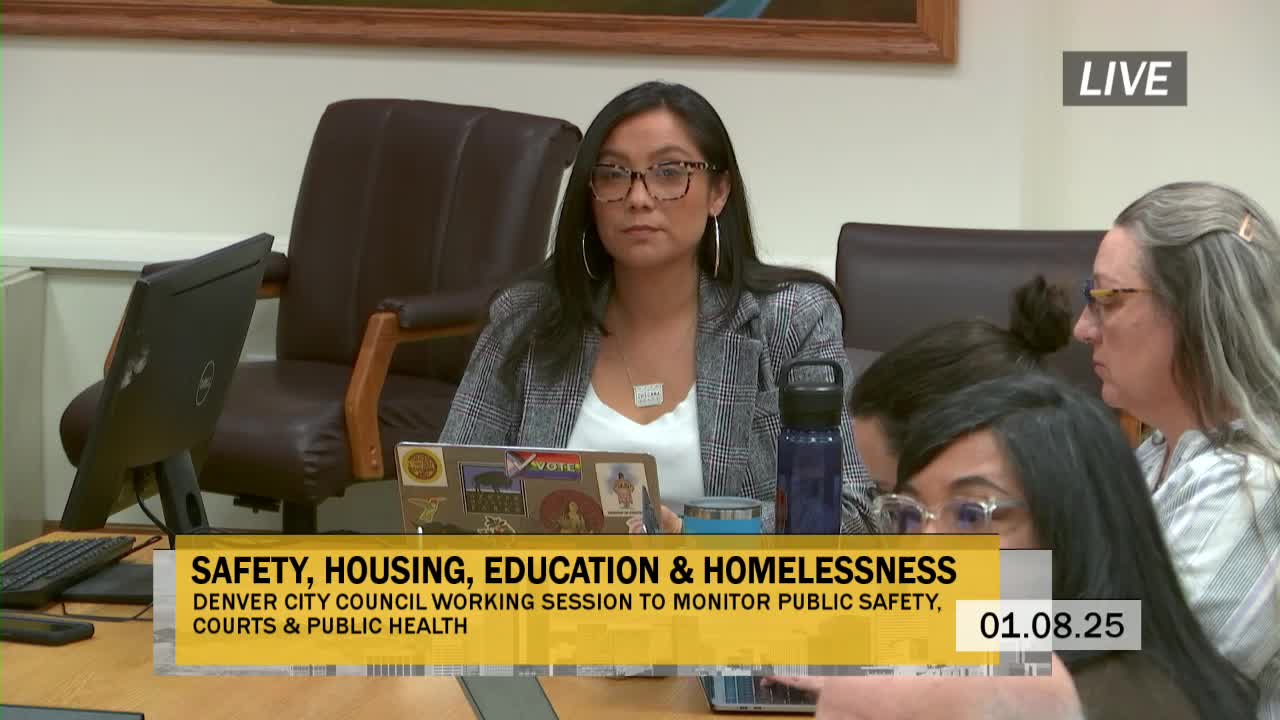
On Jan. 8, 2025, the Safety, Housing, Education and Homelessness Committee of the City and County of Denver heard a briefing from Denver Community Corrections on the city’s use of electronic monitoring and voted to forward two contract amendment requests to the full City Council for final approval.
The committee, chaired by Councilmember Serena Gonzalez Gutierrez, reviewed an amendment to extend the term of the city’s agreement with Alcohol Monitoring Systems (AMS) and a separate amendment to extend the contract with BI Incorporated for two additional years, through Jan. 31, 2027. Greg Morrow, director of Community Corrections, told the committee that the BI amendment would “add $1,650,000 to the contract total, for a new total of $3,150,000,” and that both vendors were selected through “a competitive bid process back in 2021.”
The contracts supply equipment used by two programs run by Community Corrections: pretrial services and an in‑home detention (electronic monitoring) program for post‑conviction sentences. “So, all of the case management, all of the monitoring, all of the interactions, all of the decision makings, decision making with participants is done by city staff within the Community Corrections Agency and Division,” Morrow said, stressing that vendors supply devices while city staff run supervision and casework.
Aubrey Cote, a manager with Pretrial Services, described the technologies the city uses, including active GPS ankle monitors that report location almost continuously, exclusion and inclusion zones tied to protection orders, remote breath devices that use facial recognition, transdermal (SCRAM/TAD) alcohol bracelets, and simple RF base‑station systems that confirm presence at a residence. “So, the first and probably the equipment that we use most often is GPS, or Global Positioning Systems,” Cote said.
Committee members pressed staff on program scale and costs. Morrow and Cote reported these program figures during the briefing: about 2,300 people are on pretrial release with monitoring conditions on any given day; roughly 18–20% of those have an electronic‑monitoring condition; the city has approximately 600 people on some type of electronic monitoring device on a typical day and about 500 people on GPS monitoring specifically. For pretrial outcomes over the last three years, staff reported an overall success rate of 67.3%, an appearance rate of 86.7% and a safety rate of 84.7%.
Cote said pretrial participants are not charged program fees: “We do not assess fees for the pre trial, and that is because they are pre trial and not post conviction.” She contrasted that with the post‑conviction in‑home detention program, which carries a historic fee of $13 per day (sliding‑scale reductions are available) and an average post‑conviction in‑home detention stay historically closer to 30 days. Morrow added the Department of Safety plans to reevaluate fee‑collection practices in 2025, and staff said unpaid balances can be placed with collections after 90 days of no contact.
Committee members also discussed how Denver’s use of electronic monitoring compares with other jurisdictions and whether monitoring is being used in lieu of confinement or merely as an additional condition imposed by judges. Morrow said Denver has “a higher utilization of individuals on electronic monitoring, particularly on the pre trial side,” and described the city’s time‑limited supervision policy that allows staff to remove GPS after 60 days of compliance rather than leaving monitoring in place for the entire case in every instance.
Council members asked about alternatives, equity and program impacts on employment and housing stability. Staff said they are studying effectiveness and working with Arizona State University on research into how long monitoring is effective. They also said the pretrial risk assessment tool used in Colorado was revised to reduce disparities and that Community Corrections is working with the Office of Social Equity and Innovation to improve local calibration.
On the narrower procedural question before the committee, members agreed to move the two contract amendments to the full City Council for final action. The committee did not record a roll‑call vote on the final motion during the transcripted portion of the meeting; the chair noted the items would proceed to full council for consideration.
The full council will consider the contract extensions and the added funding for BI Incorporated in a subsequent meeting.