Get Full Government Meeting Transcripts, Videos, & Alerts Forever!
Auraria Campus presents framework plan, budget shortfall and early projects including ball field, housing and childcare
Summary
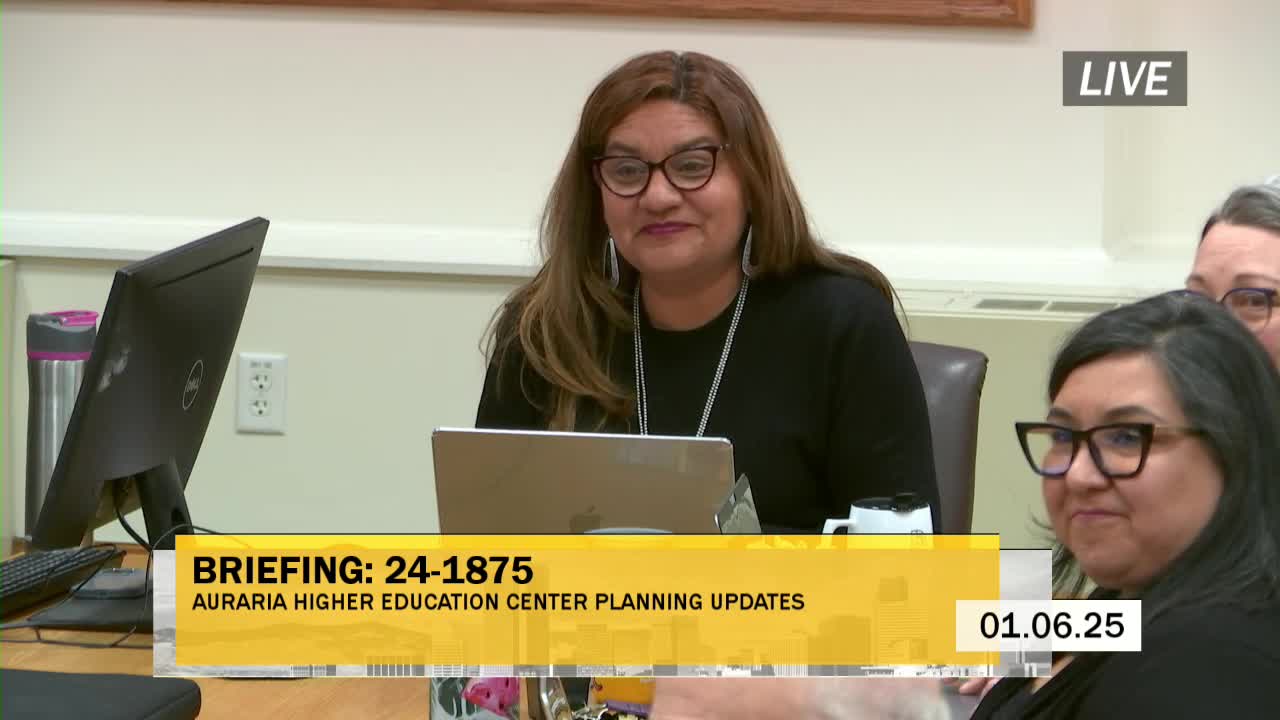
Auraria Higher Education Center officials briefed Denver City Council’s Budget & Policy Committee on Jan. 6 on a newly approved framework plan, a $6 million general-fund shortfall, a ball-field redevelopment, student and affordable housing, and expansion of the campus early learning center.
Colleen Walker, chief executive officer of the Auraria Higher Education Center (AHEC), told the Denver City Council Budget & Policy Committee on Jan. 6 that the Auraria Campus is moving forward with a new framework plan and near-term projects intended to strengthen campus identity and revenue while addressing a persistent operating shortfall.
The framework plan, approved in June, lays out a long-range vision for a denser, more integrated campus with six strategic ideas — a centralized academic core, transit-oriented higher-density edges, stronger east‑west pedestrian connections, vertical growth, honoring historic resources, and new collaborative project review procedures — and identifies new auxiliary revenue as a priority to backfill ongoing gaps in the general fund.
AHEC officials said the campus currently operates with roughly $37 million in annual general-fund costs while receiving about $31 million in reappropriated funds from the three institutions on the campus, leaving a roughly $6 million shortfall the campus covers in part with auxiliary revenues such as parking and student fees. “We have a $6,000,000 shortfall that exists,” said Zach Hermsen, chief financial officer for the Auraria Campus, describing the funding structure and why auxiliary revenue is central to the plan.
Campus finances and operations
Zach Hermsen outlined three primary operating funds: a general fund for operations and maintenance (facilities, custodial, campus police and business services); a student revenue-bond fund that supports the Tivoli Student Union and related debt service paid in part by student fees; and a parking enterprise that manages more than 6,000 parking spaces across 14 surface lots and three garages. Hermsen said the general fund…
Already have an account? Log in
Subscribe to keep reading
Unlock the rest of this article — and every article on Citizen Portal.
- Unlimited articles
- AI-powered breakdowns of topics, speakers, decisions, and budgets
- Instant alerts when your location has a new meeting
- Follow topics and more locations
- 1,000 AI Insights / month, plus AI Chat