Get Full Government Meeting Transcripts, Videos, & Alerts Forever!
Get email alerts on the K 12 Education Stem Curriculum topic
No spam. Unsubscribe anytime.
BESE committee approves $400,000 LDOE grant to build middle‑school aquaponics STEM curriculum
Summary
The BESE committee approved an LDOE contract/package over $50,000 that includes a $400,000 grant to develop an aquaponics and greenhouse-based STEM curriculum for grades 6–8 and a statewide teacher community of practice, department staff and teachers said at the meeting.
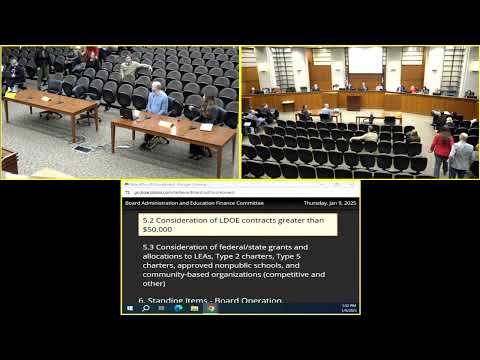
The State Board of Elementary and Secondary Education (BESE) Committee on Board Administration and Education Finance approved LDOE contracts greater than $50,000, including a $400,000 grant to develop a middle‑school aquaponics and environmentally controlled greenhouse curriculum and related teacher supports, at a committee meeting (date not specified).
The grant will fund a curriculum for grades 6–8 that the Louisiana Department of Education (LDOE) plans to publish as an open educational resource, Dr. John Underwood, LDOE STEM and computer science specialist, told the committee. “We worked with the National Academy's, Science, Engineering and Medicine to create a innovative project with aquaponics as well as an environmentally controlled greenhouse,” Underwood said, describing partnerships and resource development.
LDOE said the project will support a virtually funded community of practice for teachers from across the state, link middle‑school courses to high‑school pathways in aquaponics, aquaculture and agriculture, and create place‑based field experiences in partnership with Louisiana Sea Grant. Underwood said the Livingston Parish site will serve as a model that other schools can visit to see greenhouse systems that regulate temperature, light, CO2 and nutrient levels.
Three teachers who have used aquaponics in their classrooms described student engagement and learning outcomes. Alicia, a teacher at Westside Junior High School in Walker (Livingston Parish), said the lab teaches life skills and technical skills that connect to multiple career paths. Laura Lee Edelman said her pre/post evaluations show dramatic changes in student interest: she told the committee that initial pretest scores of roughly 2–5% understanding or interest rose to “100% interest” by the end of the school year in her program. Justin Reber, a horticulture and aquaponics teacher at Denham Springs Junior High, emphasized community outreach and said students become “little experts” who teach adults about microbiology and plant growth.
Committee members framed the grant as part of STEM initiatives the department is advancing. Mr. Morris introduced the presenters and noted prior conversations about attendance and engagement; the committee recorded no objections to the recommendation to approve the contracts.
The motion to approve the LDOE contracts and the $400,000 grant was made by Mr. Harris and seconded by Dr. Armstrong; no formal roll-call vote tally was announced in the transcript and the chair pronounced the item passed.
The committee discussion and teacher testimony focused on classroom impact, statewide teacher supports, and the Livingston Parish demonstration site. Staff said the curriculum will align with state science and math standards and connect to career pathways, but no implementation timeline or detailed budget breakdown beyond the $400,000 grant amount was provided in the meeting record.