Get Full Government Meeting Transcripts, Videos, & Alerts Forever!
Get email alerts on the Truancy topic
No spam. Unsubscribe anytime.
Louisiana Supreme Court, BESE and partners push for truancy summit and expanded FINS outreach
Summary
Chief Justice John Weimer and juvenile court leaders urged a statewide summit and stepped-up use of the Families in Need of Services (FINS) process to address rising truancy and chronic absenteeism; judges, district officials and BESE members discussed data gaps and resource shortfalls for FINS officers.
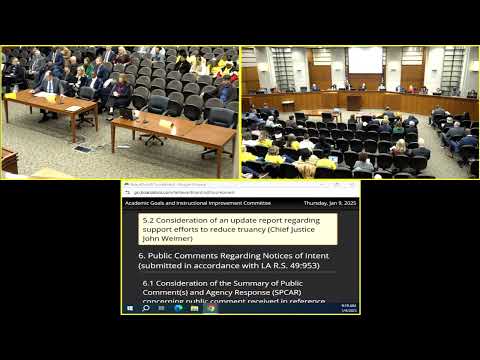
Chief Justice John Weimer of the Louisiana Supreme Court told the BESE Academic Goals and Instructional Improvement Committee on Jan. 9 that judges around the state want to play a larger role in addressing truancy and chronic absenteeism and urged a stakeholder summit to coordinate courts, schools and community services.
Weimer said judges already serve in classrooms and courts statewide and described FINS — Families in Need of Services — as a legal process meant to connect families to services before cases reach judges. “The FINS process is meant to fix problems and to improve opportunity,” Weimer said, adding that the judiciary stands “ready, willing, and able to assist.”
Why it matters: Committee members and judicial leaders framed chronic absenteeism as a public-safety and economic issue as well as an education one. Panelists said early intervention can reduce downstream costs for law enforcement and corrections and improve students’ prospects, but they said the state’s referral and monitoring systems are uneven.
Details from the discussion: Deputy Judicial Administrator Storm Ehlers told the committee that FINS officers receive fewer than 2% of the truancy referrals recorded by the Louisiana Department of Education in the 2021–22 school year, citing a gap between the Department’s counts of students reported truant and the number of complaints forwarded to court for FINS intervention. “If schools don’t report the truancy cases, they miss the chance to get help for families,” Ehlers said.
Juvenile court judges who spoke, including Judge Gail Grover of East Baton Rouge Parish and Judge Blair Edwards, described local capacity problems: Grover said courts and court-affiliated FINS workers can be overwhelmed when school systems send large numbers of referrals and that some jurisdictions have far fewer FINS officers than needed. Grover said East Baton Rouge Parish has roughly 41,000 students and only three FINS counselors.
State education staff and board members raised data problems and implementation questions. Department leaders cautioned that districts use different thresholds and tracking methods for absenteeism, complicating cross-district comparisons and efforts to route families to court-based services. Dr. Clark (chair of the STAR task force) and State Superintendent Cade Brumley recommended standardizing definitions and reporting so referrals and outcomes can be measured uniformly.
Next steps and commitments: Chief Justice Weimer proposed convening a summit of stakeholders coordinated with the governor’s children’s cabinet; multiple BESE members asked the committee and department to support a coordinated legislative and funding plan. Board members said any ask to the Legislature should include cost estimates and measurable outcomes. Several BESE members asked that the board and department collect clearer evidence — including pilot metrics — to justify recurring funding for expanded FINS staffing and coordinated prevention efforts.
Ending note: Committee members and presenters agreed on the broad priorities — improve district reporting, expand early interventions that connect families to services, and convene a summit of courts, schools, social services and the faith- and nonprofit sectors — but emphasized that action will require clearer data, staff resources and legislative direction.