Get Full Government Meeting Transcripts, Videos, & Alerts Forever!
Get email alerts on the K12 Funding And Policy topic
No spam. Unsubscribe anytime.
Education leaders walk through $2.9 billion K–12 budget, ESSER wind‑down and funding formula mechanics
Summary
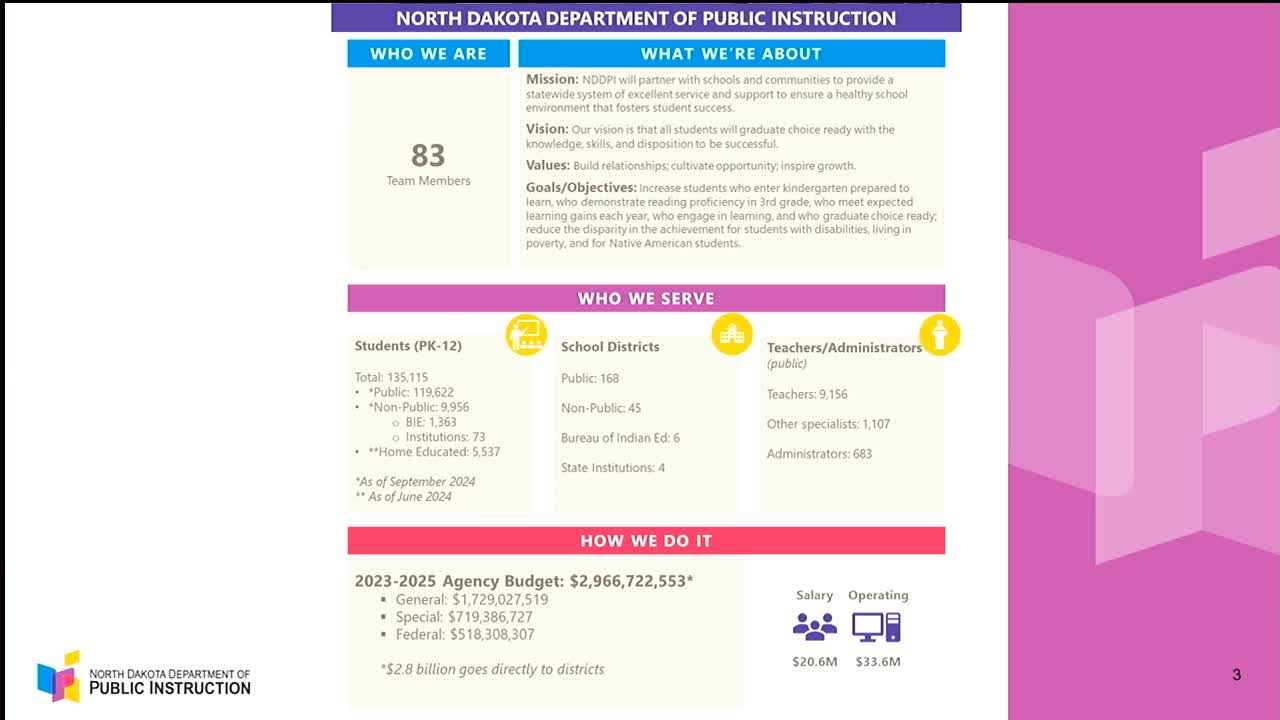
State education officials told the House Appropriations Committee the majority of the $2.9 billion K–12 appropriation is passed through to local districts and walked lawmakers through the enrollment‑driven funding formula that generates district payments.
The Department of Public Instruction presented a high-level overview of K–12 funding and the mechanics of the statewide per‑pupil funding formula to the House Appropriations Committee.
Kirsten Basler, state superintendent, said the department’s 2023–25 agency budget was roughly $2.966 billion and stressed most K–12 appropriations are passed directly to local school districts.
"Of the $2,900,000,000 that is appropriated to education, K12 education in the state of North Dakota, $2,800,000,000 is delivered directly out to our local school districts and special education units," Basler told the committee, noting the state agency’s operating budget represents roughly 2 percent of the total K–12 appropriation.
Why it matters: Lawmakers received a worksheet-driven walkthrough of how enrollment, weighted student units (for special education, English-language learners, at‑risk students and other categories), district size weightings and local revenue sources produce district payments. Committee members raised questions about remaining federal ESSER funds, special-education funding levels and the state’s treatment of virtual academies and distance education.
ESSER and recovery spending: Basler said the state “administered $427,100,000 in COVID funding that came to a close in December of 2024.” She said most of the money was passed through to districts and that the department had tracked returned amounts and planned to provide a detailed accounting.
Special education weighting: Adam Tesher, school finance officer, walked the committee through a model worksheet for a sample district (South Heart) and explained weighted student units. He said the special-education weighting factor was 0.082 historically and was increased to 0.088 in the current biennium.
"That weighting factor up until this current biennium was 0.082. ... This 23 through 25 biennium that was increased to the 0.088," Tesher said. Lawmakers and some school leaders told the committee that higher-cost special-education cases can exceed the average support provided by the weight and asked whether a categorical special-education funding model or a high-cost reimbursement pool should be examined.
Virtual academies and Center for Distance Education: Lawmakers also asked about students who take courses through other public virtual academies or the North Dakota Center for Distance Education (CDE). Basler described how districts can operate an authorized virtual academy and receive the full per‑pupil payment under state law; she said many districts contract with CDE for course delivery and that the department and CDE were discussing implementation safeguards.
"We could calculate how many courses the students are taking ... and instead of having the district receive all of the money and then pay $239 or $259 per course to the school district, we could calculate all of the students that are taking x number of courses and make a payment on behalf of," Basler said when discussing alternative payment models and accountability options.
Transportation, transition minimums and local revenue adjustments: Tesher reviewed how property tax, other local revenue (including 299 county oil and gas payments, mobile home and wind revenues), and transportation reimbursements interact with the formula and noted certain statutory caps and transition minimums that reduce year‑to‑year volatility but are scheduled to phase down.
Next steps: Education staff told the committee it will deliver section-level detail in upcoming division hearings, provide district-level worksheets for committee members, and follow up on outstanding items including ESSER liquidation totals and possible changes to special-education funding mechanisms.
Ending: Lawmakers said the E&E committee will hold detailed policy discussions on formula changes; DPI officials said they will provide the requested data and modeling to support those deliberations.