Get Full Government Meeting Transcripts, Videos, & Alerts Forever!
Get email alerts on the Nursing Services Agency Regulation topic
No spam. Unsubscribe anytime.
Bill to license nursing‑services agencies advances amid debate over oversight, costs and duplication
Summary
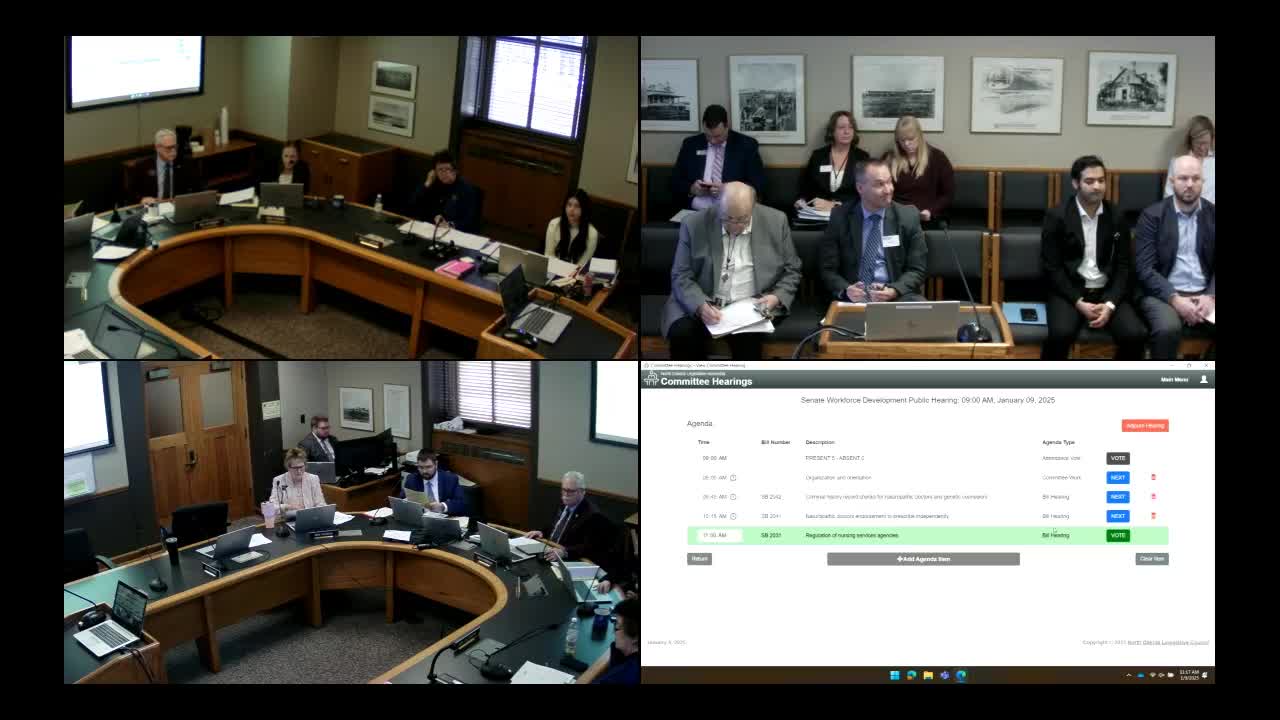
The Senate Workforce Development Committee heard Senate Bill 2031, a proposal to license nursing services agencies and require operational standards, reporting and complaint mechanisms for firms that supply temporary nurses and aides to health facilities.
The Senate Workforce Development Committee heard Senate Bill 2031, a Legislative Management proposal that would create a licensing program for nursing services agencies (NSAs) that supply temporary nurses and aides to health care facilities.
Senator Kyle Davidson, who presented the study as chair of the interim committee, said the measure is intended to set baseline standards for an industry that expanded rapidly during and after the COVID‑19 pandemic. “I chaired the healthcare interim in regards, and this was one of the studies that we did for nursing service agencies,” Davidson said in opening remarks.
Legislative Council attorney Beth Dittis walked the committee through the bill’s structure: defined terms (the Department of Health and Human Services is “the department”), an application and licensing requirement, a $2,000 application/first‑year fee, operational standards (personnel records, annual competency evaluations, malpractice and general liability insurance), complaint and reporting mechanisms, and enforcement authority including fines up to $1,000 per day and license denial, suspension or revocation. The bill would take effect January 1, 2026, if enacted.
Nursing‑home operators and the North Dakota Long Term Care Association urged passage. “Contract nursing hours have more than doubled from 2021 to 2023 and nearly $73,000,000 was spent on these services in 2023 alone,” Nikki Wagner of the Long Term Care Association told the committee, citing association figures. Witnesses said the number of agencies operating in or doing business in the state has jumped from roughly eight to “over 60” in a short period and that rural facilities, in particular, have limited leverage to reject poorly performing agencies because of local housing and transportation constraints.
Administrators and hospital representatives described cases in which facilities received workers whose credentials or on‑the‑job competency did not match representations from an agency, and they characterized licensing as a tool to create consistent baseline standards, streamline complaint handling and reduce risk to residents and patients. Knife River Care Center administrator Blake Craigness said licensing would reassure facilities contracting for temporary staff that agencies meet minimum oversight and record‑keeping requirements.
Staffing firms generally signaled conditional support but proposed technical changes. DTN Staffing’s director of business development, Sheriff Sharma, told the committee his company supports the bill’s goal but asked for an amendment to the disqualifying‑conviction language: the draft disqualifies an agency if an owner or employee has a felony conviction, and Sharma said that clause could create conflict with equal‑opportunity employment laws if it is applied to back‑office staff who do not have contact with vulnerable populations.
The Department of Health and Human Services opposed the bill as drafted. Tim Wedrick of HHS told the committee the department believes many problems can be resolved by hiring facilities discontinuing contracts with poor performers, by existing regulatory boards (for example, the Board of Nursing), or through civil remedies. HHS also raised administrative concerns: a statutory malpractice‑insurance minimum can become outdated; the department’s fiscal analysis assumed only 10 licenses and 25 complaints and estimated fixed costs plus one full‑time staff member, and Wedrick warned enforcement workload would grow with additional licensing and complaints.
Hospitals urged guardrails but said the bill is a reasonable first step. Tim Blassel of the North Dakota Hospital Association said the bill creates transparency and accountability without banning agencies or imposing unworkable conditions; he cautioned the state should avoid drafting that would drive agencies out of the state and worsen staffing shortages.
Why it matters: nursing services agencies supply critical temporary staffing to hospitals, long‑term care centers and other facilities. Legislators and providers told the committee that the sector’s rapid expansion has produced inconsistencies in credentialing, variable quality and costly emergency staffing expenditures. The bill aims to set minimum standards while preserving facilities’ access to contract staff.
What’s next: the committee recessed after the hearing. Sponsors and stakeholders will likely negotiate technical amendments—on malpractice thresholds, the felony‑conviction disqualification and the level of the application fee—before a committee vote.