Get Full Government Meeting Transcripts, Videos, & Alerts Forever!
Get email alerts on the Vehicle Registration topic
No spam. Unsubscribe anytime.
Highway patrol, DOT back bill to tighten temporary vehicle registration rules
Summary
The Transportation Committee heard testimony on House Bill 1118 to standardize where temporary registration permits must be displayed and to criminalize altered or forged temporary permits; bill received support from the Highway Patrol and Department of Transportation and drew questions about commercial vehicles, visibility and permit duration.
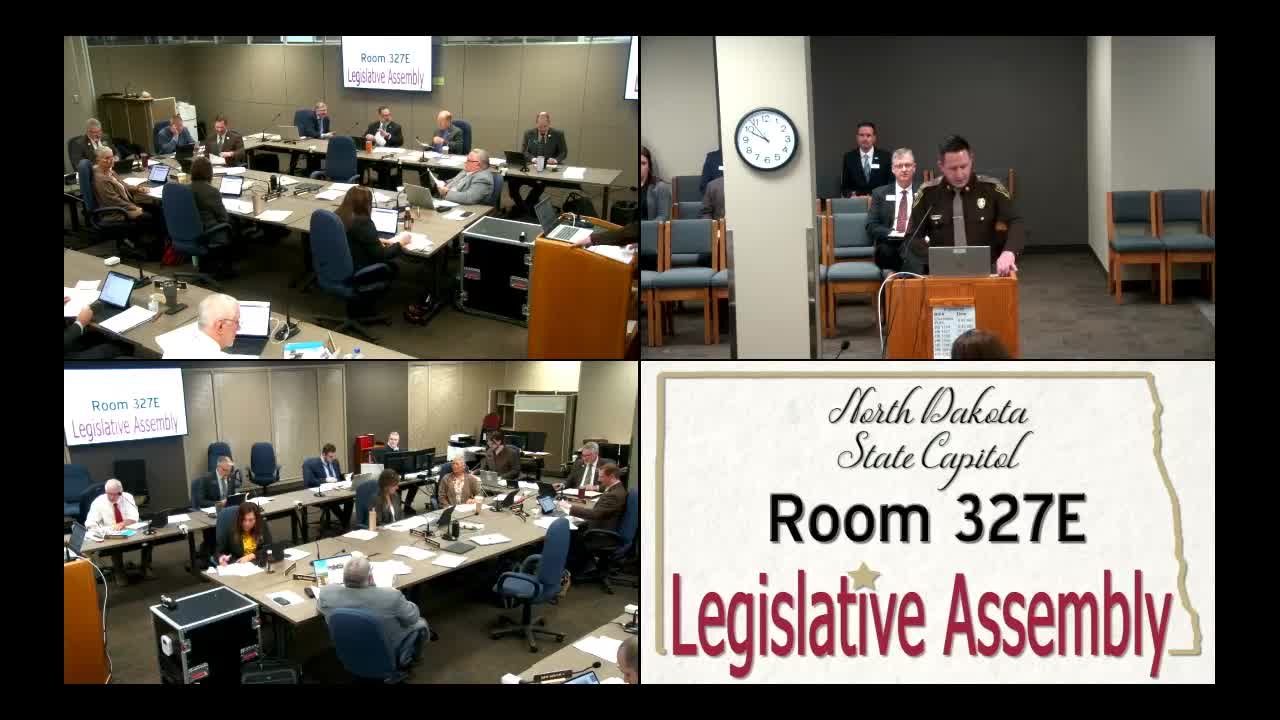
A bill to clarify where North Dakota’s temporary motor vehicle registration permits must be displayed and to add temporary permits to statutes governing unlawful use drew support from law enforcement and the state Department of Transportation at a House Transportation Committee hearing.
Tom Iverson, chief of operations for the North Dakota Highway Patrol, told the committee House Bill 1118 “amends North Dakota Century Code 3904.11, 390436, 390437, and 390456, pertaining to motor vehicle registration” and would require the temporary registration permit to be displayed in “the lower left of the rear window.”
The bill’s sponsors and agency witnesses said the measure responds to widespread inconsistent placement and to fraud. “When law enforcement comes across vehicles with temporary registrations they’re quite often displayed in multiple locations throughout the vehicle,” Iverson said, adding that modern temporary permits are available online or at NDDOT kiosks and are easier to track than the older paper registration cards.
The Department of Transportation’s Brad Schaeffer described the online permit system and recent upgrades that let law enforcement view temporary permits through DOT and Criminal Justice Information System portals. He said the DOT will “work with that individual if there are issues” when the permit cannot be issued in 30 days and that dealers routinely issue 75‑day dealer permits.
Members of the committee pressed staff about practical problems if the permit is required to go in a rear window. Representative Roger Mackey asked whether the rule would apply to commercial combination vehicles such as semitrailers, which often lack a rear cab window. Iverson agreed the rear-window rule is aimed at passenger vehicles and said he would consult NDDOT on how the rule would affect commercial vehicles.
Representative Nels Christensen and Representative Desiree Morton raised sightlines and weather concerns: rear windows can be obscured by mud, graphics or tinting. Iverson said states have taken different approaches, and that law enforcement and DOT prefer a rear-window location now because it is the most practical option available without issuing temporary plates.
Committee members also asked whether 30‑day private party permits can be extended when title or lien paperwork delays transfers. Schaeffer said the DOT can issue dealer 75‑day permits and that the DOT will work with individuals who need additional time; he said the agency has issued multiple consecutive 75‑day permits in some cases.
The committee did not take a vote. Staff and committee members signaled there will be follow-up work on drafting—particularly around whether the rear-window requirement should change for vehicles without a rear window and whether dealer/private-party permit durations need statutory adjustment.
The hearing record includes suggested drafting edits from the Highway Patrol (changing “authorized car dealership” wording to match Century Code terminology) and a recommendation to remove a provision requiring observation of permits at 100 feet at night as impractical.