Get Full Government Meeting Transcripts, Videos, & Alerts Forever!
Get email alerts on the Naturopathic Prescribing topic
No spam. Unsubscribe anytime.
Committee debates new pathways for naturopathic doctors to prescribe independently
Summary
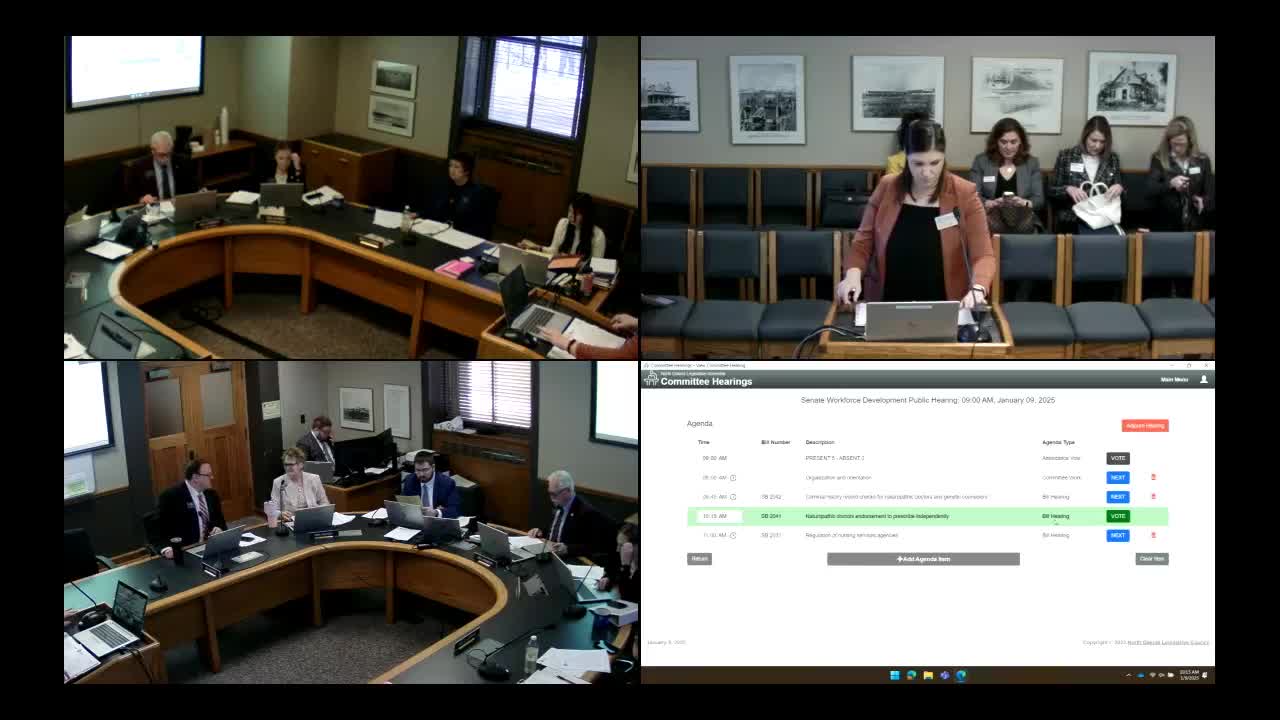
The Senate Workforce Development Committee heard Senate Bill 2041, which would add two alternate pathways—an accredited residency or verified out‑of‑state prescribing experience—to allow naturopathic doctors to obtain independent prescribing endorsements without taking a pharmacology exam.
The Senate Workforce Development Committee heard Senate Bill 2041, which would add two alternate pathways for naturopathic doctors to qualify for independent prescribing endorsements in North Dakota.
“After that bill passed, the board… came up with two additional pathways to be used in lieu of the exam,” Sandra DuPentes, executive director of the North Dakota Board of Medicine, told the committee. Under current law enacted in 2023 (Senate Bill 2221), naturopaths seeking full prescribing endorsements must first hold a limited endorsement and practice under the supervision of a licensed North Dakota physician for 12 months or until they reach 100 prescriptions, and then pass a pharmacology portion of the NPLEX exam. SB 2041 would keep that initial supervised step in place but allow applicants to instead demonstrate competency by either completing 12 months of an accredited residency or showing three years of prescribing experience in another jurisdiction without disciplinary action.
DuPentes described how the Board plans to verify out‑of‑state experience: physician attestations and employment‑verification records from facilities (credentialing or HR) would be used to confirm dates and personnel records, and the Board would adopt a policy describing satisfactory proof. She proposed a simpler alternative wording for the bill’s experience pathway during the hearing: substantial experience prescribing for three years without discipline “as determined by the board,” to reduce reliance on particular types of attestations.
Naturopathic clinicians and the Board stressed practical barriers to the exam pathway: the NPLEX pharmacology exam is a 75‑question multiple‑choice test offered twice a year, typically outside the state in a distant testing center, and candidates can face travel and scheduling burdens. Dr. Leslie Link, a licensed naturopathic doctor who serves as the Board‑appointed naturopath member, described the profession’s education and clinical rotation structure and said graduates have multiple ways to gain clinical prescribing experience, including residencies.
Physician testimony raised safety and standardization concerns. “A 100 scripts doesn't seem to be a sufficient amount to really determine if someone has the competency to practice all 35 classes of that medication,” said Dr. Eric Heitkamp, a board‑certified internal medicine physician from Fargo who testified in opposition. Heitkamp said the naturopathic curriculum and clinical hour totals differ from medical residencies and expressed concerns about the bill’s subsection permitting verification of three years’ experience in another jurisdiction, particularly if a practitioner had not been active recently or if the verification relied on facility administrative records rather than clinical attestations.
Board representatives provided data in committee: the Board currently lists 27 active naturopathic licenses in North Dakota, with five licenses issued since the profession moved under the Board’s jurisdiction in August 2023; three naturopaths currently hold the limited prescribing endorsement. DuPentes said there have been no disciplinary actions against naturopaths to date. Board witness Link said when she graduated there were more than 30 residencies; she told the committee there are no naturopathic residency programs in North Dakota today.
Opponents recommended changes. Physician witnesses asked the Board to consider requiring more granular evidence of competency, for example prescribing experience that covers each drug class on the formulary rather than an undifferentiated total of prescriptions. The North Dakota Medical Association’s executive director, Courtney Kobal, described concerns submitted by member physicians and introduced Heitkamp as speaking on his own behalf.
Supporters argued the bill creates reasonable alternative pathways where the single‑exam route can be impractical for applicants and that the Board will retain discretion to vet experience closely. DuPentes told the committee the Board had reviewed the draft in multiple public meetings and sent news blasts to licensees after the language was approved. She also noted the Board requires a reentry‑to‑practice plan for any practitioner who has not clinically practiced for two or more years.
Why it matters: SB 2041 would broaden the mechanisms by which naturopathic doctors can qualify for independent prescribing. Backers say that will reduce barriers to licensure and make use of existing clinical experience; critics say the alternative routes as drafted risk uneven standards for prescribers and leave open patient‑safety gaps unless the Board adopts tighter verification standards.
What’s next: the committee closed the hearing and recessed; sponsors and board staff signaled willingness to refine the bill’s language, particularly the subsection addressing verification of out‑of‑state experience.