Pipeline Authority outlines Bakken East gas pipeline, nonbinding open‑season and state backstop option
Loading...
Summary
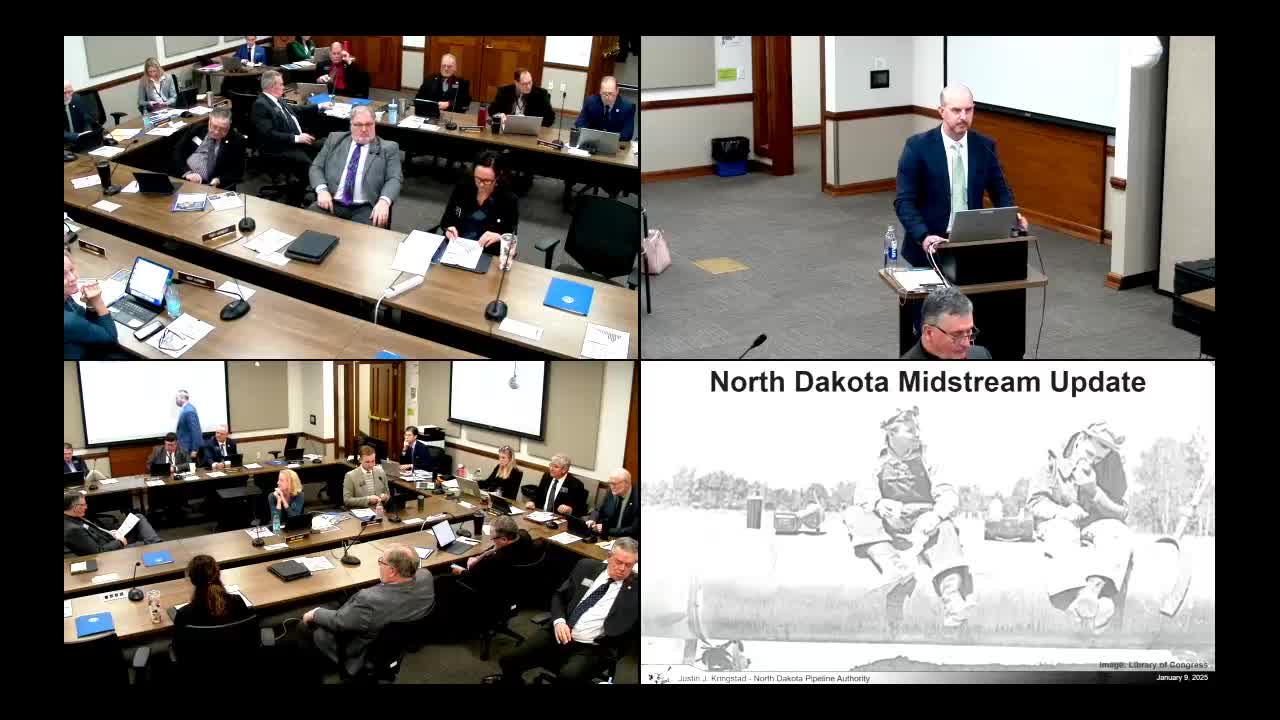
Justin Kringstead of the North Dakota Pipeline Authority briefed lawmakers on current crude and natural‑gas transport, a newly announced Bakken East pipeline proposal in nonbinding open season, and options for state participation under a $30 million‑per‑year backstop program.
Justin Kringstead, representing the North Dakota Pipeline Authority, told the Legislature’s energy committees that the state’s crude oil transmission system is generally adequate today but that natural‑gas takeaway capacity is the critical near‑term constraint for producers as wells get “gassier.”
Nonbinding open season for Bakken East/Bakken Express: Kringstead described a proposed new project—referred to in the presentation as Bakken East (also discussed as Bakken Express and involving multiple developers)—that would add pipeline capacity out of western North Dakota. He said the project’s developer has opened a nonbinding open season for potential long‑term contracts and that the initial scope described in the presentation calls for roughly a 375‑mile pipeline sized at about 30 inches in the western segment tapering to 24 inches in the east. The developer’s schedule presented to the committee showed phased in‑service dates in 2026 for the western segment and a twin east segment in late 2029, subject to commitments from users.
Capacity and timing concerns: Kringstead said the state’s major transmission system, Northern Border, is now 80–90% utilized by Bakken gas and other volumes, and that, depending on assumptions about Canadian flows and other projects, the state could face pipeline capacity shortfalls in the 2027–2029 timeframe in a base scenario. He said a specific project under discussion—Bakken Express—would add roughly 300,000,000 cubic feet per day (as described in the presentation) of capacity from the Kurtz/Glen Ullin area by re‑using existing pipe and interconnecting to larger hubs.
State financial tools and participation: The Pipeline Authority explained that the state has existing authority and financing tools to take a capacity position in a project as a participant of “last resort.” Kringstead said the Legislature previously provided a financing backstop that the authority could use; he described a currently available program that supports up to $30,000,000 per year (the presentation referred to it as a $30,000,000‑per‑year line of credit through Bank of North Dakota and backstopped by state investment funds). Under that program, Kringstead said, the state could take capacity commitments and then lease or release that capacity to private users if private interest is insufficient. He cautioned that, if private demand falls short and the state must retain capacity, the state could be liable for committed transport charges for the contracted term.
Open‑season mechanics, economics and risks: Kringstead explained that large pipeline projects commonly require long‑term (often 20‑year) take‑or‑pay commitments from producers, marketers or major industrial consumers before construction can proceed. The presentation included rate examples in the neighborhood of $0.85–$0.90 per dekatherm as an illustrative transport rate noted by the developer; Kringstead emphasized that the pipeline’s final sizing and timing depend on the level of binding shipper commitments that emerge from the open season.
Other infrastructure and storage: Kringstead highlighted the region’s major existing transmission systems (Northern Border, Alliance) and called attention to the WBI underground natural gas storage field near the southwest corner of the state, noting that the storage asset “has a tremendous amount of additional space and capability” and could be an important regional asset for supply security and flexibility.
What the committee heard: Lawmakers asked how the state’s $30 million annual capacity tool works in practice. Kringstead said that, as currently designed, the tool is intended to fill a gap alongside private sector commitments rather than be the primary financier. If the open season shows a meaningful shortfall, Kringstead said the authority would evaluate options and may request a policy decision from the Legislature on whether to provide a larger commitment.
Ending: Kringstead closed by asking interested counties, utilities and potential users to engage in the open season and said the authority will report back after the open season closes to show whether private commitments suffice to move the project forward.