Get Full Government Meeting Transcripts, Videos, & Alerts Forever!
Get email alerts on the Physician Assistant Licensure Compact topic
No spam. Unsubscribe anytime.
Committee recommends 'do not pass' on physician assistant compact amid legal and cost concerns
Summary
The Workforce Development Committee voted unanimously to recommend a "do not pass" on Senate Bill 2,108, which would join North Dakota to the interstate physician assistant licensure compact. The Board of Medicine and other witnesses cited unresolved legal, cost and operational questions, including the compact's use of a "privilege" model rather
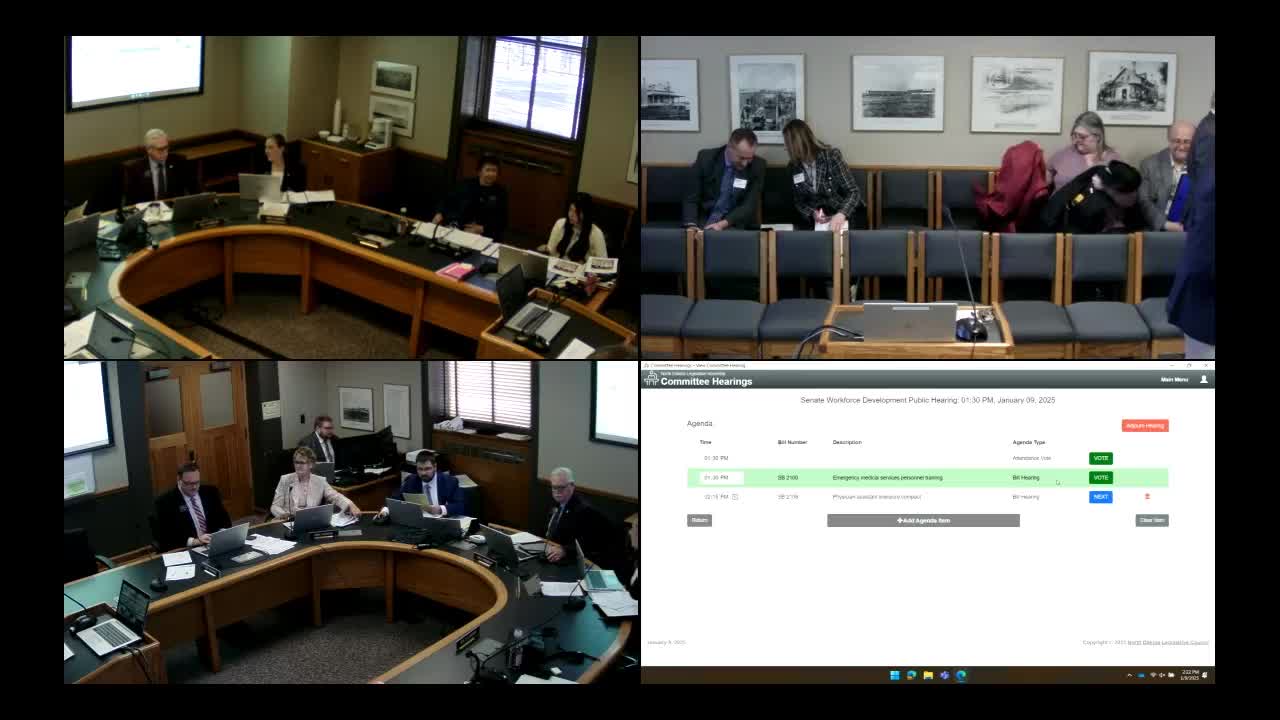
The Workforce Development Committee voted unanimously to recommend a do‑not‑pass on Senate Bill 2,108 after witnesses from the North Dakota Board of Medicine and other state stakeholders raised legal, financial and operational concerns about joining the interstate physician assistant (PA) licensure compact.
Senator Jeff Barta, R‑43, introduced the compact bill and said the intent was to make the state more military‑friendly by easing licensure for incoming health professionals and their families. He told the committee, however, that the bill was being held because key definitions and cost details remained unresolved.
Sandra DuPentes, executive director of the North Dakota Board of Medicine, delivered informational testimony that cataloged several areas of uncertainty in the compact as drafted. The compact uses a “privilege to practice” model rather than the Interstate Medical Licensure Compact’s model of issuing direct licenses, and DuPentes said that distinction matters. “If it was the exact same thing, you would have used license,” she said. She noted that PAs in North Dakota have prescribing authority and that other interstate compacts using privileges involve different scopes of practice; DuPentes said the impact on prescription monitoring (PMP) registration and Drug Enforcement Administration oversight is unclear.
DuPentes also flagged cost and governance questions. The compact commission could assess an annual fee on member states, she said, and the compact’s IT and operating model are not yet built. The Board of Medicine’s review found the compact is not operational yet and would likely take at least one to two years to implement; DuPentes recommended the state wait for those details to be resolved and for legal review by the attorney general’s office on dispute‑resolution and fee provisions that may conflict with state law.
Representatives of the North Dakota Academy of Physician Assistants participating online said they had discussed the compact with the board and planned to return the next session after outstanding questions are answered. Mr. Metzger, speaking for the state PA association, said the group intended to bring the matter back next year.
After testimony, a senator moved a do‑not‑pass recommendation on Senate Bill 2,108; the committee approved the motion unanimously on a roll call. Recorded committee votes were: Chair Wabamaw, yes; Senator Axman, yes; Senator Larson, yes; Senator Boshee, yes; Senator Powers, yes. The motion was carried by the committee and the bill was recommended not to pass for this session.
Committee members said the record should include more precise answers about whether privileges can be renewed with fees, how prescribing and PMP rules would apply to compact privileges, what the commission might charge member states, and how the compact’s IT platform would integrate with state systems. The committee closed consideration of the bill and said staff would assist with follow‑up as parties continue discussions.