Get Full Government Meeting Transcripts, Videos, & Alerts Forever!
Get email alerts on the School Accountability topic
No spam. Unsubscribe anytime.
DPI outlines federal ESSA framework, ND First interventions and how schools are identified
Summary
Amanda Peterson of DPI explained how North Dakota uses the federal Every Student Succeeds Act framework for accountability, the state’s TSI/CSI identification process, and the new ND First interventions authorized by recent legislation.
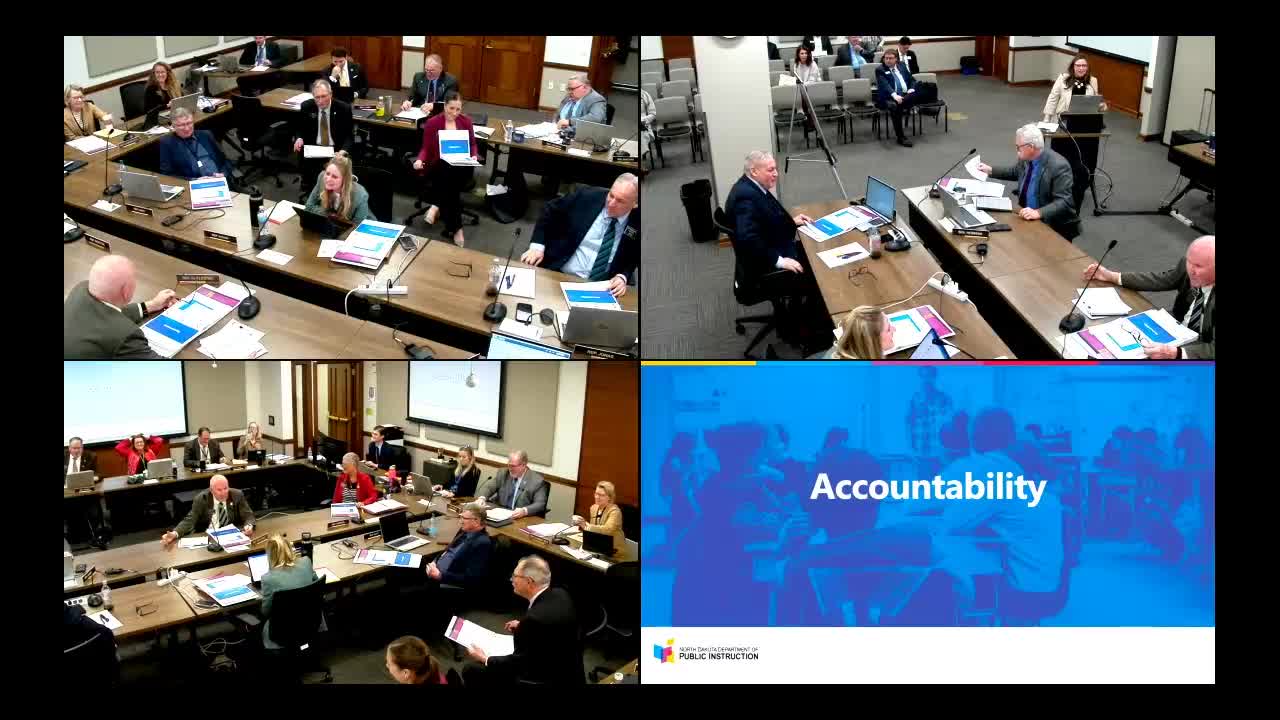
Bismarck — Amanda Peterson, director of Educational Improvement and Support at the Department of Public Instruction, told the Joint Education Committee that North Dakota follows the federal Every Student Succeeds Act (ESSA) framework for statewide accountability and posts required indicators on the department’s public dashboard.
Peterson described the state’s approach to measurement: a mix of state assessment results, growth measures, graduation rates and other federally required indicators that are combined into a weighted “accountability” measure. She said the state calculates targeted support and improvement (TSI) annually and identifies the lowest performing schools for comprehensive support and improvement (CSI) on a three‑year cycle; CSI designations are retained for three years while states provide additional supports and resources.
Peterson discussed Senate Bill 2254, enacted in the prior session, which created the ND First (Fostering Improved Results for School Transformation) interventions. She said the bill will take effect in the 2025 implementation cycle and DPI has been using the months since enactment to consult with districts, draft implementation documents and plan supports to avoid disruptive or punitive rollouts.
She said DPI relies on Regional Education Associations to deliver many school support services because the department staff are too few to maintain continuous, close engagement with all identified schools; DPI and REAs hold checkpoints across the school year, including presentations by CSI and TSI schools during scheduled review windows.
Peterson noted that ESSA requires states to identify the bottom 5% of schools each cycle. When asked by Senator Beard, she agreed that the federal requirement means there will always be an identified lowest performing group, even if overall statewide performance improves. She said the ND First implementation will seek to preserve locally successful strategies while adding supports and oversight for persistently low performers.
Why it matters: Peterson said the accountability system determines which schools receive intensified supports and federal supplementary funding and that the department will produce legislative reports on implementation of ND First as the program rolls out.
She encouraged committee members to consult DPI dashboards and implementation documents and said DPI would report back through interim committee updates as ND First is implemented.