Get Full Government Meeting Transcripts, Videos, & Alerts Forever!
Get email alerts on the Dhhs Audit Response topic
No spam. Unsubscribe anytime.
DHHS tells audit committee it is addressing hospital medication controls, HCBS pilot payment issues and improving child-protection response times
Summary
Department of Health and Human Services officials told the Legislative Audit and Fiscal Review Committee they are implementing automated dispensing cabinets at the State Hospital, completed follow-up on HCBS workforce pilot payment concerns and are continuing efforts to improve timeliness for child-protection face-to-face visits.
Department of Health and Human Services officials told the Legislative Audit and Fiscal Review Committee they have taken steps to address findings in the 2022–23 operating audit relating to the State Hospital’s controlled substances handling, a pilot workforce retention payment program for home- and community-based services (HCBS), and timeliness of face-to-face child-protection visits.
State hospital controlled-substance controls
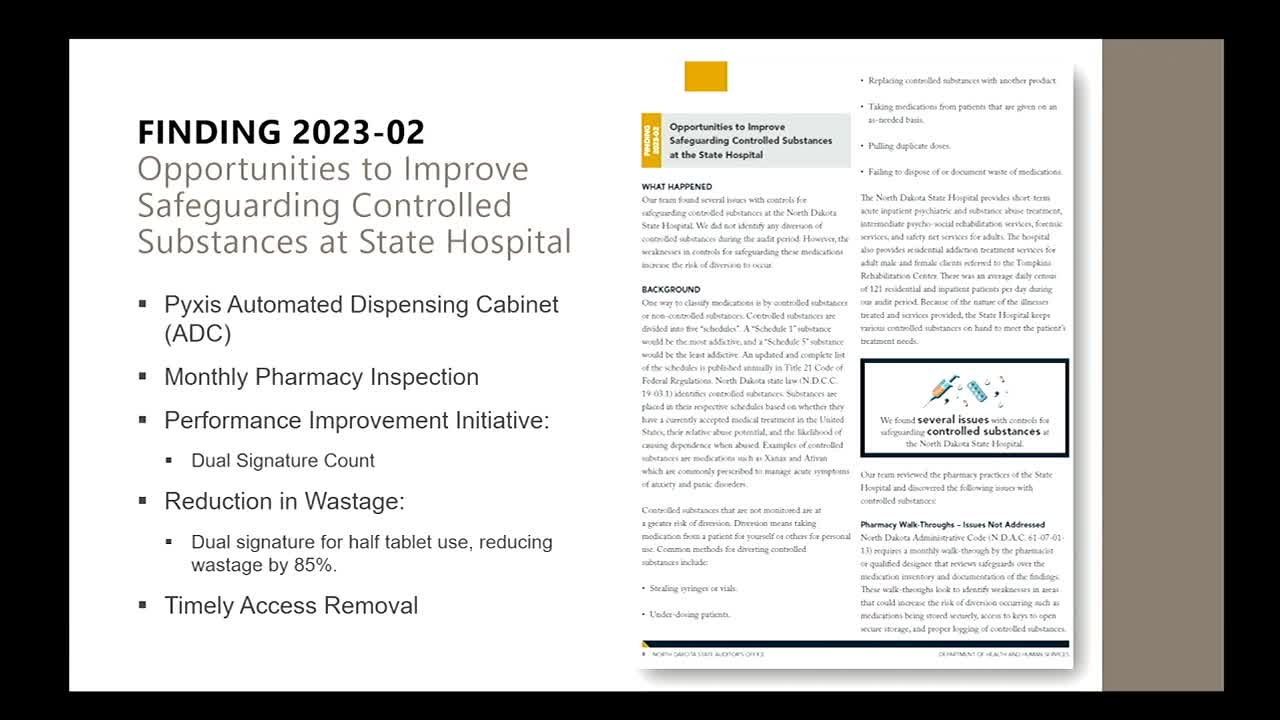
Dr. Ed Yabbot (medical director for the State Hospital) told the committee auditors found opportunities but no confirmed diversion of controlled substances. The hospital agreed with the recommendation to install automated medication-dispensing cabinets (Pyxis) to tighten tracking and reduce manual handling. "We were given an appropriation for about $75,000 to procure 7 or 8 Pyxis dispensing cabinets," Dr. Yabbot said; procurement was underway but, as of the meeting, the machines were held up in contract and procurement review with an anticipated arrival around March (as stated in committee testimony). Monthly pharmacy inspections and tighter waste-handling procedures were already in place while Pyxis installation is completed.
HCBS 10% workforce-retention pilot: payments, verification and recoupments
Jessica Thomason, Executive Director for the Human Services Division at the Department of Health and Human Services, reviewed the department’s HCBS retention pilot that used a one-time funding stream intended to strengthen the workforce for home- and community-based services. The department issued program guidance beginning in March 2022 and made final payments in October 2023.
The audit examined provider confirmations and identified cases where agencies misinterpreted confirmation forms or where payments exceeded program limits. HHS staff conducted a full 100% review for sampled large providers and requested repayment where an employee or provider did not meet program criteria or where payments exceeded the program cap. Thomason said the agency requested and received recoupments totaling about $4,418.20 across six employees in five providers sampled by the auditor’s office; two other providers repaid amounts ($150 and $268.10) on separate overpayments. The department said it also evaluated program impact and published an evaluation in June 2023; respondents reported short-term benefit from the bonuses but said one-time incentives were not sufficient to resolve longer-term workforce shortages.
Child-protection face-to-face visit timeliness
The audit identified significant delays in meeting required timeliness for face-to-face child-protection visits in the audit period. Thomason and Children and Family Services staff outlined state and zone efforts to improve timeliness: redesign of social services practice, central intake, expanded training, 24/7 on-call coverage in human service zones, and improved data dashboards. Thomason said the State’s QA team performs semiannual case reviews and ran an ad hoc sample in 2024 that showed improvement (a 92% compliance rate on that ad hoc sample). Human service zone director Rhonda Allery told the committee that zones staff 24/7 and keep supervisors on-call, but that legitimate exceptions (law-enforcement-led investigations, inability to locate families, logistics such as children being in school or advocates coordinating interviews) can make an on-the-ground face-to-face visit in the strict audit window impossible even when other safety measures are in place.
Quotes and context
"We already have the procedures at the state hospital to address safety and to prevent diversion of controlled substances," Dr. Yabbot said, noting Pyxis cabinets are intended to raise compliance to 100% for counts and reduce wasted/manual tablet splitting. Thomason noted the HCBS pilot reached 61 agencies, 942 individual providers and more than 5,500 employees; the program distributed about $7.9 million in incentives and the department recovered small sums where documentation showed noncompliance with program rules.
Committee response and next steps
Committee members thanked DHHS staff and zone directors for the work, pressed for continued timely reporting, and discussed the challenges auditors face in using data fields when exceptions and policy context are recorded in narrative case notes. Committee members asked DHHS to provide more accessible and timely QA dashboard reports to the committee and asked the department and the State Auditor’s Office to work on ways to make future audit findings' context clearer when an audit looks at historical data.
Ending
DHHS said it will continue the Pyxis procurement process, maintain monthly pharmacy inspections at the State Hospital, continue HCBS follow-up and recoveries, and provide periodic child-protection QA results to oversight groups. Human service zone directors asked the committee to support continued funding for a new child-welfare case-management system (referred to in testimony as "Oceans") to improve data, case narratives and reporting accuracy.