Get Full Government Meeting Transcripts, Videos, & Alerts Forever!
Get email alerts on the Autopsy Records And Release topic
No spam. Unsubscribe anytime.
Panel considers bill consolidating rules for release of autopsy reports and images into Title 23
Summary
House Bill 1068 would consolidate rules on autopsy reports, working papers and autopsy images into North Dakota Century Code Title 23, clarify who may receive records (including certain review commissions), and preserve confidentiality for photographs and third-party images.
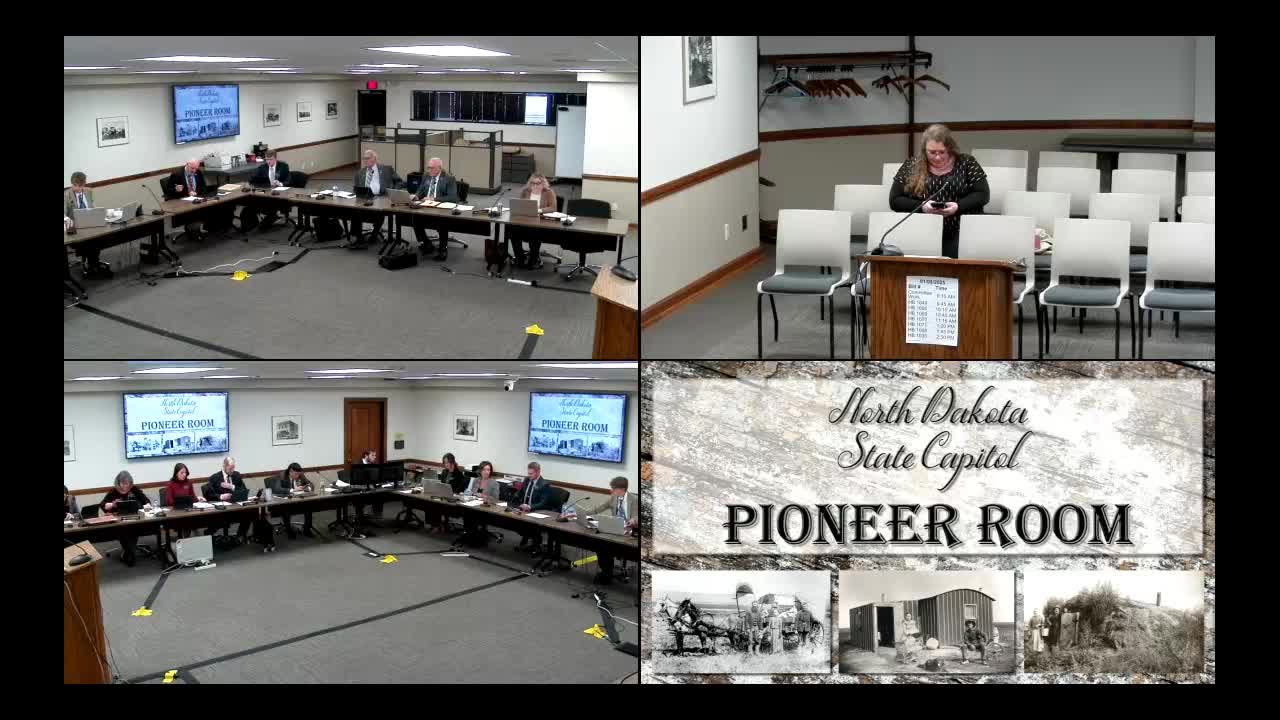
The House Human Services Committee heard testimony on House Bill 1068, which would amend and reenact sections of North Dakota law to consolidate the rules governing autopsy reports, working papers and autopsy photographs or recordings into Title 23 of the North Dakota Century Code.
Kirby Krueger, director of disease control and forensic pathology with the Department of Health and Human Services, told the committee the bill moves scattered language from Title 44 into Title 23 to make it easier for the State Forensic Examiner's office to determine who may receive forensic records and under what conditions. "Just at a high level, section 1 of this bill clarifies which records from the state forensic examiner's office are the forensic examiner officers offices designee can be released to and to whom and defines the conditions of the recent of the records," Krueger said.
Krueger said the draft adds definitions distinguishing notes and working papers from autopsy reports, and clarifies that working papers exclude autopsy photographs and other visual images. The bill specifies that a decedent's child must be 18 or older to request a copy of the autopsy report, authorizes the maternal mortality review committee to receive autopsy reports, and allows the suicide fatality review commission to receive autopsy reports when there is no active criminal investigation. The bill also clarifies conditions under which autopsy photographs, visual images and audio or video recordings may be released for educational and training purposes.
Allison Lisonbee Hicks, assistant attorney general and general counsel for the public health division, said the bill rationalizes where statutory language lives so the State Forensic Examiner's office has a single section to consult when fielding requests. "So the maternal mortality review commission, already in law, were just giving the state forensic examiner authority to release it. It's just very clearly written out that the SFE's office can hand over those records to the MMRC," she said.
Krueger also advised the committee that the Department of Corrections has submitted related proposed changes addressing access to autopsy reports for deaths that occur in county jails, but he said the crossover between the two proposals was small and the bills would not conflict depending on enactment order.
Committee members asked whether families must consent before the maternal mortality review committee or the suicide fatality review commission receive reports. Krueger and Lisonbee Hicks answered that those committees request records directly from the department and the bill would permit those releases without family permission; family members retain the independent right to request reports if they meet the statutory family-member criteria.
No testimony in opposition was recorded. The committee closed the hearing after receiving department and attorney general office explanations of the consolidation and the specific authorization for review commissions.