Get Full Government Meeting Transcripts, Videos, & Alerts Forever!
Get email alerts on the Revenues And Oil Tax topic
No spam. Unsubscribe anytime.
Fiscal staff: large starting balance, oil tax assumptions and revenue drivers shape 2025‑27 outlook
Summary
Legislative fiscal staff summarized the Burgum executive budget’s revenue outlook: a large beginning balance, proposed increased oil tax transfer to the general fund, and sensitivity of oil revenue forecasts to price and production assumptions.
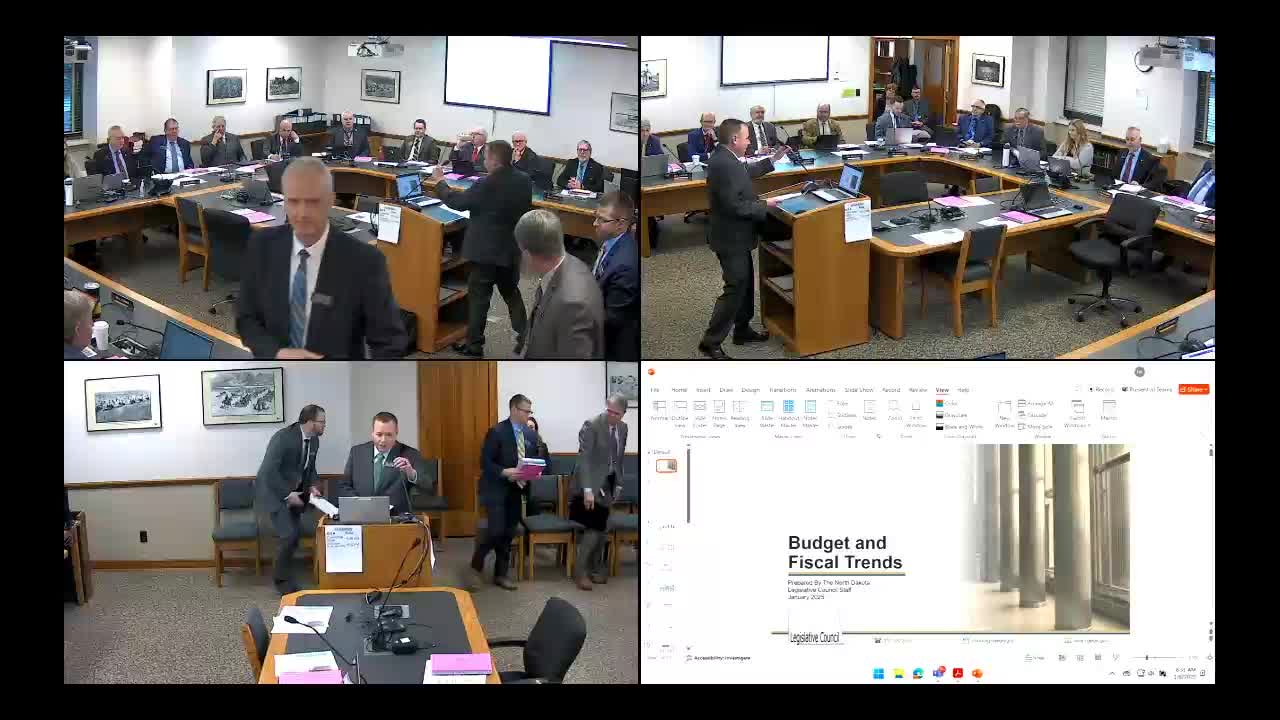
Brady Larson and other Legislative Council fiscal staff summarized the revenue and appropriations picture in the Burgum executive budget and explained key sensitivities that will shape the budget outlook.
Larson said the executive budget shows a projected beginning general fund balance of about $1.215 billion, ongoing revenues near $5.07 billion and transfers of roughly $397.4 million for total available general fund resources near $6.7 billion for the 2025‑27 biennium. He noted that beginning balances historically have been much lower in prior bienniums and that the current beginning balance includes $225 million of expected turnbacks and a $202 million one‑time transfer from the budget stabilization fund.
Larson described the executive recommendation to increase the statutory transfer of oil and gas tax receipts to the general fund from $460 million per biennium to $600 million — a $140 million increase — and explained that, despite the larger transfer, the executive projects total oil and gas revenue available for the state will fall compared with the current biennium because of lower forecasted prices and production. The executive budget assumed oil at $62 per barrel in the first year of the biennium and 1.1 million barrels per day production, with small declines thereafter.
Fiscal staff outlined sensitivity figures: they estimated that an average miss of 100,000 barrels per day in the forecast would change receipts by about $432 million for the biennium, and each dollar per barrel variance would change oil and gas tax collections by about $78 million for the biennium.
Larson also reviewed the major tax bases driving the general fund: sales and use and motor vehicle excise taxes are the largest revenue sources and have trended upward; income taxes (individual and corporate) are more volatile; and “other taxes” show reductions driven by lower estimated insurance premium taxes and interest income. He noted federal COVID funding had temporarily inflated federal funds in recent bienniums and that federal funds are receding as pandemic funding ended.
Larson closed by pointing members to more detailed schedules that Legislative Council will publish and update, and he answered member questions about how the executive budget treats transfers, turnbacks and the state tuition/common schools funding flows.