Get Full Government Meeting Transcripts, Videos, & Alerts Forever!
Get email alerts on the Medicaid topic
No spam. Unsubscribe anytime.
Appropriators briefed on Medicaid costs, FMAP changes and human services spending
Summary
Legislative fiscal staff told the House Appropriations Committee Medicaid spending is a major driver of general fund increases, reviewed FMAP calculations and noted federal share shifts from the COVID period affect upcoming budgets.
Legislative fiscal staff told the House Appropriations Committee that Medicaid and human services are major drivers of general fund growth and that federal matching rate changes remain an important unknown for final budgets.
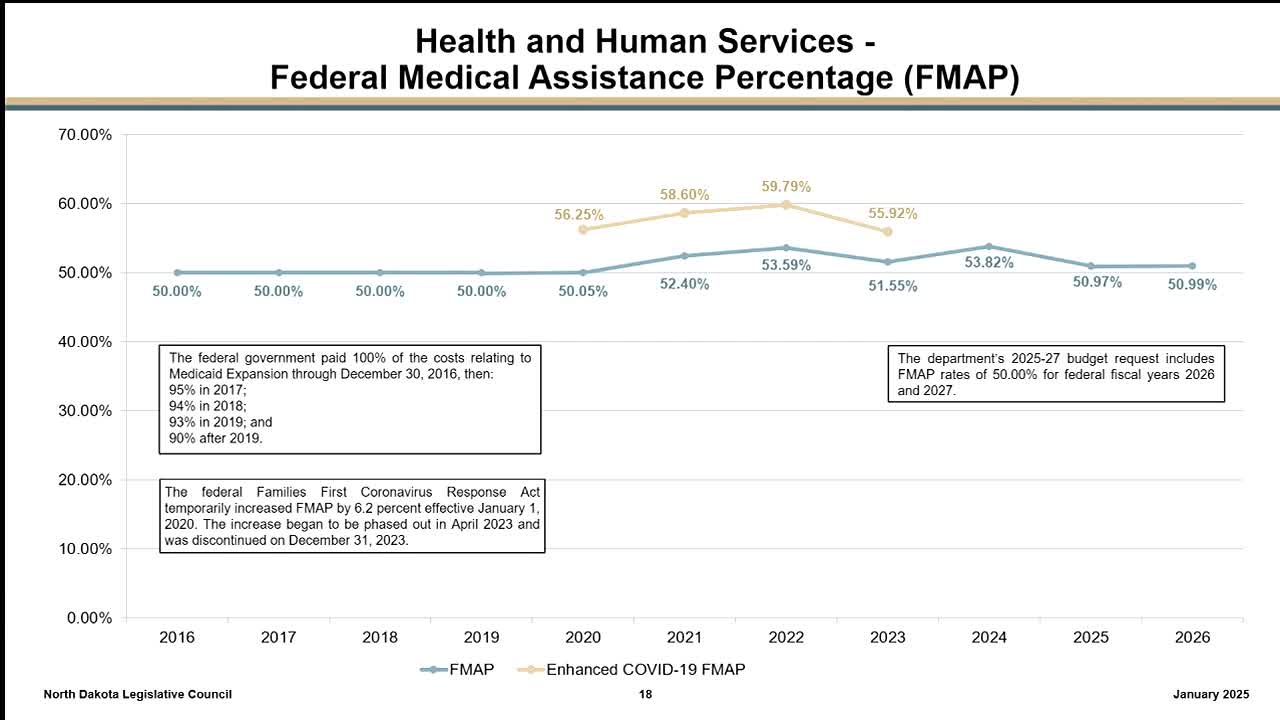
Alan Knudson, legislative council fiscal staff, explained how the federal medical assistance percentage (FMAP) affects state spending and described how the COVID-era enhanced FMAP phased out: "During those COVID years, the federal government played closer to 60% of Medicaid costs, but then that went away in 2023. And now we're back to our base level FMAP." He emphasized the FMAP is calculated by comparing a state's per‑capita personal income to other states and noted a one‑percentage point FMAP change can mean tens of millions of dollars.
Why it matters: Knudson and other staff said Medicaid spending includes large line items — developmental disabilities, nursing homes, hospitals, professional services and prescription drugs — and that small FMAP shifts materially change the state's share of those costs. Sheila Sandness, senior fiscal analyst, summarized the Burgum executive recommendation would raise general fund appropriations for Health and Human Services by about 15.5 percent, citing caseload changes, FMAP adjustments and program utilization as drivers.
Presenters called attention to program-specific items in the Burgum recommendation, including a recommended $10 million from SIF for state hospital planning and an authorization to pursue a public‑private partnership for a new North Dakota State Hospital. Fiscal staff also noted $58.3 million in provider inflationary adjustments over the biennium, of which $29.3 million would be general fund.
Committee members asked operational questions. Representative Murphy pressed on FMAP mechanics and economic drivers; Knudson answered that FMAP will be updated in April and that preliminary estimates will inform later budget work. Knudson also noted Medicaid expansion receives a higher federal match (90% under the federal expansion policy), a separate calculation from the baseline FMAP.
The staff recommended that members await final FMAP estimates expected later in the session before finalizing human services appropriations and flagged an estimated human services turnback of roughly $80 million in the governor's budget as an item the committee should review.
Next steps: staff said updated FMAP estimates and Armstrong administration proposals will be provided as they become available so the committee can model alternative funding scenarios for human services.