Get Full Government Meeting Transcripts, Videos, & Alerts Forever!
Get email alerts on the Behavioral Health Restructuring topic
No spam. Unsubscribe anytime.
Committee hears large rewrite to rename human service centers and add certified community behavioral health clinics; members flag need for follow‑up
Summary
The Senate Human Services Committee heard testimony on Senate Bill 2113, a broad rewrite renaming regional human service centers as state operated behavioral health clinics and creating a process for certificated community behavioral health clinics, but senators asked for further clarifications and flagged related bills for coordination.
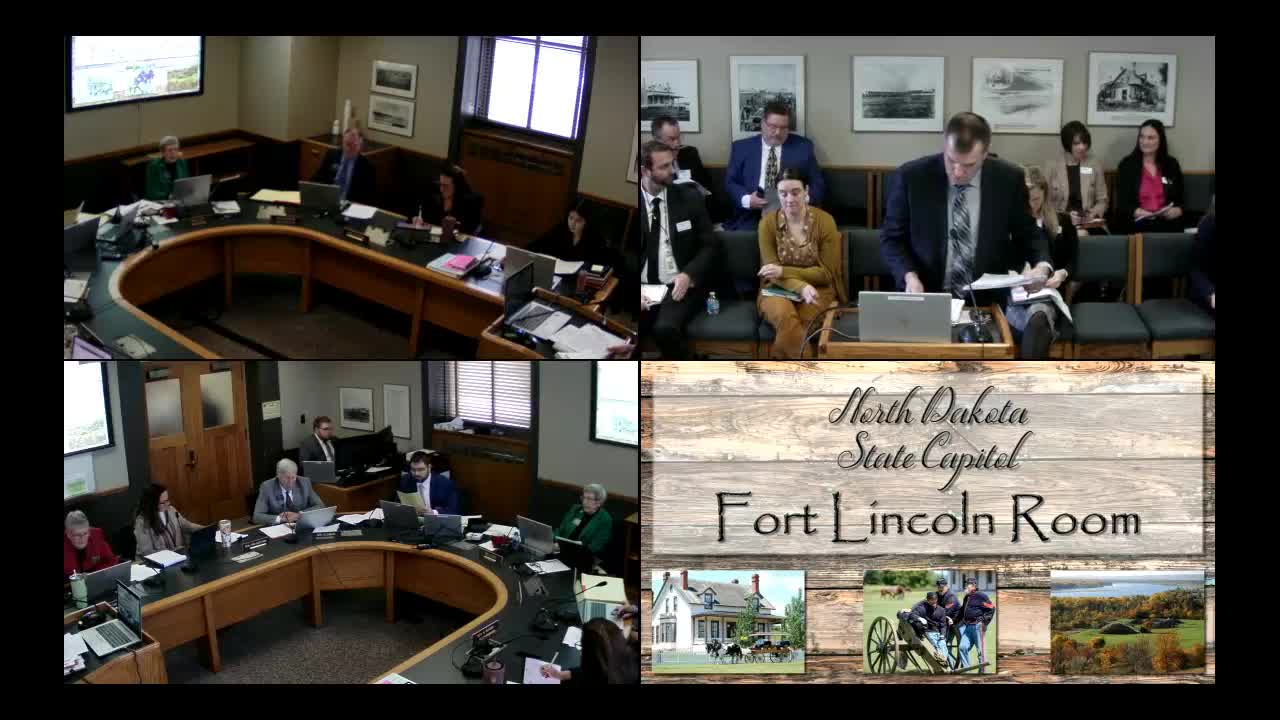
The Senate Human Services Committee held an extended hearing on Senate Bill 2113, a broad statutory package that would rename regional human service centers “state operated behavioral health clinics,” create a definition and process for certified community behavioral health clinics, and update multiple sections of Chapter 50‑6 of the North Dakota Century Code.
Jonathan Ulm, chief legal officer for the Department of Health and Human Services, explained the bill’s purpose as aligning statutory language with current structure and service delivery. Ulm told the committee the title change would reduce confusion between human service centers and human service zones, add definitions for certified community behavioral health clinic and state operated behavioral health clinic, and remove obsolete date language and provisions tied to prior restructuring.
The bill would also: update powers and duties for the renamed clinics; clarify licensing, certification, and accreditation language (including a request to fund certification efforts); remove a vendor‑specific exemption no longer needed; permit the department to pay stipends to recipients or providers serving on councils or boards; allow appeal of some court orders to the state Supreme Court; restore a rulemaking authorization for state operated behavioral health clinics; and create a statutory process for certification and special operating funds the department said it needs.
Why it matters: The changes are largely structural and technical but cover a broad swath of behavioral health policy and administration. Committee members described the bill as one of the most substantive restructuring measures in recent years and said it formalizes trends that have developed over the past decade.
Testimony and concerns: Multiple stakeholders testified in favor of the bill’s goals but urged clarifications and changes. Denise Harvey of Protection and Advocacy supported certified community behavioral health clinics but asked that courts continue to consider least‑restrictive community placements first for individuals age 25 and up. Nikki Wagner (North Dakota Long Term Care Association) and providers from gero‑psych facilities asked for a statutory exemption from a daily behavioral health bed reporting requirement in section 50641.3, arguing that gero‑psych units operate at near‑full occupancy and that daily reporting creates administrative burdens without practical benefit. Nikki Wagner and St. Luke’s administrator Amy Crite provided operational details: long average lengths of stay, infrequent openings, and barriers created when Medicaid enrollment or level‑of‑care paperwork delay transfers out of institutional settings.
Senators’ reactions and procedural posture: Senators praised the technical work but warned that dissolving the historic “one‑door” human service center model into multiple specialized entrances will require careful communication to consumers and families. Senator Hogan described the bill as a “new beginning” but noted it represented a substantive shift that merits careful review. Committee members raised questions about the cross disability advisory council, noting some federal programs require specific advisory bodies and that eliminating or consolidating councils could have downstream consequences. Several senators suggested holding the bill to coordinate it with related legislation (including changes to the cross disability advisory council and statutes governing the Life Skills and Transition Center).
Next steps: The committee closed testimony and indicated it may hold SB 2113 pending further work to reconcile related proposals and draft amendments. No committee vote on the main bill was recorded in the hearing.
Ending: The Department of Health and Human Services described SB 2113 as a technical modernization and alignment to current practice; several stakeholders supported the bill with clarifying amendments. Committee members asked the department and legislative sponsors to supply reconciled language on the cross disability council and related statutes before final action.