Get Full Government Meeting Transcripts, Videos, & Alerts Forever!
Get email alerts on the Core Technology Services topic
No spam. Unsubscribe anytime.
NDUS outlines Core Technology Services costs, ERP migration and cybersecurity challenges
Summary
NDUS presented Core Technology Services (CTS) responsibilities and a budget increase tied to software migration, licensing escalation and a planned enterprise resource planning replacement; testimony flagged security, recurring subscription costs and the need for preparatory work for cloud migrations.
Core Technology Services (CTS) staff told the Appropriations Committee that escalating software subscription costs, an impending enterprise resource‑planning (ERP) migration and ongoing cybersecurity needs drive a large portion of the system’s requested increase for information‑technology funding.
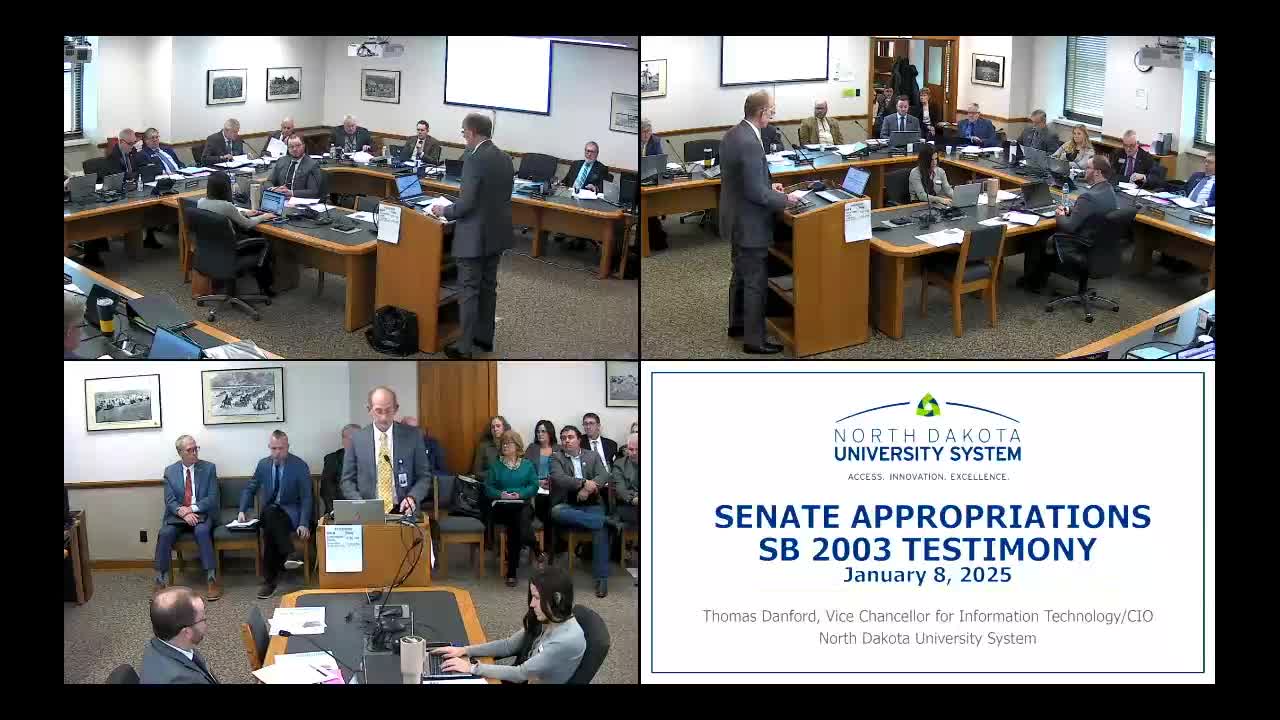
"We have 14 key on‑premise systems and another 37 cloud‑based systems that the institutions use," Thomas Danford, vice chancellor for information technology and chief information officer, told the committee while describing CTS scope. He said those systems require substantial interfacing, maintenance and security to protect student data such as information covered by FERPA.
Danford framed three core cost drivers: vendor licensing escalation tied to headcount and usage, increased security risk in a world where adversaries also use AI tools, and a market shift from one‑time software purchases to subscription‑hosted solutions. He said the system must do substantial preparatory work before moving to new cloud‑hosted ERP platforms to avoid costly surprises: "A lot of that ... is going to be used for going through and looking at all the processes and do the prep work for moving to a new ERP system," David Krebsbach told the committee about migration costs and the governor’s recommendation.
Senators referenced a governor recommendation that appeared to increase CTS funding roughly from $72 million to $86 million; committee members asked for detail on the $14 million difference and how much of it represents one‑time conversion work versus ongoing costs. Danford and Krebsbach said part of the increase reflects software‑escalation, prep work for ERP migration and an ongoing shift by vendors to hosted subscription models that include embedded AI features.
Committee members also discussed outsourcing at individual campuses: UND’s network and server outsourcing was noted; presenters said one UND position moved to the university as part of that change and that CTS is retraining remaining staff to support cloud environments and new technical roles.
Ending: CTS leaders told the committee they will provide more detailed line‑item explanations of recurring versus one‑time costs and a timeline for the ERP migration; appropriators asked for documentation separating maintenance escalations from cloud‑migration investments.