Get Full Government Meeting Transcripts, Videos, & Alerts Forever!
Get email alerts on the Ai And Data Infrastructure topic
No spam. Unsubscribe anytime.
NDUS and Dakota Digital Academy push for state AI strategy and low‑cost compute
Summary
NDUS and Dakota Digital Academy leaders urged legislators to fund a coordinated AI strategy, create a Dakota AI Collaborative and negotiate access to low‑cost data‑center compute to support workforce, research and state services.
The North Dakota University System and the Dakota Digital Academy outlined a state-focused AI strategy and urged the Appropriations Committee to consider funding to build a "Dakota AI Collaborative," increase affordable compute capacity and align workforce training with AI and digitization.
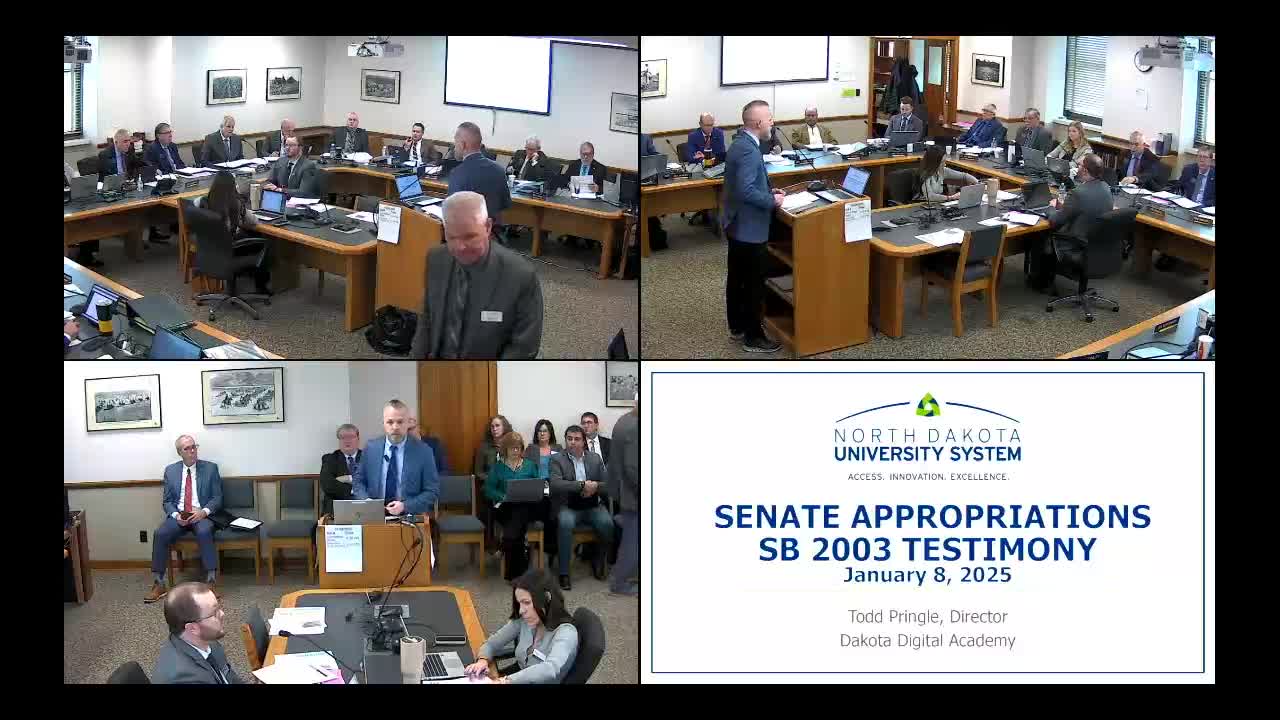
"We want to be in front of that train and not run over by that train," said Todd Pringle, director of the Dakota Digital Academy, describing why the task force that studied AI recommended a coordinated, state-level approach.
Pringle told the committee the task force identified three primary outcomes: develop critical mass of AI talent across campuses and state agencies, structure state funding so it directly benefits public needs rather than only attracting external grant dollars, and create a compute fund that would secure access to affordable, high‑performance compute for education, research and economic development. He urged legislators to consider negotiating with incoming data‑center projects to secure a dedicated, low‑cost compute allocation for state and institutional use.
Pringle described the potential uses for compute and AI in health care, manufacturing and education: "Medical technology, it's massive — already they're identifying tuberculosis at rates where they have a shortage of doctors" and digital tutors could support students who struggle in classroom settings. He also framed data centers as both an opportunity and a negotiation point: North Dakota could use its energy and geography to obtain "the lowest cost compute in the nation" if agreements reserve capacity for state benefit, Pringle said.
Committee members asked how data centers make money and what they actually do; Pringle replied that much of the buildout supports AI and cloud services and that the scale of AI compute demand is outpacing current power and infrastructure in some regions. He cautioned that no one can confidently predict every labor-market outcome from AI, saying, "Nobody knows" how jobs will change.
NDUS presenters asked for specific legislative tools in testimony: funding for AI and machine‑learning systems (the system requested a multi‑million dollar allocation for AI/ML tools and staffing), and support for a compute fund and Dakota AI Collaborative structure to pool state talent and infrastructure. The committee did not vote; legislators requested follow‑up detail on proposed governance and how state dollars would be restricted to state‑benefit projects.
Ending: Pringle and NDUS leaders offered to provide additional implementation details and to continue coordination with state economic and technology leaders as the Legislature considers funding options.