Get Full Government Meeting Transcripts, Videos, & Alerts Forever!
Get email alerts on the Judiciary topic
No spam. Unsubscribe anytime.
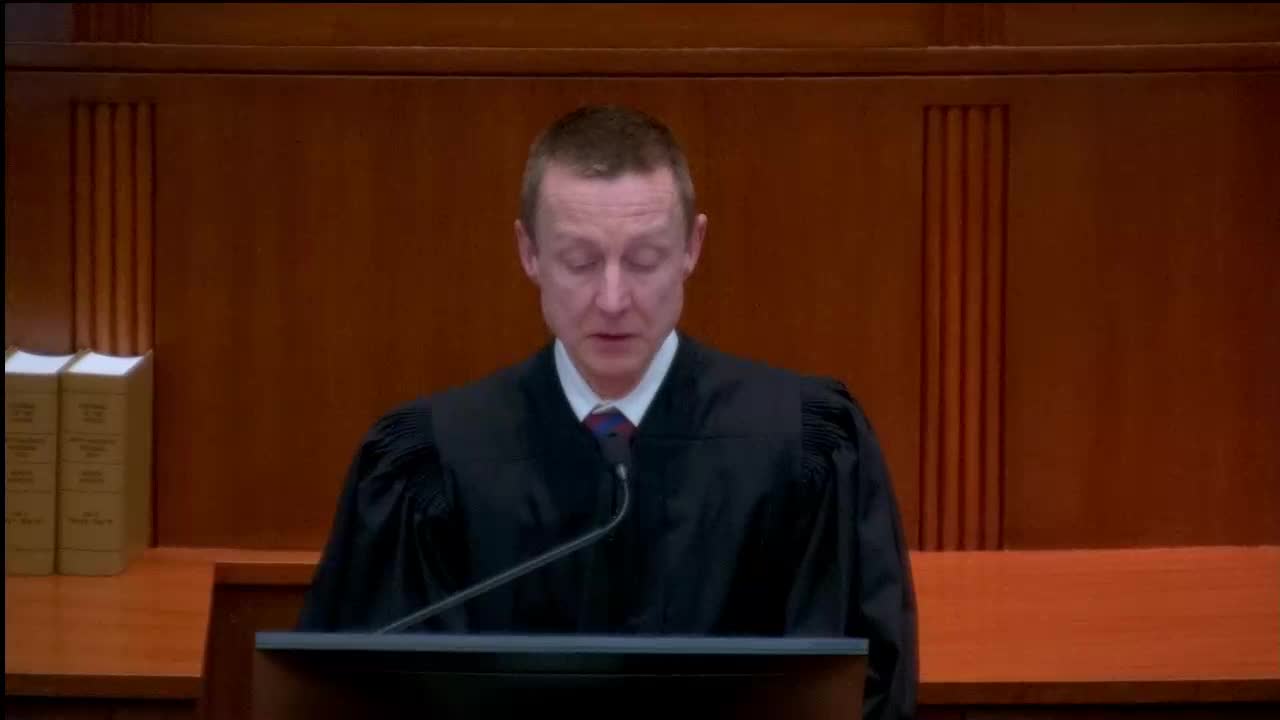
Chief Justice John J. Jensen outlines heavy caseloads, court reforms and funding needs in State of the Judiciary address
Summary
Chief Justice John J. Jensen told the 69th North Dakota Legislative Assembly that district courts handle the highest criminal caseload per judge in the U.S., outlined proposed statutory changes and requested resources including additional staff, judgeships and compensation measures.
Chief Justice John J. Jensen of the North Dakota Supreme Court told the 69th Legislative Assembly in the House chamber that the state’s courts face unusually heavy caseloads and need statutory and budgetary changes to maintain timely access to justice.
Jensen said the state’s judicial structure includes municipal courts, district courts and the state supreme court and described workload pressures on each level. “In North Dakota, we have municipal courts, district courts, and the state supreme court,” he said.
The nut graf: Jensen argued that caseload, geographic coverage and a broad scope of subject matter require legislative attention to judicial staffing, compensation and statutory updates so courts can deliver timely decisions to defendants, victims and civil litigants.
Jensen detailed workload and structure. He said there are 87 municipal courts in North Dakota; municipal courts have limited jurisdiction (including certain misdemeanors and traffic violations), no jury trials, and municipal judges serve four-year terms. He said cities with populations above 5,000 must have a licensed attorney as a municipal judge and that class B misdemeanors can carry up to 30 days in jail and fines up to $1,500. At the district level he said North Dakota has 55 district court judges elected to six-year terms serving across eight judicial districts covering 53 counties.
Jensen described the scale of filings and case processing: district courts handle about 160,000 new filings each year and roughly 20,000 additional reopened cases annually. He cited a recent three-year study showing that North Dakota judges carry the highest criminal caseload per judge in the United States while also being among the fastest to process criminal cases. “Timely completion of criminal cases brings certainty and finality, not only to defendants, but also to the victims and the families of victims,” Jensen said.
Jensen identified specific reforms and requests the judicial branch has forwarded to the legislature. He said the branch participated in a review of guardianship and conservatorship programs at the request of the 68th legislative assembly and is supporting creation of an Office of Guardianship and Conservatorship under the court to improve protection and accountability for about $17,000,000 in public funds currently spent on guardianship services. He also said the branch has proposed a rewrite of municipal court statutes to improve services and accountability.
On access to legal services, Jensen said some residents lack access because of cost or geography and outlined plans to expand self-help services by adding an attorney and creating a navigator position to review completed documents. He said the judiciary is requesting recognition of an “allied legal professional” designation to allow specially trained nonlawyers to provide limited legal assistance in certain areas.
Jensen said the judiciary is expanding problem-solving courts, naming a veterans court in Fargo and a mental-health court in Bismarck and that the branch is exploring a domestic-violence court in Bismarck. He asked the legislature to consider simplifying jury service by shortening call times and adding an online system to request postponement or excusal.
Jensen raised staff recruitment and retention as an ongoing need and asked the assembly to consider increased compensation for judicial-system employees. He also warned about threats and intimidation directed at judges and court employees, attributing part of the problem to social media and noting incidents of threats of violence. “The Internet and social media platforms provide a forum for litigants to falsely allege that things such as race, gender, ethnicity, or the perceived political affiliation of a judge was a reason for an adverse decision as opposed to the merits of the litigant’s case,” Jensen said. He urged protection of the separation of powers and respect for judicial review.
The address closed with Jensen thanking the members of the legislative assembly for their service. The House later voted to print the address in the journal and recessed until noon.
Votes at a glance: motions recorded on the House floor during the ceremony included appointments of committees to escort visiting officials, authorization to receive the chief justice, printing the address in the journal, and a motion to recess; each motion carried by voice vote.