Get Full Government Meeting Transcripts, Videos, & Alerts Forever!
Get email alerts on the Higher Education Budget topic
No spam. Unsubscribe anytime.
ND University System outlines biennium funding requests tied to SB 2003
Summary
State higher-education leaders presented the North Dakota University System’s budget priorities tied to Senate Bill 2003, citing enrollment gains, funding-formula technical changes and a package of program and capital requests; the governor’s office recommended partial funding for several items.
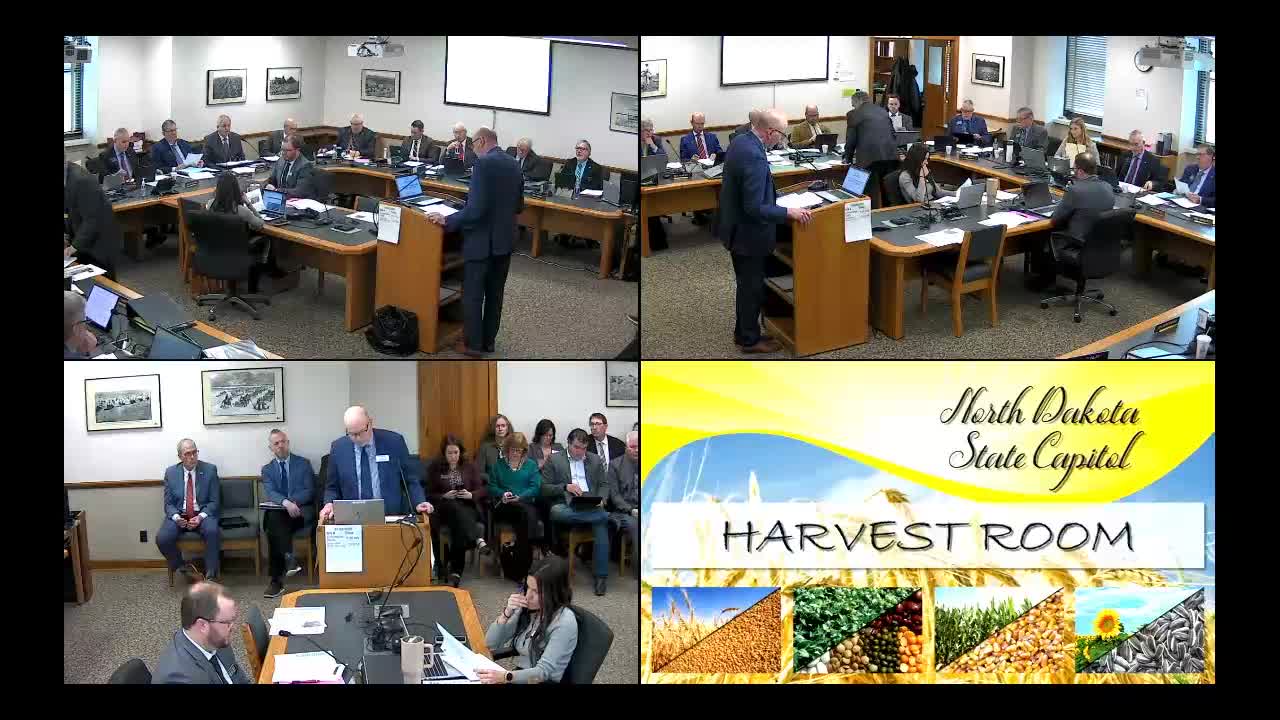
The North Dakota University System presented its budget overview and a set of requests tied to Senate Bill 2003 to the Appropriations Committee, saying the package seeks to sustain enrollment momentum and respond to workforce needs.
"I am here today to begin discussion around Senate Bill 2003," said Tim Mychajluk, chair of the State Board of Higher Education, opening the presentation.
NDUS officials told the committee that the system is recording enrollment and graduation gains that buck national trends, and they framed the budget request around Envision 2035 — summarized in committee testimony as the "RunND" theme: "Retool and Upscale Now for North Dakota." David Krebsbach, vice chancellor for administrative affairs and chief financial officer, walked the committee through formula results and line-item requests. Krebsbach said the system’s formula calculation produced a net change described in the presentation as "$588,000 reduction across the system" and that the total funding for the 2025–27 biennium was presented to the committee as "$638,600,000." The system also identified proposed changes that would affect individual campus funding calculations, including provisions in Senate Bill 2034 described in testimony as adjusting a credit-completion factor for Dickinson State University.
Krebsbach summarized the requests the board approved for the upcoming biennium and compared them with the governor’s recommendations. Among items the board requested were: continuation and expansion of student financial assistance, a nursing education consortium request, a high‑performance computing request for UND and NDSU, funding for AI and machine learning tools to support systemwide use, and capital project requests previously intended in the current biennium. The governor’s recommendation, as presented to the committee, funded some but not all of those requests — for example, the presentation stated the governor supported $4 million of the system’s high‑performance computing request and proposed a $10 million allocation for an enterprise resource‑planning initiative the system flagged as a priority.
Committee members asked for clarifications on several points: the source of dual‑credit funding (Krebsbach said the most recent dual‑credit funding used Bank of North Dakota profits), how one‑time and base funding interact in future budgets, and whether some proposed items were included in the board’s prioritized base requests or were supplemental initiatives submitted for the governor to consider. Committee members also pressed for more campus-level reporting, for example asking that campuses show how prior mental-health appropriations were spent.
The NDUS presenters emphasized workforce alignment and campus-level priorities while noting a number of technical and timing issues associated with software and capital planning. No committee vote or formal action on SB 2003 was taken during this overview session; the hearing served to present the system’s budget priorities and to take questions from appropriators.
Looking ahead, presenters told the committee that follow‑up hearings within subcommittees will examine individual items in greater detail, including capital projects and programmatic allocations.
Ending: The system’s delegation remained available for follow-up questions and data requests; committee members asked for additional campus reporting on prior appropriations and for clarifications on recurring versus one‑time funding.