Get Full Government Meeting Transcripts, Videos, & Alerts Forever!
Get email alerts on the K 12 Class Size topic
No spam. Unsubscribe anytime.
Panel hears small rise in West Virginia secondary class sizes; state to supply more detail on extremes
Summary
Deputy Superintendent Dr. Sonya White told the Legislative Oversight Commission that average class sizes in grades 7–12 for English language arts and mathematics rose by less than one student in 2023–24; staff will provide county-level outlier data and counts of classrooms limited to 12.
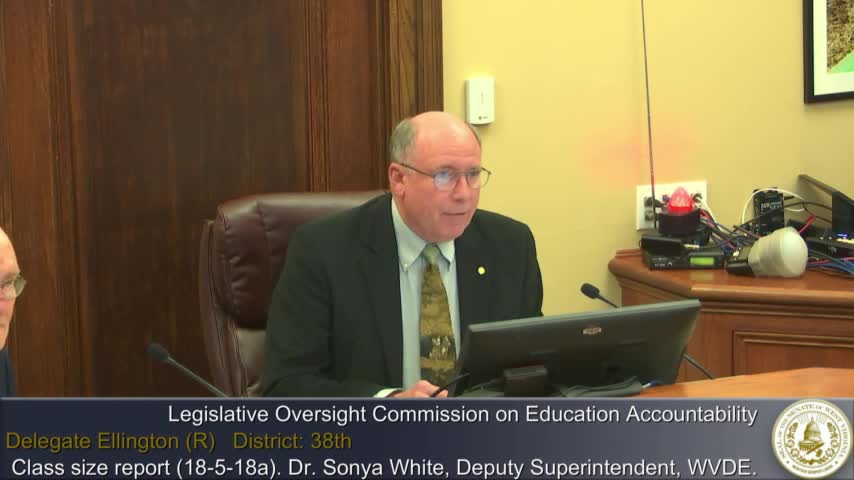
Dr. Sonya White, deputy superintendent for the West Virginia Department of Education, told the Legislative Oversight Commission on Education Accountability on Oct. 12 that average class sizes in grades 7–12 rose by less than one student in 2023–24.
White said the mathematics average was “just under 16 students per course,” and that English/reading and language-arts averages increased by less than one student from the prior year. She told commissioners some ELA sections — including dual-enrollment and AP courses — are not assigned a grade-level code and so are reported separately.
The data presented included disaggregated numbers for grades 7 and 8; grades 9–12 were grouped because many students enter high-school-level math at different points (for example, some take Algebra I in eighth grade). White cautioned the averages mask outliers: some special-education classes can have as few as one or two students while some scheduling practices create large reported rosters that are not present in the classroom simultaneously.
Committee members pressed for more detail. A senator identified as the Senator from Wetzel asked whether some math classes reach 25 or 26 students; White said she could provide the largest-class figures. Delegate Statler asked how many classrooms currently are limited to 12 students to avoid placing an aide in the room; White said the department would provide that county-level count on request.
Commissioners also asked whether class-size differences correlate with test scores. White said the department does not maintain a statewide correlation in the dataset presented but offered to work with counties to see whether that analysis can be produced.
White additionally told the panel the small rise in average size this year may reflect the end of some ESSER-funded positions, and that planned or enacted school consolidations could push some county averages up in future years.
Staff indicated they will return requested county-level details, including the largest reported class sizes and the number of classrooms reported as limited to 12 students.