Get Full Government Meeting Transcripts, Videos, & Alerts Forever!
Get email alerts on the Curriculum Adoption topic
No spam. Unsubscribe anytime.
Madison curriculum committee advances multiple course adoptions and fields parent concerns about scheduling and related arts
Summary
The Madison School district Curriculum and Student Development Committee met to review and advance adoption of multiple revised and new courses across disciplines and to discuss related curriculum work and community concerns.
The Madison School district Curriculum and Student Development Committee met to review and advance adoption of multiple revised and new courses across disciplines and to discuss related curriculum work and community concerns.
The committee considered a slate of items including a new Sports Performance and Nutrition career-and-technical elective, a renamed Acting Workshop to replace a prior dramatic workshop, a swap of the grade-9 core novel from To Kill a Mockingbird to Just Mercy, expansions to the middle-school math enrichment program, several performing-arts course adoptions and revisions (chorus, acting, musical theater, music theory), world-language updates (Latin II and American Sign Language II), and revisions tied to the Connecticut 2023 social-studies standards.
Why it matters: The committee’s work governs what students can take next school year and how some units will be taught; during public comment parents pressed the district about proposed schedule changes that could reduce time for related-arts classes and asked whether the board or administration holds final authority over instructional scheduling.
Michelle Horn, curriculum generalist and former literacy coach for the district, presented the courses on behalf of departments and teachers. She described Sports Performance and Nutrition, developed with Dan Grenier and Eric Becker, as "one of the courses that we'll be going through tonight," and said it is planned as a career-and-technical elective offered for one trimester that links practical nutrition and food-preparation skills to athletic performance and recovery. The committee heard that the course has gone through the district’s curriculum review process and is targeted for offering next fall.
On drama and theater, presenters asked the board to adopt a course under the title Acting Workshop to reflect a broader stage experience than the prior Dramatic Workshop. The course’s major changes include relocating instruction from an English classroom into a dining/assembly hall to provide a more authentic stage environment, updating unit content to emphasize stage direction and production, and adding a summative assessment in the form of a formal stage production.
In English, presenters said grade-9 teachers replaced Harper Lee’s To Kill a Mockingbird in the core curriculum with Bryan Stevenson’s Just Mercy to give students a more contemporary text that educators said can help students connect themes to current events; To Kill a Mockingbird will remain available as a book-club option. The committee clarified that book-club selections are vetted and made available to families.
The committee devoted substantial time to the district’s math enrichment program for grades 4–6. Amy (enrichment teacher) described how enrichment groups are identified unit-by-unit through pretesting, meet every other day for approximately 40 minutes during a roughly 70-minute math class, and use fluid grouping. Amy gave participation figures: "57 different students have been part of enrichment groups in 4th grade" so far this year and "41 different 5th graders have been in enrichment," with 75 4th-grade students participating during last year. Presenters emphasized that enrichment is intended as extension (not repetition) and that it gives classroom teachers opportunities for targeted reteaching when higher-performing students leave class for enrichment.
Performing-arts staff described a set of middle- and high-school course adoptions. Leah Stilman and other music teachers presented a 7th–8th chorus course (performance ensemble spanning two years with two public performances per year), acting and musical-theater courses that culminate in spring performances and student-created 10-minute plays, and a high-school foundational music-theory course positioned as the usual prerequisite for the district’s new AP Music Theory offering. The high-school music theory course covers reading notation on the grand staff, key signatures, scales, chords, melodic/harmonic construction, listening and written components, and associated music-technology tools.
World-language updates included adjustments to Latin II (adding chapters 10–14 for cultural readings and practice; prior Cambridge Latin material was removed for cultural-insensitivity concerns) and an ASL II sequence built from Signing Naturally (lessons 6–10) with interpretive and expressive assessments and a deaf-culture component using age-appropriate texts such as El Deafo.
The committee also discussed a high-school independent-project offering in grades 11–12 that gives students an extended, interdisciplinary capstone; presenters showed examples including student-created musical compositions, fabricated projects from the fabrication lab, published writing, and a student-hosted TEDx event.
On elementary work, Michelle and colleagues proposed a pilot to formally introduce the district’s Profile of a Graduate capacities to students in grades 4–5 using responsive-classroom structures and a short, classroom-ready mini-unit beginning next fall; the intent is to make civic and learning-capacity language explicit to students in that grade band.
Presenters reviewed work on the district’s response to Connecticut’s 2023 Elementary and Secondary Social Studies Standards; third grade revisions focus on Connecticut history and on how Native American tribes preserve cultural identity over time, while later-grade work will align geography (grade 4) and Revolution-era U.S. history (grade 5) with the new standards.
Public comment: A member of the community, identified as Alexia of 455 Broadway Drive, asked how the curriculum committee had been informed about recent proposals to restructure grades and reduce related-arts time. Alexia said parents are "very concerned" and told the committee it "does look like we do put a lot of rigor around the curriculum that we put forward, but it seems like a little bit of a cop out to say that scheduling is the jurisdiction of the school's leadership and not of the board of ed when it directly impacts the education."
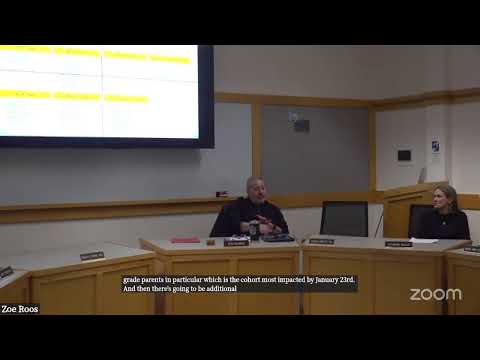
Gail Dowlinghench, assistant superintendent, told the committee and public that the board and curriculum committee have been "updated over time" about plans connected to a possible shift to a pre-K–5 model and that instructional scheduling decisions rest with district administration and teachers rather than as a prescriptive curricular change imposed by the board; she said the topic impacts curriculum indirectly. Committee members and staff acknowledged parents’ concerns and noted upcoming parent information sessions (presenters said a January 23rd meeting was scheduled for affected grade-4 families) and additional opportunities for community feedback.
What the committee decided: The meeting was primarily a presentation and review of curriculum materials; the transcript shows courses presented and vetted through the district CRC (Curriculum Review Committee) and recommended for adoption, but it does not record formal roll-call votes or motions taken on the docketed items during the portion of the transcript provided.
Context and next steps: Presenters said many of the courses have completed the local curriculum-review cycle and are ready for board adoption; some items will continue to be refined (presenters said performing-arts and world-language teams plan additional updates). The administration and teachers will continue outreach with families about any schedule or model changes and will present finalized scheduling proposals and implementation details in subsequent meetings.
Ending: Committee members thanked staff and teachers for the work; the meeting adjourned after public comment. No formal adoption roll calls are recorded in the provided transcript segment.