Get Full Government Meeting Transcripts, Videos, & Alerts Forever!
Get email alerts on the Fire Code Amendments topic
No spam. Unsubscribe anytime.
Council adopts local amendments to International Fire Code; ordinance passes unanimously
Summary
The City Council passed Ordinance 4889 amending local adoption of the International Fire Code (2021 cycle) including updated emergency responder communications, energy storage provisions, and new local enforcement tools; roll‑call was 6–0 in favor.
The Kirkland City Council adopted local amendments to the International Fire Code (2021 edition) on a unanimous 6–0 roll‑call vote, approving Ordinance 4889.
What the ordinance does
Assistant Fire Marshal Jason Chappell told the council the ordinance updates the city’s fire code to align with the model code changes and to add a set of local amendments. Major elements described by staff include:
- New model sections such as emergency responder communications (distributed antenna systems) and a consolidated section for energy storage systems (battery energy storage), which were introduced in the 2018–2021 code cycles.
- A local operational permit for “positive alarm sequence” (PAS) responses, which allows a human verification step in some alarm events before fire apparatus are automatically dispatched.
- A civil enforcement mechanism for code violations (civil infractions) to supplement the city’s existing misdemeanor enforcement approach; staff said the addition is meant to provide a graduated enforcement tool for prolonged or recurring deficiencies.
- An operational permit and maintenance approach for gates that block fire access on private properties; staff explained examples such as gated access at the city maintenance yard and residential gates where the fire department’s response requires controlled access.
Council discussion and vote
Councilors asked clarifying questions about how gated access is handled and whether the permit would add cost or delay response times. Chappell said the operational permit is intended to document and verify that gate mechanisms—click‑to‑enter systems, Knox boxes or key‑card access—remain operable and that the effect on response time should be minimal when gates are permitted and maintained. He noted staff is exploring options to keep costs low for single‑family applicants and the proposed annual maintenance permit would be modest.
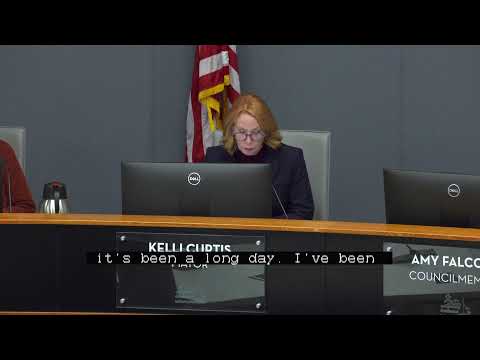
Deputy Mayor Nora Arnold moved the ordinance; Councilor Amy Falcone seconded. The city clerk called a roll and the ordinance passed 6–0 (Council members Tim Chisen, Black, Sweet, Falcone, Deputy Mayor Arnold and Mayor Kelly Curtis voted in favor). The ordinance was recorded by the clerk as adopted "as amended." The ordinance will take effect under standard municipal timelines unless otherwise noted in the adopted text.
Why it matters
The amendments align local requirements with recent national code changes (notably emergency communications and energy storage), strengthen the city’s enforcement toolbox for long‑running fire‑safety deficiencies, and formalize expectations for property owners who install gates across fire access routes.
Ending note
No public vote was required beyond the council ordinance adoption. Staff said they will finalize administrative guidance for property owners on gates and the positive alarm sequence permit to reduce implementation friction.