Get Full Government Meeting Transcripts, Videos, & Alerts Forever!
Get email alerts on the Water Fluoridation topic
No spam. Unsubscribe anytime.
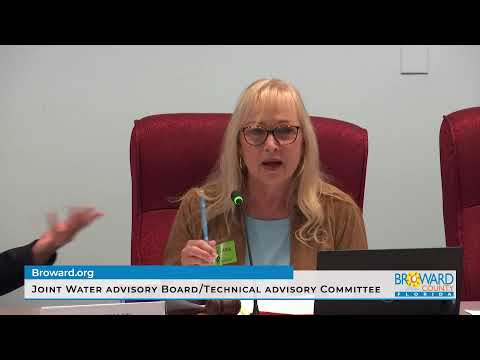
Broward advisory body hears pro-fluoride testimony, board approves resolution endorsing community water fluoridation
Summary
After presentations from a pediatric dentist and a pediatrician, the joint Water Advisory Board and Technical Advisory Committee voted to send a resolution reaffirming support for community water fluoridation; Commissioner Kevin Biederman registered the sole recorded no vote.
The joint meeting of Broward County’s Water Advisory Board and Technical Advisory Committee on fluoridation produced technical presentations from two clinicians, a discussion of recent research, and a county-level resolution reaffirming support for community water fluoridation.
Pediatric dentist Dr. Johnny Johnson and pediatrician Dr. Rana (preferred name) presented scientific, clinical and public-health material about community water fluoridation, its history, its benefits in reducing cavities across the population, and its safety at the levels recommended for U.S. water systems. Both speakers cited long-standing public-health endorsement by organizations including the Centers for Disease Control and Prevention and the American Dental Association. Alan Garcia, director of Broward County Water and Wastewater Services, summarized local operations and monitoring procedures the utility uses to maintain an optimal fluoride concentration.
The presentations focused on three core points: (1) community water fluoridation reduces dental decay across populations and reduces hospitalizations and general-anesthesia procedures for severe childhood tooth decay; (2) the United States recommends a target concentration of 0.7 milligrams per liter (mg/L) for community water fluoridation (earlier guidance used a different range and some speakers discussed historical values such as 1.2 mg/L); and (3) regulatory limits and monitoring remain important — the Environmental Protection Agency’s maximum contaminant level for fluoride is 4.0 mg/L and utilities test background fluoride and adjust dosing so total fluoride in distributed water meets the public-health target.
Speakers addressed a January systematic review and related news coverage that examined associations between fluoride exposure and child IQ. Dr. Rana and Dr. Johnson said the studies that reported associations used higher fluoride concentrations than those typical in U.S. community fluoridation programs or were based on data sources and designs that limit causal conclusions for U.S. practices. Dr. Rana emphasized the distinction between studies of high natural fluoride concentrations overseas and the regulated, low concentrations used in U.S. systems; Dr. Johnson described methodological limitations in some of the studies cited in public debate and reiterated that longstanding reviews by major U.S. and international public-health bodies find no credible evidence of cognitive harm at the U.S. recommended concentration.
Board members asked about dosage and monitoring. Garcia said Broward’s treatment plants treat raw Biscayne aquifer water with a background fluoride of about 0.15 mg/L and typically add about 0.55 mg/L to reach the 0.7 mg/L target; he described continuous monitoring at treatment facilities. Members also raised questions about bottled water and household filtration (reverse osmosis removes fluoride; carbon filters do not). Presenters and staff noted that some bottled waters contain fluoride naturally or list added fluoride on labels.
After the presentations and discussion, the board considered a resolution reaffirming the county’s support for community water fluoridation and directing the county administrator to transmit certified copies to municipalities and water providers. Council Member Susan Starkey moved the resolution; Commissioner Casciano seconded. The motion passed with one recorded opposition: Commissioner Kevin Biederman voted no; the chair recorded “everyone else in favor.” The resolution as adopted includes language affirming county support for fluoridation as a preventive public-health measure, cites CDC and ADA positions, references the EPA maximum contaminant level of 4.0 mg/L, and states the county will remain compliant with applicable federal and state regulatory guidance.
The board noted requests from some members to distribute the final resolution to municipal water utilities and suggested the county post the presentations and a plain-language information page on its website to improve public outreach and counter misinformation. Members also asked staff to continue coordination with municipal utilities on background fluoride testing and to monitor any upcoming federal or legal developments that could affect national guidance or regulatory standards.
The resolution is advisory in character; staff and members emphasized the measure does not compel municipalities to act but expresses the county board’s position and requests transmission of the resolution to local water providers.
Ending — The board closed the fluoridation item to take an 11:00 time‑certain and to continue other scheduled business; presenters and staff said they will return with materials and public education plans at a future meeting.