Get Full Government Meeting Transcripts, Videos, & Alerts Forever!
Get email alerts on the Public Records Recorder topic
No spam. Unsubscribe anytime.
Jefferson County adopts ordinances to regulate bulk recorder copies, approves watermarking and related contract option
Summary
The Jefferson County commissioners voted to allow the recorder to sell bulk copies electronically, set a bulk rate up to the state maximum, require watermarking for bulk images and proceed with a third‑party platform option presented by DocSoft.
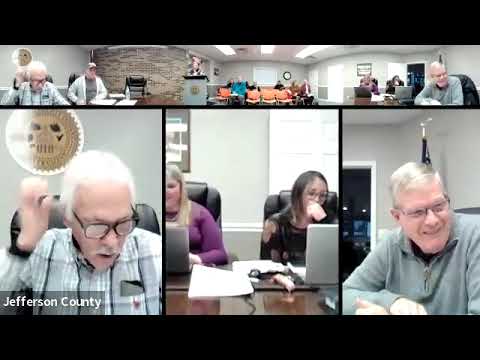
Jefferson County commissioners on Jan. 9 adopted two ordinances that set procedures and fees for bulk access to recorded documents and require watermarks on bulk images, and discussed a third‑party platform that the recorder’s office says will host searchable images and a property‑watch service.
The ordinances implement Indiana Code 36-2-7-10 (and related subsections) to allow the county recorder to provide ‘‘bulk form copies’’ electronically and to charge up to 20¢ per page for bulk deliveries. Commissioners voted by voice to adopt Ordinance 2025-1 (bulk form copies) and Ordinance 2025-2 (watermarking); both motions passed on unanimous voice votes.
Why it matters: the ordinances change how large purchasers — typically national data firms — obtain county recording data and create a mechanism the recorder can use to recover production costs and apply watermark protections. County staff and the presenter said the change should not affect routine local users of recorder services.
DocSoft presentation and services
A representative from DocSoft, who identified herself as Julie, briefed the board on three related agreements the recorder could sign with the vendor: (1) a service to host and make searchable non‑confidential recorder images; (2) a ‘‘property watch’’ addendum that will notify registrants when filings match a name or legal description; and (3) a bulk‑access arrangement for large purchasers.
Julie said the vendor provides the hosting service to other counties and that ‘‘it will not cost the county or her office any additional money. We provide the service for free, and then we offer a range of subscriptions that maintain the service.’’ She described a billing model for large institutional buyers and identified the typical bulk customers as Zillow, Black Knight, First American and CoreLogic. "These are ... outside of the state, and they don't come here and spend our money," she said, describing one rationale for setting a higher bulk rate for large purchasers.
Cost study, fees and watermarking
County staff and the presenter referenced a cost study prepared by DocSoft (dated Dec. 17, 2024) showing the recorder’s per‑page production costs and supporting a bulk fee of up to 20¢ per page; state statute currently limits bulk rates to 10¢ absent an adopted ordinance. The adopted fee schedule sets bulk copy fees at 20¢ per page and provides that revenues be deposited in the recorder’s perpetuation fund for recordkeeping purposes.
The watermarking ordinance requires that bulk form copies include a watermark indicating the copies are for the recorder’s use and are not to be resold, except as allowed by state law.
Votes at a glance
- Ordinance 2025‑1 (bulk form copies): Motion to adopt the ordinance authorizing the manner, form and fees for bulk form copies; motion passed by voice vote (ayes recorded; unanimous). (Ordinance number: 2025‑1.) - Ordinance 2025‑2 (watermarking): Motion to adopt the ordinance requiring watermarking on bulk form copies; motion passed by voice vote (ayes recorded; unanimous). (Ordinance number: 2025‑2.) - Related administrative action: commissioners authorized the recorder to proceed with agreements as discussed and directed staff to obtain signed documents; motions to accept the ordinances were seconded and passed by voice vote.
What commissioners said and next steps
County officials said the ordinances include contract and termination protections for bulk users and limits on resale consistent with state code. A county staff member noted the contract language requires bulk users to agree not to transfer bulk copies to third parties and allows the recorder to terminate contracts for noncompliance.
The ordinances take effect upon adoption and signature; staff said the recorder will collaborate with DocSoft and the county attorney to finalize contracts and implement the property‑watch and bulk delivery processes.
Ending
Commissioners and staff framed the changes as technical updates to comply with state law and recover production costs for large institutional buyers while preserving local public access options. The cost study cited in the meeting is dated Dec. 17, 2024.