
Nottoway supervisors debate smaller setbacks, buffers and a cap as they prepare public hearing on solar ordinance
Get AI-powered insights, summaries, and transcripts
Subscribe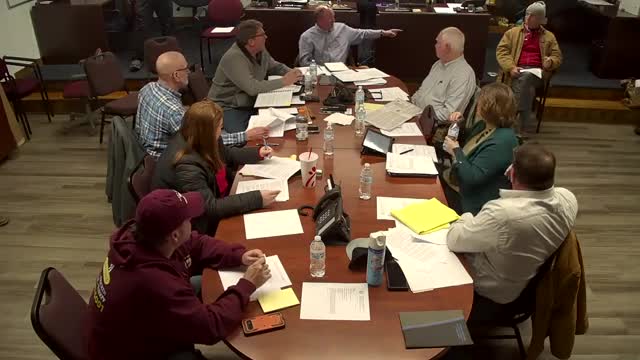
Summary
Supervisors at a Nottoway County work session discussed lowering solar-site setbacks, clarifying vegetative buffers, adding decommissioning and bonding requirements, and considering a countywide cap; staff was directed to prepare draft amendments and advertise a public hearing in February or March.
Nottoway County supervisors spent a multi-hour work session reviewing a proposed solar ordinance and directed staff to prepare advertised amendments and a public hearing after discussion about setbacks, buffers, decommissioning and a possible cap on county land used for utility-scale solar.
The discussion focused first on setbacks: an earlier planning-commission draft had included 800-foot setbacks in several locations and a compromise version reduced some distances to 500 feet. Supervisors and invited speakers said 800 feet was widely seen as excessive and suggested moving many setbacks to roughly 300 feet for roads and adjacent property lines while preserving a larger distance from habitable dwellings. The board debated lowering the current 1,500-foot distance from a habitable dwelling; one supervisor proposed 1,200 feet as an alternate that could be advertised for public comment.
The work session included multiple technical and policy points raised by invited industry speakers and counsel. Greg Kelly, introduced himself as a solar developer, and urged supervisors to weigh the county's interconnection capacity when assessing how much solar could realistically be built: "A lot of your fears would naturally go away by virtue of the interconnection capacity in the county already," he said, arguing that technical limits on transmission and substation capacity restrict how many projects can be connected.
County counsel and other participants flagged language about vegetative buffers in the current draft ordinance. One local attorney, Robert Hawthorne, noted the draft requires landscaping in the buffer: "We're telling people they have to landscape that buffer," and cautioned that the ordinance should define standards rather than simply require an undefined "landscape" strip — for example, what mix of native/evergreen plantings, spacing and who must maintain them.
Supervisors repeatedly emphasized property-rights concerns and potential local impacts. Several board members said they supported options for flexibility when adjacent landowners consent: the draft includes a waiver mechanism allowing an applicant to seek reduced setbacks when neighboring owners agree in writing. Supervisor Ingram, summarizing caution about rushing to a final decision, said, "I don't think we need to rush into that tonight," and recommended additional work before any formal adoption.
Revenue and decommissioning drew sustained attention. Supervisors and speakers cited uncertain revenue from small sites and noted that utility-scale solar is unlikely to generate immediate funds large enough to cover the county's projected courthouse debt. Board members pressed developers on decommissioning practice and bond sizing; industry representatives said state rules and contract terms typically require financial assurances, but supervisors asked for clearer local standards and bond calculations to be included in the ordinance.
The board also discussed a numerical cap on total acreage that could be used for solar in the county. Planning staff noted that existing transmission corridors make only a portion of the county technically practical for large-scale projects; several supervisors proposed advertising a cap expressed as a small percentage of eligible acreage (members discussed figures in the roughly 3–4% range as an example to include in the public notice).
On process, the board asked staff to draft ordinance language that: (1) reduces many setback distances toward 300 feet while retaining a larger dwelling setback (advertised at 1,200 feet for public comment), (2) clarifies buffer vegetation standards (including options for narrow, dense evergreen screening next to fences and a site-plan requirement for final landscaping), (3) incorporates decommissioning and bonding expectations, and (4) includes an optional county cap (example: 3–4% of eligible acreage) as part of the public notice. Supervisors directed staff to advertise a public hearing on the proposed amendments in mid-February (February 13 was discussed) and also discussed scheduling a March public hearing if additional time were needed to refine language.
The board heard from several industry and community representatives during the session, including developers and landowners, and invited Dominion representatives to a later meeting so the company could respond to technical questions about interconnection, life expectancy of sites and community agreements. The board agreed to continue work with the planning commission and to solicit sample ordinances and buffer standards from other counties before finalizing language for adoption.
Votes at a glance
- Motion to enter closed session under Code of Virginia —YI 2.2-3711(A)(3) to discuss acquisition/ disposition strategy for property near Fort Barfoot: motion made and seconded; the board voted "aye" and moved to closed session (no detailed roll-call in the transcript).