Get Full Government Meeting Transcripts, Videos, & Alerts Forever!
Get email alerts on the Lrfd Modernization topic
No spam. Unsubscribe anytime.
CPUC workshop reviews plan to modernize GO 95 with LRFD; scope, timing and workshop format debated
Summary
At a California Public Utilities Commission–hosted IOU workshop, industry and CPUC staff discussed a petition to use load and resistance factor design (LRFD) to modernize General Order No. 95 (GO 95).
At a California Public Utilities Commission–hosted IOU workshop, industry representatives and commission staff discussed a petition to incorporate load and resistance factor design (LRFD) into General Order No. 95 (GO 95), the CPUC regulation that governs the design and construction of overhead electric and communications facilities in California.
The workshop centered on whether to adopt LRFD as a modern framework for GO 95 and on procedural questions for detailed technical workshops: how many sessions will be needed, whether they will be hybrid or in‑person, how votes should be handled and how much time parties need to review the IOU‑led workshop report. Parties also debated whether related questions — including retroactivity (Rule 12) and Appendix F example calculations — should be resolved in this proceeding or deferred to narrower technical working groups.
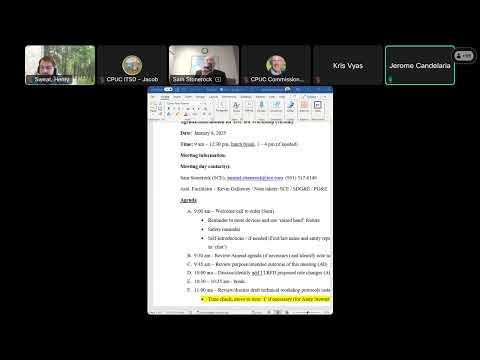
Sam Stonerock, head of the GO 95 rules committee and an engineer with Southern California Edison, framed the petition as an update to the rulebook’s engineering method. Stonerock said the rules committee proposed LRFD to align California practice with the methodology taught in U.S. engineering programs and used elsewhere in the industry. He recommended a series of technical workshops and described a set of time‑tested workshop protocols intended to let technical experts develop draft language while permitting attorneys and managers to review proposed changes before formal votes. "I prefer in person meetings," Stonerock said, but he added that IOUs planned to provide a hybrid (in‑person plus virtual) option so experts who cannot travel could still participate.
Commissioner Baker, who opened remarks for the commission, said the CPUC’s objective was to determine "whether changes are necessary to modernize the rules and regulations governing the design and construction of overhead electric and communications facilities in California." He emphasized maintaining a high level of safety while the commission evaluates any rule changes.
Consulting engineer Andy Stewart, whose slide deck the rules committee provided at staff’s request, summarized how LRFD differs from the GO 95 allowable/working‑stress approach currently embedded in section 4 of the order. Stewart said LRFD separates loading and material capacity into multiplicative factors: "In LRFD ... load factors are always greater than or equal to 1. On the other side of the equation ... strength factors are less than or equal to 1." He said the committee calibrated the committee’s proposed load and strength factors so that the LRFD ratio (load factor ÷ strength factor) produced the same numerical minimum safety factors in Table 4 of GO 95. As an example cited in the presentation, the committee proposed a 1.5 load factor for Grade A construction and a corresponding strength factor for wood poles that yields an effective safety factor of 4 — the same figure used in the current GO 95 table.
Not all participants supported showing example calculations in the public workshop. Fadi, representing the Safety and Enforcement Division (SED), objected to the inclusion of an Appendix F comparison calculation in the workshop materials and asked that comparative numerical examples be handled in the technical workshops. "SED oppose this, and we don't support this calculation because we think this calculation should be left to all the technical workshop," Fadi said, adding that a single favorable example can be misleading unless parties also show scenarios where LRFD produces lower margins.
Cal Broadband’s Jerome Candelaria urged the commission to consider retroactivity — Rule 12 — as part of the proceeding because retrospective application "kind of really shapes just what all of these changes will mean for those who attach and those who build poles." Stonerock said the rules committee had not taken a formal position on scoping; parties should raise scope items in comments to the workshop report and staff’s subsequent scoping memorandum.
Several procedural items drew extended discussion: how many workshops will be necessary, how voting operates in the protocols the IOUs proposed, and the time for preparing the IOU‑led workshop report. Stonerock and other IOU representatives suggested a multi‑session calendar (four to six multi‑day technical workshops with legal/regulatory touch points) and described a two‑stage voting approach used in prior proceedings: a preliminary vote in the workshops followed by a final vote after parties have had time to consult management and counsel. Justin Wen of the California Municipal Utilities Association and others noted that voting should follow the historical practice of "one party, one vote," with associations that represent multiple municipal utilities raising questions about how member participation would be counted.
Parties disputed the schedule for the IOU‑led workshop report. The CPUC decision that opened the proceeding requires an IOU‑led workshop report; several parties noted that the decision set a very short 10‑day deadline for filing that report. Jerome Candelaria and others said the complexity of the topics and the number of parties will require more review time; several industry representatives recommended 30–45 days after the final technical workshop to circulate and finalize a draft for submission.
No formal motions or votes were taken at the workshop. Participants were invited to submit opening and reply comments to the workshop report; the commission’s assigned administrative law judge or the CPUC may use those comments to craft a scoping memo or to call a prehearing conference to refine next steps. Stonerock said parties should expect technical workshops to start with technical level‑setting (including LRFD principles) and then move into detailed edits of affected rules (the committee identified rule 44 and section 4 as initial priorities), with legal/regulatory review scheduled at regular intervals.
Next steps: parties will file comments on this IOU‑led workshop report and propose calendars and protocols for the technical workshops. The commission will use the workshop record and comments to determine scoping, schedule and whether to proceed with the LRFD integration into GO 95.