Get Full Government Meeting Transcripts, Videos, & Alerts Forever!
Get email alerts on the Geropsychiatric Admissions topic
No spam. Unsubscribe anytime.
Senate Human Services committee approves amendment and advances bill easing state-hospital evaluation requirement for geropsychiatric admissions
Summary
The Senate Human Services Committee voted unanimously to approve an amendment and gave a do-pass recommendation for Senate Bill 2081, which removes a statutory requirement that the North Dakota State Hospital evaluate every patient before admission to geriatric psychiatric units and clarifies admission priority and oversight.
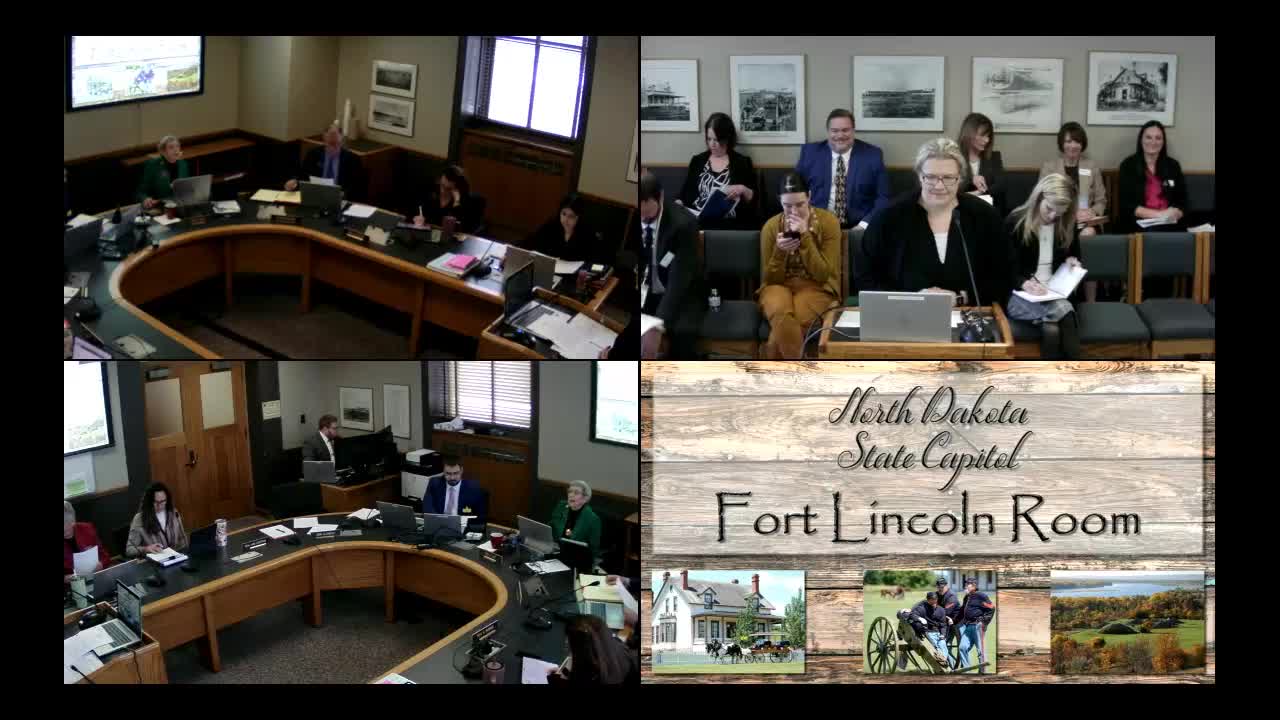
Senate Human Services Committee Chair Judy Lee and a unanimous panel on Thursday advanced Senate Bill 2081 after the Department of Health and Human Services and long-term care providers said the measure would modernize how geriatric psychiatric ("gero psych") facilities accept patients.
"My name is Pam Segnus. I'm the executive director of behavioral health with Health and Human Services. And I'm here today to introduce Senate Bill 2081, which is introduced at the request of the department," Pam Segnus told the committee as she opened testimony for the bill.
The bill removes language that requires the North Dakota State Hospital to perform evaluations of people before they may be admitted to privately run gero psychiatric units, allowing facilities to accept transfers directly when a clinical evaluation already exists. The department also proposed an amendment, agreed with the Long Term Care Association, to clarify that state-hospital referrals will receive first priority while confirming that the department generally does not control individual facility admissions.
Supporters, including providers that operate the state's three gero psychiatric skilled nursing units, told the committee the change aligns state law with current practice and would avoid duplicative assessments that delay transfers.
Nikki Wagner, president of the North Dakota Long Term Care Association, said the amendment "clarifies that individuals do not need to be admitted to the state hospital before being considered for a gero psychiatric facility while maintaining the practice of prioritizing the state hospital referrals when openings are available." Wagner added that gero psych units serve residents who need both skilled nursing and psychiatric services and that the update would "better serving those most in need while fulfilling their specialized role."
Operators described the facilities as long-stay settings for people with serious, persistent psychiatric conditions. Amy Crite, administrator at St. Luke's Home in Dickinson, said their gero psych unit has 20 beds within an 88-bed nursing facility and that residents must have a primary psychiatric diagnosis. She said many residents also have histories of substance use and come most frequently from the state hospital or the VA.
Wagner cited data to describe typical operational realities: gero psych facilities in North Dakota have very high occupancy and long average stays. She told the committee that occupancy averaged about 98.3% in 2023 and 98% in 2024 and that the average length of stay is roughly 251 days; openings are rare and often filled by predetermined placement pathways. Wagner said these realities informed a separate operational request (discussed later during the day's hearings) about bed-management reporting frequency for gero psych units.
Committee action and votes
Senator Rorick moved the department's proposed amendment; Senator Hogan seconded. The amendment passed on a unanimous roll call of members present (Senators Judy Lee, Vice Chair Weston, Rohrs, Hogan, Van Osteen and Clemens voting aye). After the amendment passed, a motion to pass SB 2081 as amended was made and seconded; the amended bill passed on a unanimous roll call of the members present.
Discussion and context
Committee members asked several practical questions about how gero psych units operate and how the proposed statutory changes would affect access and oversight. Senators sought assurances that less-restrictive options and home- and community-based services would continue to be considered as part of admissions screening. Testimony from Protection and Advocacy emphasized preserving consideration of community-based services where appropriate, especially for people under age 25 transitioning from other settings.
The department and providers told the committee the change is intended to reduce unnecessary duplication (state-hospital evaluations) and to allow timely transfers when patients already have current clinical assessments from other providers.
What the bill does not do
The amendment and committee discussion did not change the stated priority for state-hospital referrals; the department's amendment makes that priority explicit and clarifies the department does not generally manage day-to-day admissions at private facilities. No statutory expansion of involuntary admission authority or expansion of inpatient capacity was adopted in committee testimony; the bill focuses on admission process language and administrative alignment to current practice.
Next steps
The bill passed the committee as amended and will move forward in the legislative process with the committee's do-pass recommendation.
Ending note
Committee members and testifying providers emphasized the specialized role of gero psychiatric units as a bridge for people with combined skilled nursing and psychiatric needs, and they asked the department to continue tracking outcomes and referral pathways as the statutory language is implemented.