Get Full Government Meeting Transcripts, Videos, & Alerts Forever!
Get email alerts on the School Transportation topic
No spam. Unsubscribe anytime.
Durham schools pause express-stop rollout, keep family-responsibility walk zones after community survey
Summary
Durham Public Schools administrators told the board they will not implement express stops this school year and will continue family responsibility walk zones while working to end rotational bus coverage in mid-January.
Durham Public Schools Board of Education work session, Jan. 9, 2025
Durham Public Schools administrators told the school board on Thursday they will not implement express stops for magnet-school transportation this school year and will continue with family responsibility zones (FRZs) while pressing to end rotational bus coverage in mid-January.
The decision followed a survey of families affected by proposed FRZs and express stops and a staff presentation that flagged safety, equity and logistical concerns voiced by parents, students and bus drivers. Transportation staff said express stops remain a possible tool for the 2025–26 school year but should not be rolled out this year.
Why it matters: The change would alter how many students are expected to walk to school or to centralized stops rather than use neighborhood bus stops. Parents, students and some board members said the proposal raised safety and equity concerns for families without cars, for working parents and for neighborhoods lacking sidewalks. District officials said the changes are intended to end the unpredictable rotational bus coverage that has left routes canceled or repeatedly delayed.
What staff presented Transportation staff said the district surveyed more than 500 households identified as affected by proposed FRZs and express stops; 86% of respondents were parents or guardians and 15% identified Spanish as their primary language. The written responses, staff said, repeatedly cited safety risks walking to stops, greater traffic congestion, lack of supervision at centralized stops, and disproportionate hardship for low-income and single-parent families.
The district reported it had reduced the walking radius for no-transportation zones from 1.5 miles (the statutory baseline referenced in policy) to 1.0 mile when designing FRZs and said the average assigned distance for impacted students is about 0.7 miles. Staff noted, however, that a student’s route-to-school distance may be longer than a straight-line radius because of subdivision layouts and street patterns.
Dr. Webb, a member of the transportation leadership team, told the board: “We do not recommend implementing express stops this school year. However, we do believe that it should be implemented for the 25–26 school year.” Staff also said they were confident Durham Public Schools could end rotational coverage in mid-January; presentation slides referenced both Jan. 17 and Jan. 19 as target dates during different portions of the briefing.
Exceptions, forms and safety District staff described an FRZ process that includes: school-level coordination of how students get to school; an independent-walker/biker permission form (pre-K students must be accompanied by a responsible adult); a transportation exception form for families seeking continued bus service; and a grievance path under board policy 6322 for denied exceptions.
On hazardous conditions, staff said certain recurring neighborhood conditions — such as people loitering or some reports of crime — are “generally will not qualify” as automatic exceptions but acknowledged the language allows review of extreme hardships on a case-by-case basis. The board’s discussion pressed administration to clarify who would adjudicate hardship claims and how principals would be involved.
Driver recruitment, retention and support Administration described an active recruitment and retention push: streamlining licensing procedures for prospective drivers, outreach to past drivers, improved working facilities between routes and a career fair set for Tuesday, Jan. 21 (5–6:30 p.m.). Transportation Director Harris and other staff said they were exploring ways to improve drivers’ working conditions and to retain current staff; the presentation also noted ongoing route optimization and bell-schedule evaluation as ways to improve efficiency.
Public comments and board reaction Parents and students who signed up to speak on Jan. 9 repeatedly urged caution. Parent Chad Heffley said, “School bus service in Durham is in crisis,” and warned that ending neighborhood bus service and imposing walk zones would “disproportionately impact families without flexible schedules.” Multiple student speakers and members of community groups likewise urged a slower, equity-focused rollout and suggested seeking federal funding for solar and efficiency work — comments that the board and staff received as part of the record.
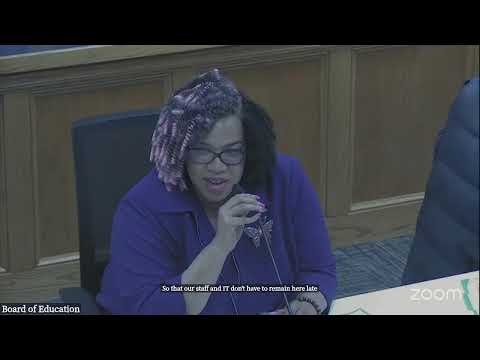
Board members voiced a mix of urgency and caution. Chair Rogers urged the board to give administration a chance to implement a non-rotational plan and monitor the results: “We always intended to move forward with something other than rotational routes. And if it doesn't work … we won't know unless we try it,” she said. Several board members requested more detail on appeals criteria, community resources available to families, and localized safety reviews for proposed walk routes.
Actions and next steps - Administration said it will not implement express stops this school year and will refine express-stop planning for 2025–26. - Staff said they expect to end rotational coverage in mid-January (presentation referenced both Jan. 17 and Jan. 19) while continuing recruitment and retention efforts for drivers. - The district will publish a transportation exception form and post related guidance on the transportation web page; principals will be part of the review and communication process. - A career fair for recruitment is scheduled for Jan. 21 (5–6:30 p.m.).
What remains unsettled Board members asked for clearer documentation of which conditions qualify as exceptions, a school-by-school inventory of community resources (carpools, partner organizations) to help families in FRZs, and a plan to regularly report recruitment/retention metrics for drivers. Several board members also urged additional outreach to bus drivers and community delegations before finalizing large-scale operational changes.
Ending Transportation staff said they will continue route optimization and the recruitment/retention push and return to the board with more data. The district’s stated near-term goal is to stop rotating drivers across multiple routes and provide stable coverage while refining FRZ boundaries and the hardship-exception process.