
Evanston Land Use Commission closes public testimony on Envision Evanston 2045 after extended public debate; commissioners elect chair and vice chair
Get AI-powered insights, summaries, and transcripts
Subscribe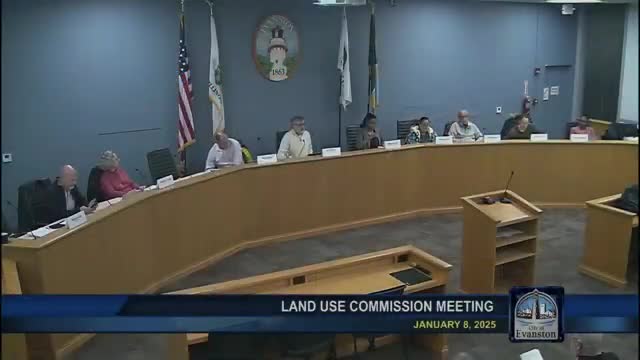
Summary
The Evanston Land Use Commission on Jan. 8 closed public testimony on the draft Envision Evanston 2045 comprehensive plan after hearing about 45 speakers and electing its chair and vice chair.
The Evanston Land Use Commission on Jan. 8 closed the public-comment portion of hearings on the draft Envision Evanston 2045 comprehensive plan after more than 40 residents and stakeholders testified for and against the draft and commissioners completed internal elections of leadership.
The meeting, chaired by Matt Rogers with eight members present, opened with staff briefings and then more than three hours of public testimony in which speakers urged both prompt action to increase housing supply and broader protections for neighborhood character and preservation. After public testimony, commissioners discussed staff-proposed “change options” and metrics staff will use while preparing a revised draft for City Council review.
Why it matters: Envision Evanston 2045 is the city’s proposed comprehensive general plan and the basis for an accompanying zoning rewrite. The commission’s recommendation will go to City Council; any edits or directions made now will shape zoning options and city priorities affecting housing supply, affordability, preservation, parks and transportation over the next two decades.
Public testimony and themes
About 45 people had signed up to speak; speakers included homeowners, architects, nonprofit leaders, landlords and representatives of affordable-housing organizations. Testimony ran a wide range:
- Supporters said the draft is a necessary first step to increase housing supply. Naki McMullen, who described moving to Evanston from Florida last year, said the reforms "will improve housing affordability and lead to a more equitable and sustainable city." Betty Bogg, CEO of Connections for the Homeless, said the city is "not doing enough" and described an urgent need for housing resources and reforms to prevent displacement.
- Opponents and cautious speakers urged more time, more data and stronger preservation safeguards. Jennifer Drake, who identified herself as an engineer and homeowner in Evanston, said she was "concerned that this was only put through 3% of the Evanston population who was involved in the plan" and asked the city to slow the timeline. Multiple speakers including Jim McKee and Michelle Quebec warned that allowing more units across traditional single‑family areas could encourage demolition of older homes, increase carbon emissions from construction and change neighborhood character.
- Specific policy requests and concerns recurred: strengthen the inclusionary housing ordinance (several speakers suggested higher set‑asides or lower unit thresholds), adopt anti‑displacement measures and tenant protections, expand and clarify preservation policy and clarify how parks/open‑space and school district properties would be treated. Open Communities’ Dominic Vaz and other housing advocates pressed for zoning reform paired with strengthened public programs: "We must also enact public policies that protect renters of color," he said.
Staff presentation and data requests
City staff and the consultant team provided a high‑level data briefing comparing Evanston to neighboring jurisdictions on population, household size, housing mix and price indices. Senior Housing Planner Uri Pachter and staff emphasized the plan will be accompanied by more detailed citations and data at the next drafting stage.
Commissioners and many commenters pressed for additional, neighborhood‑level analysis. Questions included: how the plan estimates future population growth given relatively flat recent population trends; a request for vacancy‑type breakdowns (why units are vacant); and the need for clearer metrics and targets (for example, an explicit affordable‑housing unit target or a target for changes in population density).
Staff proposed change options to be incorporated before the draft goes to City Council. Staff said they will add citations, expand the parks/open‑space and preservation text, integrate additional housing metrics (supply, vacancy, unit mix), and include an implementation metrics table for monitoring outcomes over time. Staff also noted the city will continue to accept written comments that will be part of the record sent to council.
Commission discussion and next steps
Commissioners discussed whether to retain the plan’s centers-and-corridors framing or focus policy more explicitly at the neighborhood level, and whether campus designations (for large institutions) should be carried forward. Several commissioners urged creation of a consolidated "people" or "community health" section that addresses life expectancy, environmental justice, mental‑health supports and anti‑displacement measures, with metrics to monitor progress.
Staff told the commission that the next Land Use Commission meeting (Jan. 15) will include deliberation and a recommendation vote on the comp plan, and that zoning ordinance discussion will begin Jan. 22 with a final zoning vote projected for Feb. 12. Staff also said City Council will hold a process/timeline discussion at its Jan. 13 meeting that could affect the commission’s schedule.
Votes at a glance
- Election of chair: Motion to elect Matt Rogers as chair; moved by Commissioner Lindwall, seconded by Commissioner Halleck; tally 8–0, motion carried.
- Election of vice chair: Motion to elect Max Pucel as vice chair; moved by Commissioner Lindwall, seconded by Commissioner Halleck; tally 8–0, motion carried.
- Adjournment: Motion to adjourn moved by Commissioner Lindblad, seconded by Commissioner Johnson; voice vote in favor, motion carried.
What the commission asked staff to do
Commissioners asked staff to: add citations and neighborhood‑level data to the draft; expand the parks/open‑space and preservation sections; include measurable metrics (baseline and targets) tied to the plan’s goals; produce illustrative graphics that show how zoning changes would look at block and neighborhood scale; and forward public comments and the commission’s requested changes to City Council for consideration.
Context and outlook
The hearing reflected broad community engagement and also deep division about how to balance housing supply, affordability, preservation and neighborhood character. Several nonprofit and faith‑based speakers framed the agenda as one of racial equity and anti‑displacement; others, including preservationists and longtime homeowners, emphasized the potential loss of historic fabric and the need for more study. Staff and commissioners said the record will remain open to written comments and that upcoming meetings will address remaining technical work and the zoning ordinance.
The Land Use Commission will reconvene Jan. 15 for deliberation and a formal recommendation to City Council; public comments submitted online will be included in the official record.