Get Full Government Meeting Transcripts, Videos, & Alerts Forever!
Get email alerts on the Accountability Essa Nd First topic
No spam. Unsubscribe anytime.
DPI outlines federal accountability approach, ND First intervention plan and how schools are identified for support
Summary
Amanda Peterson of DPI described how North Dakota applies the Every Student Succeeds Act (ESSA) accountability system, distinctions between Targeted Support and Improvement (TSI) and Comprehensive Support and Improvement (CSI), and how the ND First statute expands interventions for persistently low‑performing schools.
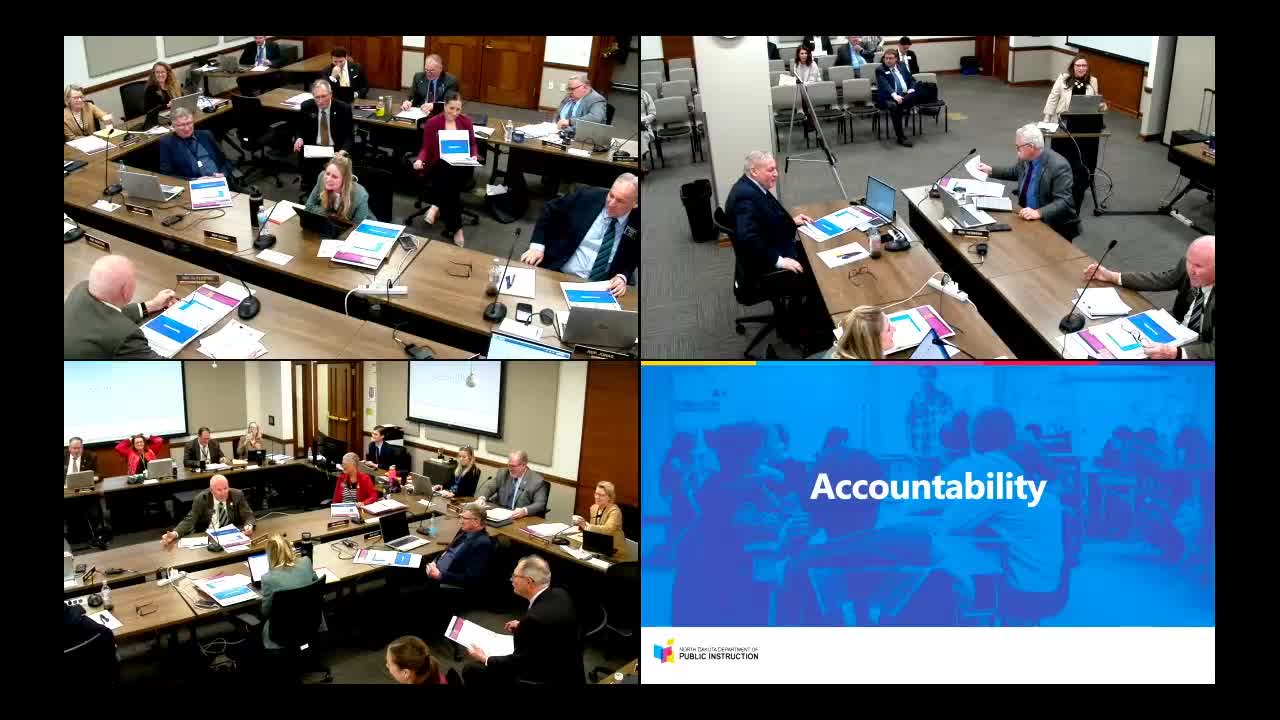
Amanda Peterson, director of Educational Improvement and Support at the North Dakota Department of Public Instruction, briefed the Joint Education Committee on the state’s accountability framework under the Every Student Succeeds Act and on a recently passed state measure establishing ND First, North Dakota’s approach to more rigorous interventions for persistently low‑performing schools.
Peterson said North Dakota aligns its accountability model to federal ESSA requirements rather than maintaining a separate state accountability system. She described the accountability “pie” — the weighted indicators DPI uses to synthesize assessment results, growth, English‑learner progress, graduation rates and other measures — and said the state uses that composite to identify schools needing targeted or comprehensive support.
Under federal rules, Peterson said, the state identifies Targeted Support and Improvement (TSI) schools annually and identifies Comprehensive Support and Improvement (CSI) schools — generally the lowest‑performing 5% — every three years. She told the committee North Dakota currently has 15 schools in CSI status, some identified since the 2020–22 cycle, and that the TSI list is more fluid with schools entering and exiting annually.
Peterson described ND First (legislative implementation tied to Senate Bill 2254) as a statutory framework passed in the most recent session that enables more rigorous interventions for schools that do not exit CSI status after required supports. She said the legislation’s implementation timing meant the new provisions take effect for the fall 2025 accountability cycle and that DPI has used the intervening months to draft implementation documents, consult with districts and prepare reporting tools for the Legislature.
She explained DPI’s use of Regional Education Associations (REAs) as local support partners: REAs provide professional development, assist with Medicaid billing and help implement improvement plans, and a statutory indicator explicitly tasks REAs with assisting schools to achieve the superintendent’s identified improvement goals.
Peterson noted the federal requirement to notify families when a school is identified for TSI or CSI status and said the department conducts periodic checkpoints with identified schools; she described an ongoing cadence of presentations and technical assistance work between DPI, REAs and districts.
In response to committee questions, Peterson agreed that because ESSA requires the state to identify a lowest‑performing percentage, the list will persist over time even as absolute performance improves, and she said ND First aims to add graduated, targeted interventions without discarding locally effective practices.