Get Full Government Meeting Transcripts, Videos, & Alerts Forever!
Get email alerts on the Information Technology Budget topic
No spam. Unsubscribe anytime.
Core Technology Services seeks funds for ERP migration, cloud and cybersecurity as governor recommends $10 million ERP appropriation
Summary
NDUS core technology officials explained a growing services portfolio, rising software and cloud costs, and a multi-pronged funding request that includes a $10 million ERP initiative, expanded cybersecurity and migration to cloud-based services.
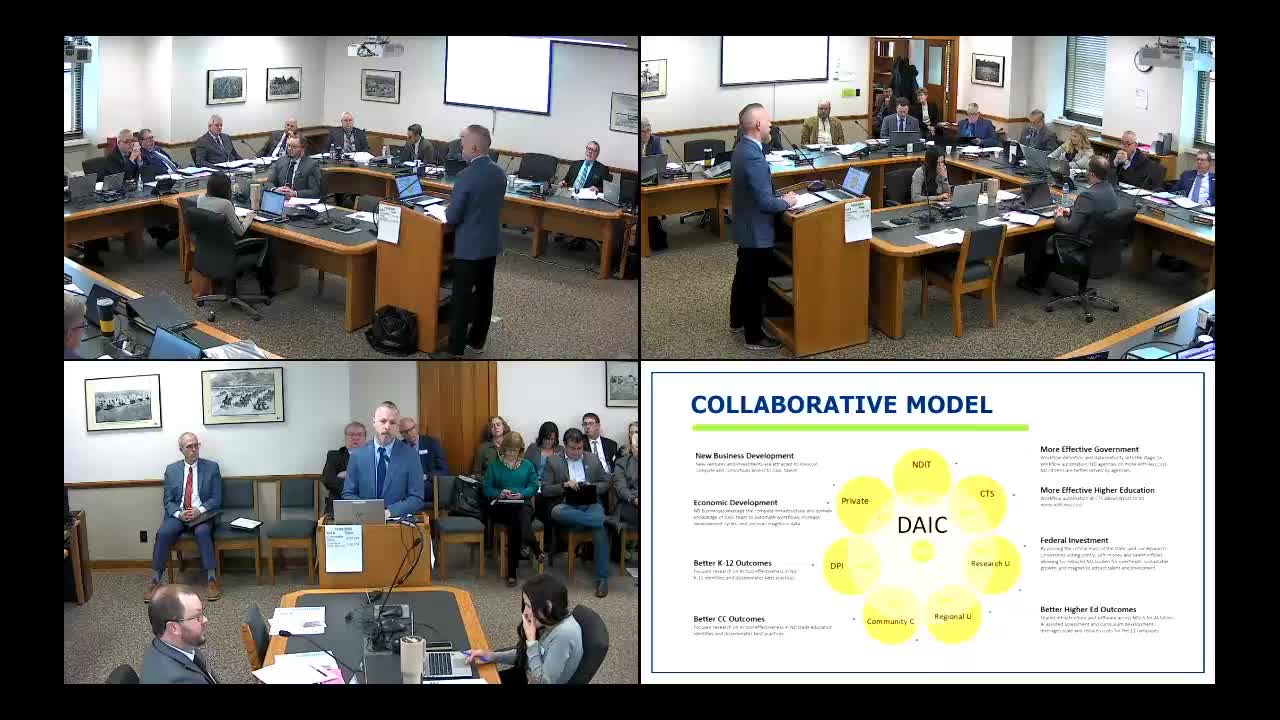
Thomas Danford, vice chancellor for information technology and chief information officer for NDUS, and David Krebsbach, NDUS vice chancellor for administrative affairs, briefed the Appropriations Committee on Core Technology Services (CTS) and the system’s IT-related budget requests.
"My objectives today is really to cover, 3 items," Danford said, listing complexity of the CTS environment, the business case for CTS and the primary technology challenges facing campuses.
Presenters described CTS as supporting 14 on-premises systems plus roughly 37 cloud systems, a single library consortium (ODIN) and systemwide security operations. They said recurring software licensing and the industry shift to cloud-hosted subscription models are driving predictable cost increases; Danford told the committee the main Enterprise Resource Planning (ERP) product NDUS uses is being deprecated by its vendor and a cloud replacement will require substantial preparatory work.
Krebsbach summarized NDUS budget requests and the governor’s recommendations: an ERP initiative the governor recommended at $10 million (the system requested $10 million for PeopleSoft replacement work), high-performance computing funding the governor partially supported ($4 million for UND/NDSU), a $3 million AI and machine-learning request (for a shared system and staffing) and $2.6 million for core infrastructure and hybrid-classroom technology. The governor’s executive recommendation also showed increases in CTS budget lines (the guide showed a recommended NDUS CTS general-fund increase from roughly $72 million to $86 million in the executive request; Krebsbach and Danford described most of the difference as escalation, cloud and migration costs and one-time implementation work tied to the ERP transition).
Danford and Krebsbach also discussed cybersecurity risks, the need for a security operations center, and how cloud-hosted vendor models can change cost structure and vendor lock-in. They said UND recently outsourced some campus services and CTS is retraining staff to support cloud operations and to transition employees into cloud-engineering roles where possible.
Committee members asked for more granular estimates, the proposed scope of the ERP replacement, and clarification of which items are one-time versus ongoing costs. NDUS officials said they will provide more detailed line-item estimates and process plans in subcommittee hearings.