Get Full Government Meeting Transcripts, Videos, & Alerts Forever!
Get email alerts on the Ai And Compute Policy topic
No spam. Unsubscribe anytime.
RunND and Dakota Digital Academy urge state AI strategy, propose Dakota AI Collaborative and low-cost compute fund
Summary
The Dakota Digital Academy and NDUS leaders urged legislators to fund a coordinated state AI strategy, an AI collaborative to pool talent and compute, and a compute-access fund tied to data-center negotiations to support research, workforce and economic development.
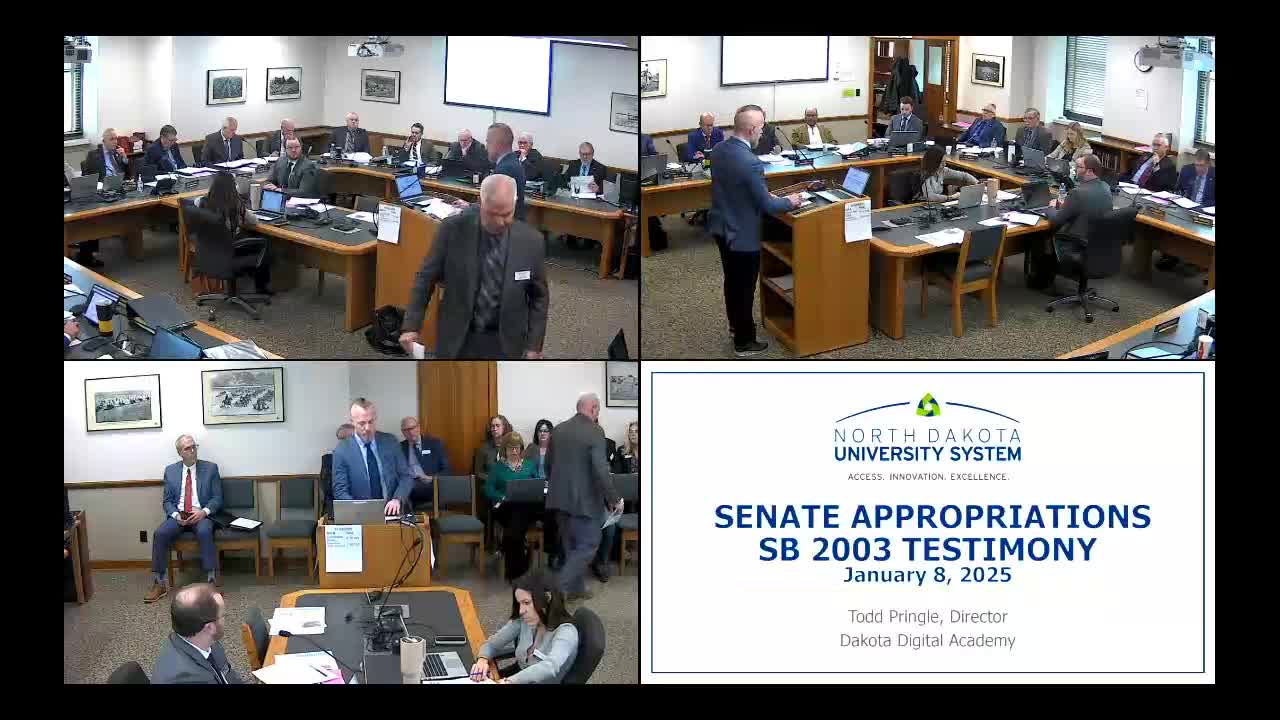
Todd Pringle, director of the Dakota Digital Academy, told the Appropriations Committee the systemwide Envision 2035 process identified AI and digitization as dominant drivers of change and urged a coordinated state effort.
"We want to be in front of that train and not run over by that train," Pringle said, describing risks and opportunities as institutions adapt teaching, research and workforce programs to emerging AI tools.
Pringle outlined three near-term outcomes from a governor-appointed task force: formation of a Dakota AI Collaborative to consolidate AI talent and projects across institutions and state agencies; a compute fund that would provide low-cost access to high-performance compute for state-benefit projects; and a data-center negotiation strategy to secure a share of low-cost compute capacity for in-state use.
Pringle said state-funded compute applied through a constrained collaborative can be leveraged to attract federal grants and private investment while ensuring state dollars produce direct state benefits. He proposed that funding be conditioned so state money supports projects that yield state-level workforce or service improvements rather than stand-alone research that primarily chases federal grants.
Legislators raised questions about data centers and energy. Pringle and others noted North Dakota’s energy and natural-gas resources position the state geographically and economically for data centers, but they urged careful negotiation so incentives deliver long-term compute access rather than only short-term tax breaks.
Chancellor Hagerott and other panelists framed the proposal in workforce terms: using AI and compute to strengthen healthcare, manufacturing and agricultural innovation while also funding humanities and ethics initiatives (the proposed Dakota Humanities Academy) to address values, civic engagement and the nontechnical dimensions of AI adoption.
Committee members asked for more detail on governance, precise cost estimates and safeguards to prevent state funds from subsidizing projects that produce limited public benefit. The presentation described the recommendations as policy proposals and budget requests rather than enacted programs.