Get Full Government Meeting Transcripts, Videos, & Alerts Forever!
Get email alerts on the Industry And Business topic
No spam. Unsubscribe anytime.
Committee advances DOT bill allowing short, public bid-opening delays
Summary
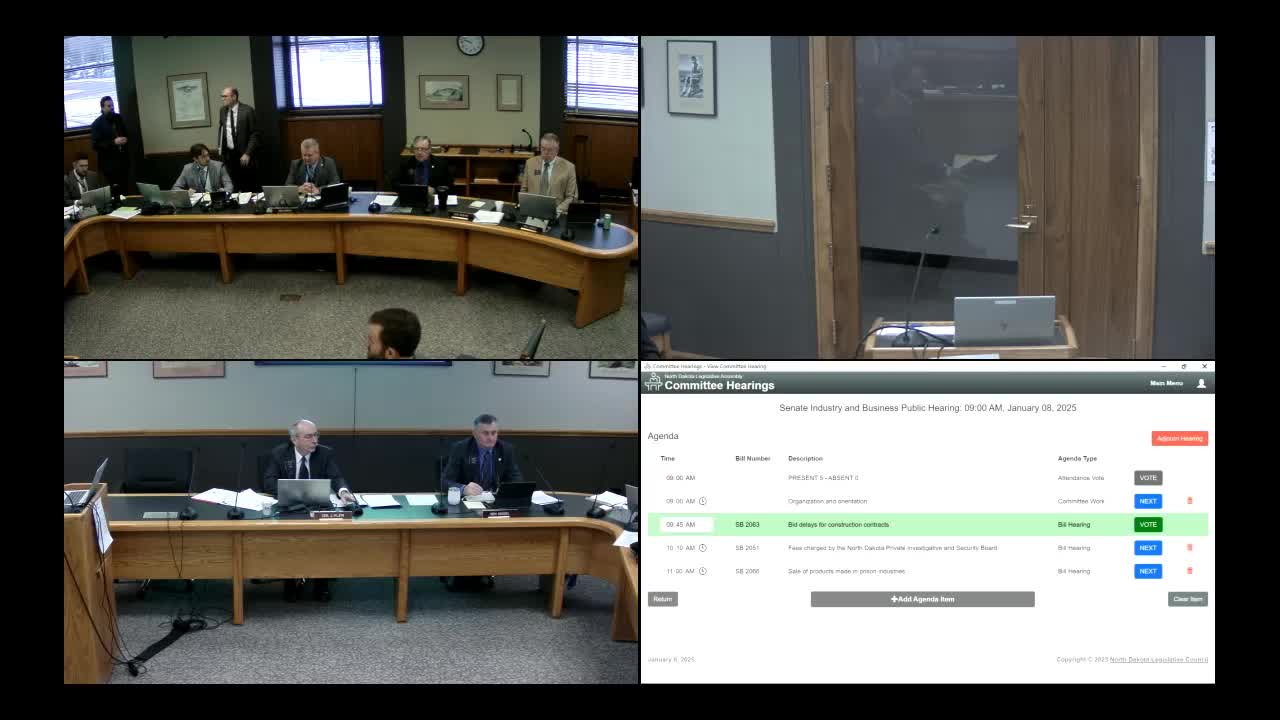
The Senate Industry and Business Committee voted to recommend passage of Senate Bill 2063, an agency bill from the North Dakota Department of Transportation that would let the DOT postpone advertised highway bid openings up to 21 days by publishing a public notice rather than restarting the 21‑day advertisement process.
The Senate Industry and Business Committee voted to recommend passage of Senate Bill 2063 after hearing from the North Dakota Department of Transportation about a change to how the agency handles delayed highway construction bid openings.
The bill would amend state law to allow the DOT to postpone a scheduled public bid opening for up to 21 days by publishing a public notice and keeping the project active on the bid site, instead of removing the project and re‑advertising for a new 21‑day period.
Senate chairman Barta opened the hearing and the DOT's deputy director for engineering, Matt Lindeman, told the committee the change is intended to reduce months of delay in narrow circumstances. "Sometimes we need to push it out a week or we're waiting for a permit or we're waiting for a railroad agreement," Lindeman said. "This would allow us to just say we're gonna present a public notice...and move it out a week or up to 21 days." Lindeman called the revision an "interim fix" for moderate timing problems that do not require a full re‑advertisement.
Committee members questioned how notice would be handled and whether the change could advantage particular bidders. Lindeman said the DOT would post any questions and answers and addenda to its public bidder website and that the same information would be available to all bidders. "We have a question and answer website that we use...and we post them so everyone can see all the questions that have been posted," he said. He told senators the DOT envisions most such delays would range from about seven to 21 days; delays longer than that would trigger the current full re‑advertisement process.
Russ Hanson of the Associated General Contractors of North Dakota testified in support and said the DOT had vetted the change with stakeholder groups. "We don't see an issue with this," Hanson said, adding the tool would be used infrequently but would be valuable when needed.
Senator Klein moved for a "do pass" recommendation; Senator Kessel seconded. The committee then opened its electronic voting system and recorded a 5‑0 passage in favor of recommending SB2063 to the full Senate. The committee designated Senator Angott to carry the bill out of committee.
The DOT framed the proposal as a limited, procedural change to reduce schedule risk during short construction seasons and avoid re‑starting the full public advertisement process when the necessary fix can be handled within a few weeks. The committee and witnesses emphasized that the agency would continue to disclose the reason for a delay through public notices and addenda so bidders would have equal information.
A vote tally recorded by the committee clerk showed five votes in favor, no opposition; individual roll‑call names were not read into the transcript.