Get Full Government Meeting Transcripts, Videos, & Alerts Forever!
Get email alerts on the Victims Rights Notifications topic
No spam. Unsubscribe anytime.
Victims' notification bill draws support and opposition over default opt-in language
Summary
Department of Corrections witnesses urged changes to North Dakota's victim-notification wording so victims who do not want notices need not receive them; the Attorney General's office opposed the change, arguing it would shift notification responsibility onto victims and could undermine constitutional victims' rights.
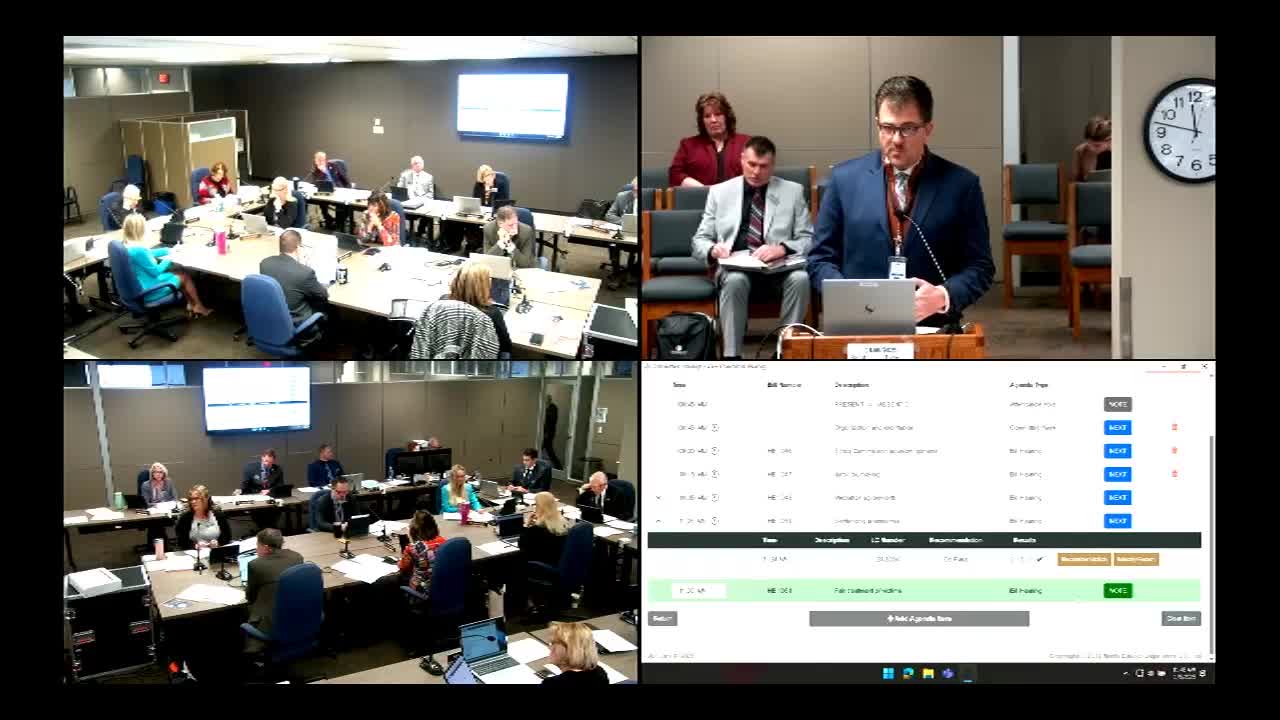
The House Judiciary Committee heard opposing testimony on House Bill 1061, a measure that would change how the state notifies victims about offender movement and release. The Department of Corrections' victim services staff asked the committee to amend notification language so victims who do not want further notices can decline them; the Attorney General's office urged a do-not-pass recommendation, saying the change could place victims at risk.
Charlie Hedden, who works on victim services for the Department of Corrections and Rehabilitation, told the committee the department's existing practice is to offer victims several ways to register for notifications and that some victims explicitly tell staff they do not want to receive release or movement notices because the messages re-trigger trauma. Hedden asked the committee to add the words "when requested" to subsection 1 and to make related edits so that notifications would be provided to victims when they request them, rather than being sent automatically.
"Victims have told us they want it to be put in their hands," Hedden said, describing the department's experience offering registration through the statewide automated victim-information system and through county victim coordinators. Hedden also sought to add education-release events to the list of movements that would trigger a notice and to permit notice by an authorized representative of the parole board or parole clerk.
Attorney General's office objects Heidi Smith, director of the Attorney General's victim-services IT division and administrator of the state's SAVN (state automated victim information and notification) system, opposed the bill. Her written and oral testimony cautioned that inserting "when requested" into the statute would shift responsibility onto victims to know the registration system exists and to register, potentially leaving victims unaware of critical events — including escapes or releases — that the constitution specifically requires to be notified. "The suggested changes do not align with Article 1, Section 25 of the North Dakota Constitution," Smith said, and would make the automated system the sole method of notification while removing custodial authorities' duty to notify when victims are not registered.
Smith said SAVN is a tool to assist agencies and is not meant to replace in-person or direct notifications in urgent circumstances. She warned that an automated-only approach might delay or limit timely, individualized outreach when custody deaths, escapes or other high-priority events occur.
Why it matters The dispute raises practical and constitutional questions about how the state balances victims' desire to avoid re-traumatizing notices against the state's constitutional obligation to provide timely notice of release, escape and certain other events. Proponents say limiting notices to victims who request them respects victims' wishes and reduces re-triggering; the Attorney General's office says removing custodial authorities' obligation to give notice to unregistered victims risks leaving victims unaware of critical and potentially dangerous events.
Status The committee hearing recorded the competing positions and testimony but did not record a committee recommendation in the excerpted transcript.