Get Full Government Meeting Transcripts, Videos, & Alerts Forever!
Get email alerts on the Criminal Justice Jurors topic
No spam. Unsubscribe anytime.
Court administrator seeks limited counseling for jurors exposed to graphic evidence
Summary
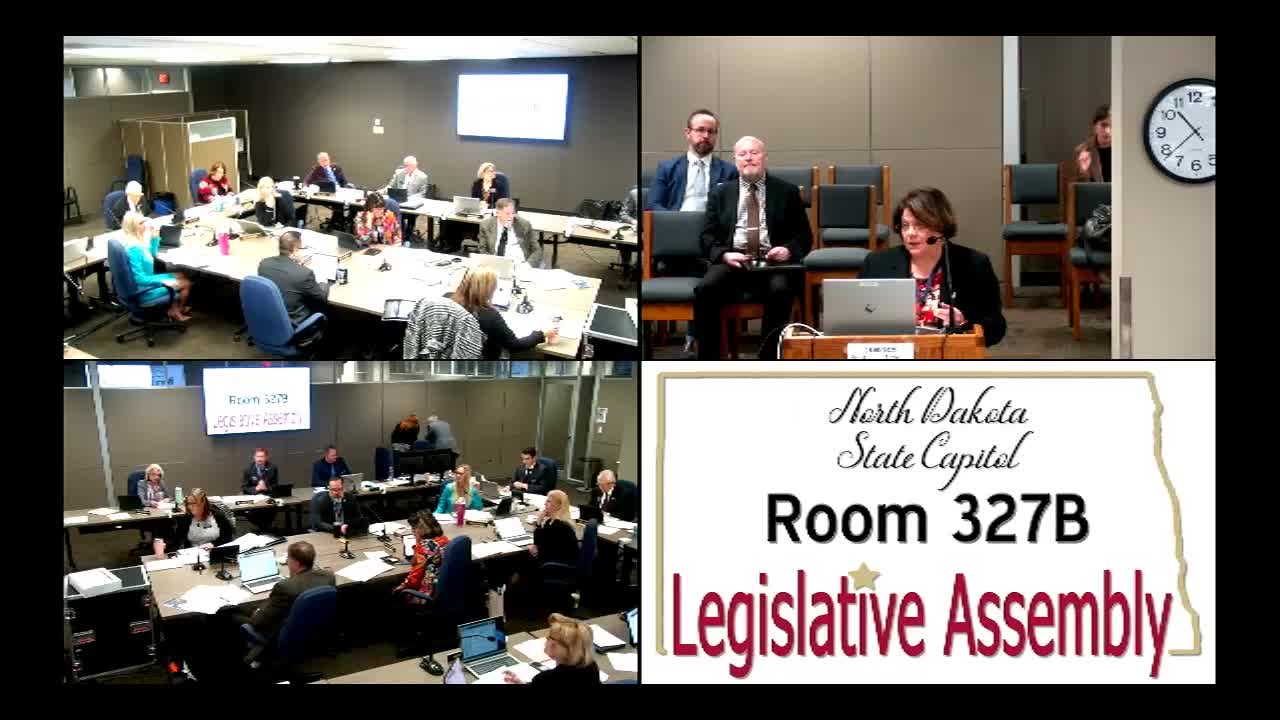
State Court Administrator Sally Holeva told the House Judiciary Committee that House Bill 1047 would authorize up to 10 hours of counseling for jurors exposed to extraordinarily graphic evidence; estimated cost in the fiscal note is $10,000 for the first biennium.
State Court Administrator Sally Holeva told the House Judiciary Committee that House Bill 1047 would let courts provide up to 10 hours of counseling, at state expense, to jurors who served on trials involving extraordinarily graphic, gruesome or emotional evidence.
Holeva, who said the measure was requested by the Supreme Court, said the counseling would be available within 180 days after a jury was discharged and would be limited to up to 10 hours per juror. She told members the proposal is modeled on an Alaska program and estimated the first-biennium cost at about $10,000; the fiscal note submitted with the bill lists $10,000 for the next biennium and $12,000 for the following one.
"Jurors have to look," Holeva said, describing evidence such as 911 calls or graphic images that jurors must study and discuss. "This is an opportunity for them to work that out so that they're not carrying it with them for the next, you know, two years or five years or 10 years." Holeva said prior group-style critical-stress debriefings were sometimes offered but that the state's employee-assistance provider no longer supplies that service.
Supporters at the hearing included Greg Kosowski of the Children's Advocacy Centers of North Dakota, who said such counseling could reduce barriers to jury service and help jurors focus on evidence in difficult child-abuse cases. Travis Fink, executive director of the Commission on Legal Counsel for Indigence, testified that practicing defense attorneys and other court practitioners also experience vicarious trauma and supported the bill.
Scope and delivery The bill defines qualifying trials to include homicide, certain sexual offenses, child- abuse and other cases involving extremely graphic evidence; the measure authorizes counseling provided by court staff, a state agency or a contractor and explicitly allows telehealth. Holeva said other states who enacted similar programs most often contracted for telemedicine counseling.
Why it matters Holeva told the committee that jurors can experience post-traumatic symptoms or vicarious trauma for years after exposure to graphic trial evidence, and that the program is narrowly tailored and usage in Alaska has been low (Alaska reported under 1 percent usage over five years). Proponents argued the cost would be small compared with the state's overall budget and would address a recurrent but limited need among jurors and criminal-justice professionals.
Status House Bill 1047 received supportive testimony in committee but the transcript does not record a committee vote during that hearing.
Next steps Committee members will decide whether to recommend the bill for floor consideration; no vote was reported in the hearing record.