Get email alerts on the Teacher Workforce topic
No spam. Unsubscribe anytime.
State expands teacher pipeline with ‘grow your own’ grants and registered apprenticeships
Summary
DPI described multiple programs to increase the teacher and principal workforce: state 'parent to teacher' grants, a registered teacher apprenticeship funded by a U.S. Department of Labor grant, and a new principal apprenticeship program.
Department of Public Instruction leaders told the joint education committee they have stood up several programs intended to address longstanding teacher shortages, especially in special education.
Basler and Assistant Superintendent Lori Matzke described two complementary state initiatives: a state grant program created by the 2023 Legislature (Senate Bill 2032) that provided $3 million over two years to help paraprofessionals become certified teachers, and a registered teacher apprenticeship supported by a competitive U.S. Department of Labor grant.
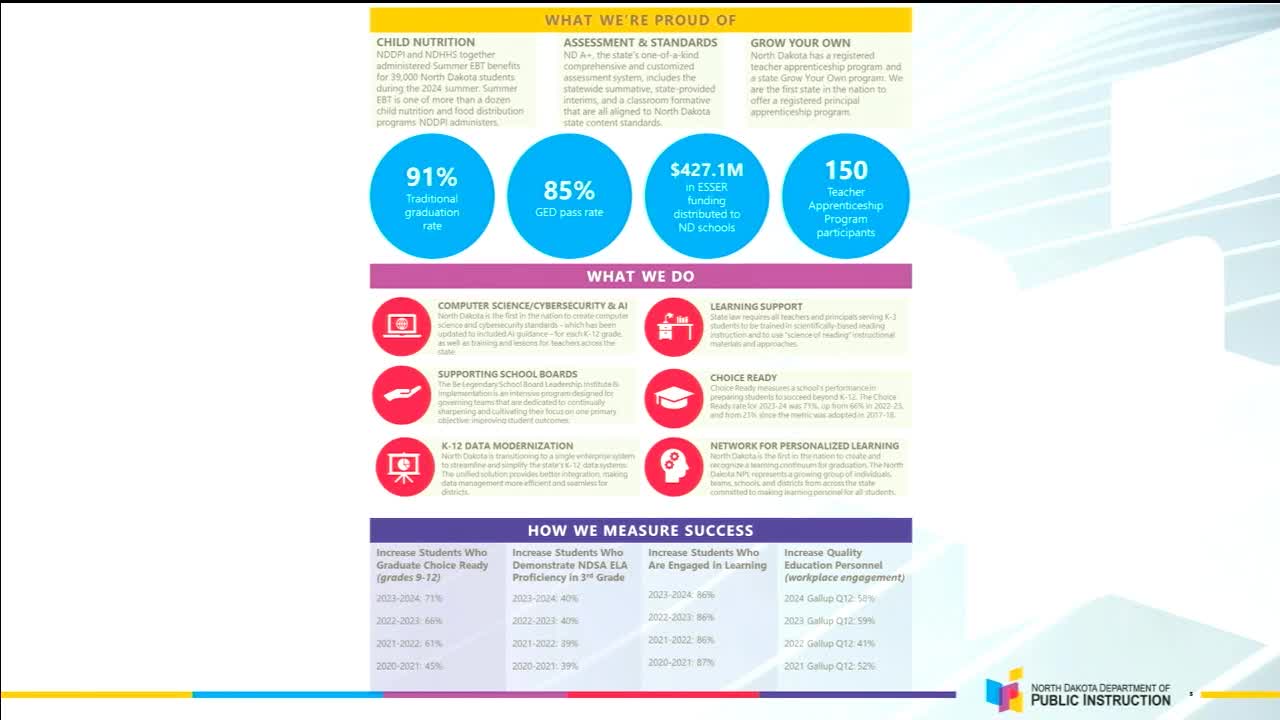
Matzke said the U.S. Department of Labor award was about $4.1 million and allowed the state to add an apprenticeship track. “We were the only education agency in the nation to receive those apprenticeship dollars,” she said. DPI officials said the combined funding has supported roughly 230 paraprofessionals through the state grant program and about 150 registered apprenticeship seats; the department reported about 30 paraprofessionals already graduated and are now classroom teachers, with more participants in the pipeline.
DPI also said it has approved principal apprenticeships: the state obtained approval to add principals as an apprenticeship occupation and has funded initial cohorts through university partners. Matzke said NDSU and UND are hosting initial principal apprenticeship cohorts with participants placed in school districts for mentored, on‑the‑job training.
Officials told the committee these programs are designed to “grow your own” educators in their home communities by allowing in‑place employees to pursue credentials largely online and while remaining employed. DPI said the initiative also included efforts to recruit high‑school students into education careers through a national program called Educators Rising.
Why it matters: State and federal funding for these pipeline programs directly targets shortages in classrooms and leadership positions. Committee members asked for data on specific shortage fields, and DPI said it will provide district‑level vacancy and shortage statistics on request.
AI generated
The text on this page is AI generated. Summaries, highlights, analysis, and video transcripts are all produced from the original source material.
AI can make mistakes, so if you spot one, and we will fix it for everyone.
Note: the source content is unaltered by us. Any content source we link to, be it a video, an audio recording, or a document, is presented exactly as its publisher released it. That publisher is usually a government body, sometimes an individual official or another organisation.