Get Full Government Meeting Transcripts, Videos, & Alerts Forever!
Get email alerts on the Mn Dot Lup Snowmobile Trails topic
No spam. Unsubscribe anytime.
County denies MnDOT limited-use permit for snowmobile trails after liability concerns
Summary
The Houston County Board voted to deny a MnDOT limited-use permit request that would have authorized nighttime two-way snowmobile use in MnDOT right-of-way at four locations, citing potential liability and minimal DNR grant amounts tied to the right-of-way miles.
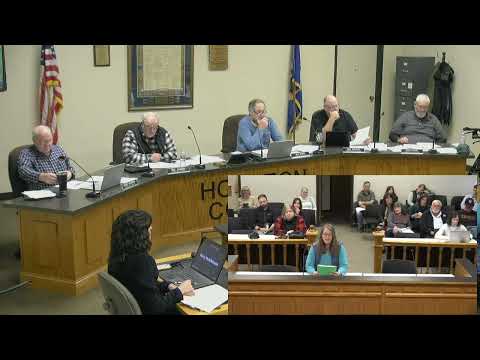
Houston County commissioners voted to deny a Minnesota Department of Transportation (MnDOT) limited-use permit (LUP) request that would have authorized nighttime two-way snowmobile trail use in MnDOT right-of-way at four locations in the county.
At a staff presentation, Brian Veronen (county staff) summarized coordination with MnDOT and the Minnesota Department of Natural Resources (DNR). Veronen said club mapping indicated approximately 18.9 miles of snowmobile trail within MnDOT right-of-way; at the DNR grant-and-aid rate of $264 per mile, the county’s share of that support would be about $4,989.60 for the affected miles.
MnDOT District 6 representatives described the agency’s role and the standard LUP language. District engineer Mark Schulenfelder and Dave Evans, assistant MnDOT right-of-way supervisor, explained that the LUP covers only locations where snowmobile traffic would operate two-way at night alongside highway traffic — the specific safety concern being head-on headlights for motorists.
Snowmobile-club representatives told the board they requested the LUP to provide the landowner permissions required by state DNR grant rules. Al Christian, speaking for the club, said the DNR requires documented permission from landowners where trails cross public and private land; clubs said they sought the county’s signature to show permission for the sections inside MnDOT right-of-way and to maintain the state funding eligibility for the trail miles.
County Attorney Sam cautioned against signing the LUP because of open-ended indemnity and liability language in the standard agreement. "There's a vast unknown," Sam told commissioners, saying the county could be named in lawsuits if a serious injurious incident occurred on trails that run in highway right-of-way. Sam recommended denial because the potential county liabilities outweighed the modest DNR aid tied to the affected miles.
After discussion, the board voted to deny the MnDOT LUP for the identified locations. The roll call was District 1 — yes; District 2 — yes; District 3 — yes; District 4 — no; District 5 — no.
What this means: Denial removes county-level permission under the MnDOT LUP form for those specific two-way nighttime segments identified in the application. County staff and MnDOT said riders retain statutory authority to operate in highway ditch areas in some circumstances, but DNR grant eligibility for the affected trail miles depends on documented landowner permission. Club representatives warned that denial could jeopardize state grant aid for those miles if no other permission mechanism is provided.
Clarifying details: County staff and MnDOT cited that DNR grant-and-aid supports snowmobile trails at $264 per mile; the staff calculation for the identified segments was about 18.9 miles (presenter-provided), equal to roughly $4,989.60 in DNR aid for those segments. MnDOT staff said the LUP text is standardized and is requested only for two-way nighttime uses; questions remained over which entity should assume indemnity or maintenance obligations.
Ending: Commissioners denied the MnDOT limited-use permit request on advice of the county attorney and asked staff to continue coordination with MnDOT, the DNR and local clubs about whether alternate permission mechanisms or revised LUP language could address county liability concerns.