Get Full Government Meeting Transcripts, Videos, & Alerts Forever!
Get email alerts on the Commercial Solar Moratorium topic
No spam. Unsubscribe anytime.
Houston County adopts six-month interim moratorium on commercial solar permitting after public hearing
Summary
The Houston County Board voted 3-2 to adopt a six-month interim ordinance that pauses permitting and construction of commercial solar projects while staff reviews regulations. County staff, a landowner proposing a 5-megawatt project and developers testified at a public hearing about potential local benefits and regulatory gaps.
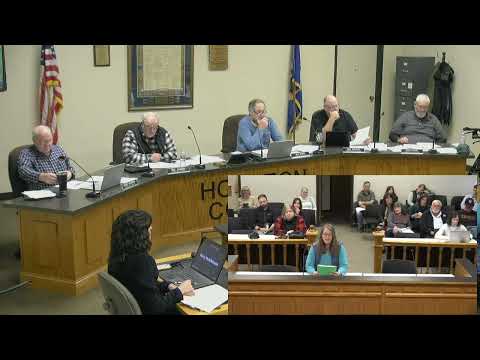
Houston County commissioners voted 3-2 on Tuesday to adopt an interim ordinance pausing permitting and construction of commercial-scale solar projects for six months.
The vote followed a public hearing in which Amelia (staff member) asked the board to enact a moratorium to allow county staff time to clarify definitions, bonding requirements and other permit standards for commercial projects. "Late last summer it was brought to my intention that we were in a tax incentive district for alternative energy projects," Amelia told the board, and said the county's current code appeared to be written primarily for small private solar installations rather than larger commercial arrays.
Why it matters: Commissioners said the moratorium is intended to give the planning department and the planning commission time to study model ordinances used by neighboring counties and to set consistent standards for setbacks, decommissioning security and differences between distribution-scale and transmission-scale projects.
During public comment, landowners Sherry and Andy Allen urged the board not to block their proposed 5-megawatt project near the Caledonia Substation. Sherry Allen said the project would be located "on just a small portion of our land near the Caledonia Substation" and described plans for native-seed plantings inside the array that would support pollinators and educational uses. Her husband, Andy Allen, spoke in favor of the project as a way to diversify farm income and establish a prairie area on roughly 27.5 acres of a 109-acre parcel.
Developer 1 Energy Renewables and My Energy Cooperative described the proposed Wild Turkey project in Caledonia as a 5-megawatt, distribution-connected array sited to serve the Caledonia Substation. Kent Whitcomb, vice president of member services at My Energy Cooperative, said the project recently received a distribution-system approval from the Midcontinent Independent System Operator and that the project required a $60,000 deposit to complete that study. Whitcomb called the project a "distribution-scale" facility and said it is sized to fit existing local substation capacity rather than requiring a new transmission substation.
Beth Esser of 1 Energy Renewables described project components and mitigation: bifacial panels mounted on driven steel piles, a seeded prairie under the array and fencing meeting electrical-code requirements. Esser said the developer typically signs 30-year leases with a 10-year extension option and commits to removing facilities within 12 months after the project ends.
Board discussion focused on the scope and timeline of a moratorium. Amelia recommended the county advertise a one-year interim ordinance but noted the board could set any shorter period. Commissioners debated 3, 6 and 12-month intervals; several members said staff workload and the planning commission calendar made a six-month pause more realistic. The board settled on a six-month moratorium and directed staff to consult other county ordinances and to return with draft regulatory language.
The board's motion setting an interim ordinance for six months passed on a roll call vote: District 1 — yes; District 2 — yes; District 3 — yes; District 4 — no; District 5 — no.
What was not decided: The moratorium is a temporary pause to allow ordinance drafting. Commissioners did not adopt final regulations, and the board did not exempt the Wild Turkey project from the moratorium. Commissioners and staff repeatedly noted that a shorter moratorium could be considered if the county can complete the ordinance work sooner.
Clarifying details recorded at the hearing: the Wild Turkey project was described by 1 Energy as 5 megawatts sited on approximately 27.5 fenced acres of a 109-acre parcel; developer materials say a 5-MW distribution project could power about 1,000 households; My Energy reported a $60,000 MISO deposit for the interconnection study; Kent Whitcomb estimated local property taxes from the array at about $13,000 per year (presenter estimate) and a production-tax note that the group cited was $1.20 per megawatt-hour (presenter cited figure); developers said they group projects to pursue bulk procurement and financing and asked that distribution-scale projects be treated differently from large transmission-connected projects.
Ending: Commissioners asked staff to draft ordinance language that distinguishes distribution- and transmission-connected commercial solar, addresses bonding and decommissioning, and sets setbacks and performance standards; staff will return with draft ordinance language and a recommended timeline to the planning commission and then to the board for final action.