
Legislators consider scheduling gabapentin after DOJ and crime-lab testimony on rising abuse
Get AI-powered insights, summaries, and transcripts
Subscribe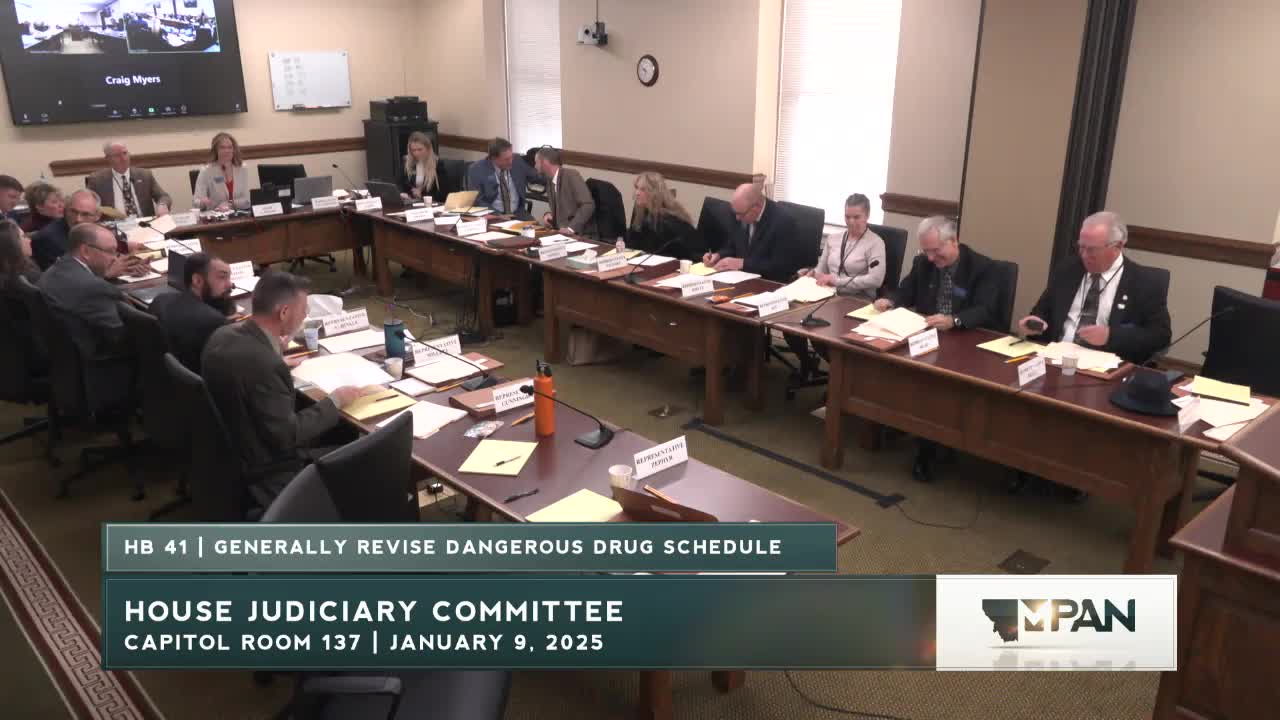
Summary
Witnesses told the House Judiciary Committee that gabapentin is increasingly detected in toxicology casework and polydrug incidents; House Bill 41 would add gabapentin to state controlled-substance schedule V to aid enforcement and toxicology tracking.
Curtis Schomer, on behalf of the Department of Justice, opened a hearing on House Bill 41, a request to add gabapentin to Schedule V of Montana's controlled substances. Schomer described gabapentin as a central nervous system depressant commonly used for seizures and neuropathic pain and said the change was requested because the state is seeing more abuse and better testing capability.
Attorney General Austin Knudson and multiple law-enforcement groups supported the bill. Knudson said gabapentin has become increasingly common in DUI and post-mortem toxicology findings and noted improved testing ability at the state forensic lab. Capt. Doug Samuelson of the Montana Highway Patrol (formerly drug-recognition program coordinator) and representatives of sheriffs and police associations also voiced support.
Beth (Beth Smalley), toxicology section supervisor at the Montana DOJ Forensic Science Division, testified as a proponent and provided a handout to the committee. She said the lab developed methods to report gabapentin and that, once testing was implemented, gabapentin began appearing more frequently in casework — overtaking some prescription opioids in detection frequency. Smalley said the lab can report quantitative gabapentin levels and compare them to therapeutic, toxic, or lethal ranges, but also emphasized individual variation in response and that impairment depends on total circumstances.
Committee questions focused on whether scheduling would change prescribing limits, how prescription-holders would be treated in DUI investigations, whether a numeric impairment threshold should be set (as with alcohol blood-alcohol concentration), and how prevalence appears in polydrug cases. Proponents said scheduling would not create an automatic conviction for prescription-holders and that DUI prosecutions require evidence of impairment rather than presence alone; the toxicology lab will provide quantitative results to prosecutors.
Representative Curtis Schomer closed by urging a do-pass recommendation. No committee vote was recorded in the provided transcript.